Sheriff in Minnesota's Ramsey County says Somali gang violence must be curbed, but community warns of dangerous rhetoric
Published in News & Features
MINNEAPOLIS — Ramsey County Sheriff Bob Fletcher is publicly warning of what he says is a surge in violence involving Somali gangs — an issue he says has not received enough attention.
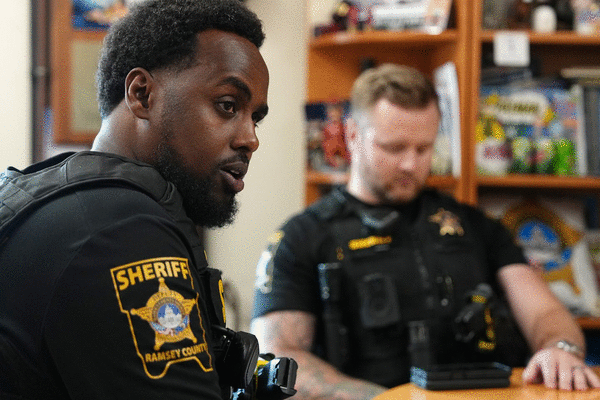
Fletcher’s brought the issue forward in a video he posted to social media Monday flanked by gang investigators, a day after one man was killed and four people were wounded in Minneapolis shootings late Saturday and early Sunday.
The video has since garnered tens of thousands of views and reactions across various platforms. While Minneapolis is not in Fletcher’s jurisdiction, he called it a statewide issue as gang activity travels quickly between cities.
“Why speak out now? It’s obviously a problem,” Fletcher said in an interview this week. “We’ve been monitoring it for two years, and it’s exponentially increasing.”
Fletcher stressed that the problems have stemmed from a small percentage of Somali children and young adults in gangs — he estimates it’s about 300 out of 100,000 Somali Minnesotans.
Ramsey County Attorney John Choi agreed with Fletcher that there is a growing trend of “retaliatory violence” in the Twin Cities with groups of teens and young adults shooting at one another. Choi’s office has received some cases involving Somali gangs, but he cautioned that he “wouldn’t call it necessarily a trend” specific to that community.
Several Somali community members and the Council on American-Islamic Relations Minnesota (CAIR-MN) took issue with Fletcher’s take. They agreed that there have been problems with “community violence” that need to be worked on.
But they said the sheriff’s statements were harmful, shift the focus away from solutions to help young people, and wrongly paint all Somali youths as dangerous. They also worry that the way Fletcher spoke on the issue will build on growing anti-Somali sentiments in the state.
“This kind of rhetoric is not only wrong, it is dangerous,” said Minneapolis City Council member Jamal Osman, who posted his own reaction to social media. “It targets an entire community, creates fear, and makes it harder to build the trust we need to actually keep people safe.”
The sheriff’s office says it has identified 12 Somali gangs in Minnesota. The dozen meet the criteria, as defined by state statutes, to be considered a gang — consisting of three or more people, having a group name or identifying sign, and engaging in a pattern of crime.
Fletcher provided the Minnesota Star Tribune with a list of more than 100 criminal cases from across the state dating back to 2023 believed to be connected to these gangs — ranging from illegal gun possession and street robberies to a stabbing at Washburn High School and at least a dozen fatal shootings.
Some of the cases involve large-scale shootouts between rival gangs, some of which are carried out near busy gatherings such as college and high school graduations. The man killed in a shooting over the weekend was a Somali club soccer coach from Willmar who previously was in a gang years ago but had “turned his life around” when he moved to Willmar, Fletcher said.
Minneapolis police Sgt. Garrett Parten said the department “will not comment on investigative details or speculate about potential gang or group involvement until all facts are confirmed” in the shooting.
Backlash and debate
Osman, Minneapolis city council vice president and the first Somali American to hold the position, said he was “dismayed and deeply disappointed” by Fletcher’s comments, saying it scapegoats a segment of the community by using “fear to divide our neighbors.”
Osman said the focus shouldn’t be on the violence, but longstanding issues such as “disinvestment, poverty, lack of opportunity, social isolation and systems that have failed too many families for too long.”
CAIR-MN Deputy Executive Director Suleiman Adan noted that along with taking issue with Fletcher’s remarks, CAIR takes the crimes that have been happening “seriously, and we will remain committed to addressing them as a community.”
In the interview, Fletcher said he has received positive feedback from some Somali leaders for acknowledging the issue and noted that his investigators discussed outreach and assistance efforts in the video.
“If you stay in denial, you’ll never fix the problem,” Fletcher said. “My goal has always been to help these kids change course.”
Ramsey County Deputy Ben Seidl, an investigator who specializes in gang violence, acknowledged that there are other, non-Somali gangs in his jurisdiction as well. But in his recent experience, he said, the shootings he’s responded to in Ramsey County have typically been between Somali gangs.
“It’s an ugly truth at this point, and if we don’t talk about it, what’s going to change?” Seidl said in an interview alongside other investigators who joined Fletcher. “If these parents aren’t made aware, and if we don’t build trust, too, with the parents, to tell them, ‘You can trust law enforcement, and we can work together to help stop this before your kid is shot, killed, or in jail,’ then we’re doing a disservice at that point.”
Osman and CAIR fear the Sheriff’s remarks will stoke anti-Somali sentiment flared by President Donald Trump in December 2025.
At the time, Trump called Somali immigrants “garbage,” and said Somali gangs were “roving the streets” and “terrorizing” Minnesota.
Adan said Fletcher’s comments effectively “villainize” young Somali men, puts a “target on their backs” and encourages people to have negative perceptions of those they don’t know.
“This kind of rhetoric shifts attention away from real solutions that puts innocent families, our young folk, and community members greatly at risk,” he said.
Mahamoud Wardere, a Somali American who ran for Minneapolis mayor in 2001, said the Somali community has “youth issues” like any other, but it’s particularly harmful to a population on edge after months of attacks by the Trump administration.
“While we appreciate the energy and good intentions of helping youth and parents,” he said Fletcher and his team should be careful about mixing their message with those of President Donald Trump and other politicians like Rep. Tom Emmer, who said last month that Somalis who “don’t assimilate” “should go the hell back to where they came from.”
“It is called normalizing hate,” Wardere said.
Working with community
Each case of gang violence in the Twin Cities typically isn’t motivated by financial incentive, but instead is carried out for social media clout, Seidl said. After shootouts, investigators will door-knock at homes of gang members.
The door-knocking helps to reduce the chance of further violence, and to inform families of children’s participation in gangs, Seidl said. In some cases parents have been surprised to learn their kids were involved. He said they’re working with the community to help young people get out of the lifestyle.
To help educate families and faith leaders about gang issues, the Sheriff’s Office is holding a “community conference” event July 21 to discuss the topic.
Ramsey County sheriff’s deputy Jama Shine, a gang investigator, witnessed the start of local Somali gang culture in the early 2000s after immigrating to the United States. Seeing fellow Somali kids die in the streets made a lasting impact on him, he said.
“You guys need to check on your kids, and know where your kid’s at, and ask for help, right?” he said in a message directed at parents of gang members as part of the social media video. “If you have issues with your kids, just ask for help, and let’s figure it out.”
Fletcher said he has worked in the gang field extensively since the 1980s. After he was defeated in his sheriff’s office re-election bid in 2010, he transitioned to working closely with the Somali community. He studied Somali history, taught classes on it, and emphasized getting to know families and local leaders before he was again elected sheriff in 2018.
“I’m also comfortable (saying) that most of the Somali parents want help with their children that are running delinquent,” he said.
Choi, Ramsey County’s top prosecutor, commended the work of Fletcher and his office to track gangs and what’s known as more informal “group” violence in the Twin Cities. The solution, he said, needs to involve non-enforcement strategies as well, by intervening before incidents take place and working closely with the community.
Choi said it’s “always valid” for the community to raise concerns and wants to ensure authorities are not targeting certain groups unfairly. At the same time, he said difficult conversations should be had to avoid reoccurring tragedies, like shootings near graduations or funerals.
“I think, in some ways, Minnesota has gone wrong in the context of not allowing for officials to do their jobs without fear or favor,” he said.
_____
(Deena Winter of the Minnesota Star Tribune contributed to this report.)
_____
©2026 The Minnesota Star Tribune. Visit startribune.com. Distributed by Tribune Content Agency, LLC






Comments