China again warns Russia not to use nuclear arms against Ukraine
Published in News & Features
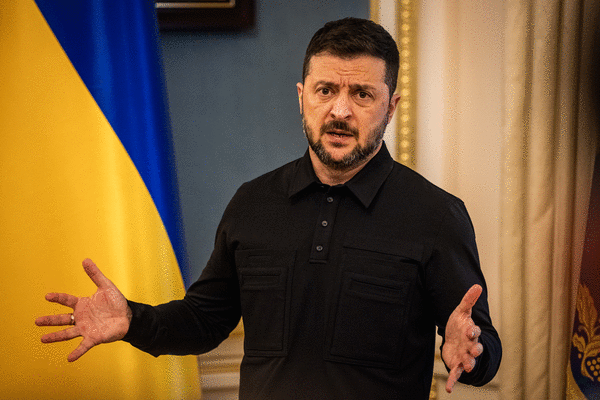
China has again told Russia not to even consider using a nuclear weapon against Ukraine, according to President Volodymyr Zelenskyy.
Russian nuclear saber rattling has accelerated in 2026, with officials and major Russian outlets making the case for tactical nukes more forcefully and unambiguously than any time since Vladimir Putin ordered the 2022 full-scale invasion of Ukraine.
In response, China, a vital enabler of Moscow’s assault, has told Russia it must avoid any atomic attacks, Zelenskyy said — reiterating Beijing’s long-stated opposition to nuclear strikes.
“I think you have heard such voices in Russian media — ‘What if we respond to Ukrainian strikes with nuclear weapons?’” Zelenskyy told reporters during an online briefing on Thursday. “China responded very clearly and very firmly, even in ultimatum form, that there cannot even be thoughts about the use of nuclear weapons.”
Senior Chinese officials confirmed they’d relayed that message to Moscow in talks with a western government ahead of this week’s NATO summit, according to an European official with knowledge of the conversation. The topic of Russia’s potential tactical nuke use was also raised in at least one leader’s meeting with Zelenskyy at the summit, according to European officials familiar with the discussion.
China’s message is a potent one for Russia, given Moscow has become increasingly reliant on Beijing to enable its military production. Beijing has warned Russia before about making nuclear threats.
A spokesperson for the Chinese Foreign Ministry didn’t immediately respond to a request for comment.
While Russia is considering an escalation in Ukraine or elsewhere, there are no signs whatsoever that it is planning or preparing to deploy tactical nuclear weapons, said the officials, who spoke on condition of anonymity to talk about intelligence assessments.
Moscow is fear-mongering in the hope that the U.S. and other allies cut their support to Ukraine, the officials said. More likely escalations include mobilizing additional troops or targeting NATO countries with bolder hybrid attacks, the officials added.
Russia is amping up its nuclear rhetoric as Ukraine gains battlefield leverage with strikes deep into Russian territory, worsening the country’s fuel shortages and economic strains. The development has North Atlantic Treaty Organization allies calling for increased pressure on Moscow to come to the negotiating table.
“Current Russian messaging is about how Putin increasingly feels backed into a corner and that the only path forward he has is escalation,” said Jennifer Kavanagh, director of military analysis at Defense Priorities, a Washington-based think tank, who recently visited Moscow. “Maybe it’s a little bit to intimidate, but it’s also to encourage a greater Western effort at deescalation.
Even if Russia is not actively planning a nuclear assault, high-profile figures are certainly pushing the idea.
Russian political scientist Sergei Karaganov, a foreign-policy hawk who advises the Kremlin, has repeatedly urged Putin to resort to a preemptive nuclear strike to undermine western military support for Ukraine and end the war.
“The Western elite pretends that Russia is threatening it, but in reality it is not afraid, certain as it is that Russia will never punish them with nuclear weapons,” he wrote in a May 12 article. “We need to instill primal fear in them. Maybe then they will back off.”
Putin himself has publicly hinted at the concept several times since the day he launched the all-out invasion on Ukraine. In 2024, he revised Russia’s nuclear doctrine to expand the terms under which the president can order strikes, allowing for a nuclear response against an attack “by any non-nuclear state, but with the participation or support of a nuclear state.”
That came after Putin warned the U.S. and European states against letting Ukraine strike inside Russia using Western long-range high-precision weapons. Since then, Ukrainian drone and missile attacks deep into Russia have become an almost daily occurrence.
In December, Putin told reporters that “we are ready” for war if Europe wants to fight against Russia, adding: “Then a situation may arise very quickly where we will be left with no one to negotiate with.”
But Russia’s decision-making may also be partly linked to China’s ongoing support.
Russia is importing more than 90% of its sanctioned technology through China, Bloomberg reported in April. Those supplies are critical to making weapons, including the missiles Russia uses to hammer Ukrainian cities and critical infrastructure.
Chinese companies were also crucial in helping to scale up Russia’s drone production, Bloomberg previously reported. Separately, The Insider reported this week that the partnership between Moscow and Beijing has included plans to counter Elon Musk’s satellite internet network Starlink and joint weapons development.
Specialists tracking Russia’s military movements said there will be physical evidence if Moscow is preparing an escalation.
“We need to pay close attention to what Russians are doing as opposed to what they are saying,” said Thomas Graham, a former U.S. National Security Council senior director for Russia, who is now at the Council on Foreign Relations. “If the Kremlin is intent on escalating the conflict, it will have to move assets around and gather capabilities, most of which Western intelligence should be able to detect. No one I know of is reporting such actions right now.”
(Arne Delfs and Colum Murphy contributed to this report.)
©2026 Bloomberg L.P. Visit bloomberg.com. Distributed by Tribune Content Agency, LLC.






Comments