Salad greens scrutinized as cyclosporiasis outbreak spreads
Published in News & Features
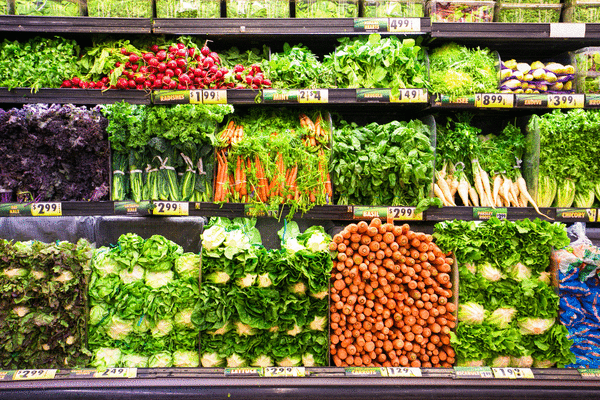
As state and federal officials work to identify the source of the recent outbreak of the intestinal illness cyclosporiasis, Michigan health officials have identified lettuces or salad greens as one potential culprit.
“Early information has shown lettuce as a common product that regularly comes up during the investigation,” said Dr. Natasha Bagdasarian, chief medical executive at the Michigan Department of Health and Human Services, in a news release. “We will continue to provide updates as we learn more.”
Officials cautioned they haven’t ruled out other food items as the source. The U.S. Centers for Disease Control and Prevention has confirmed 843 cases in 31 states, but that is a significant undercount based on the numbers being reported by state health officials.
Cyclosporiasis is caused by the parasite cyclospora. Symptoms include watery or “explosive” diarrhea, nausea and stomach cramps. It’s often contracted by eating or drinking something contaminated with the parasite, which lives in feces.
Michigan first reported an outbreak of cyclosporiasis on July 1 after nearly 200 cases were reported across seven counties. The state now leads the nation in cases, with the state health department reporting 2,640 cases Monday and 44 hospitalizations. The case numbers jumped 69% from Friday.
New York, Ohio, Illinois, Indiana and Kentucky also have reported a higher than usual number of cases. New York City alone has seen 403 cases this year, most of them since May 1. The New York City Health Department said in a statement to Stateline that it’s working with partners to determine a common source.
Ohio health officials reported 177 cases as of July 2, with 28 hospitalizations.
“Fortunately there have been no deaths in Ohio, as is consistent with our past experiences with this illness,” said Dr. Bruce Vanderhoff, director of the Ohio Department of Health, in a statement.
“Nevertheless, this is a serious illness that can cause dehydration and require people to seek emergency medical care, and it should be taken seriously.”
The CDC expects case numbers to continue rising, given a typical six-week lag between the onset of illnesses and when cases are typically reported to the CDC. The New York Times reported it has independently confirmed at least 4,800 cases this year.
States such as Michigan are rushing to do their own sleuthing after cutbacks have reduced surveillance capabilities at the federal level. Last year, the CDC scaled back its surveillance program that monitors foodborne illnesses. It no longer requires monitoring for six pathogens, including cyclospora, only requiring reporting for two: salmonella and Shiga toxin-producing E.coli.
The CDC acknowledged that while it’s working to collect and analyze data at the national level, “State health departments may have more timely information about the situation in their jurisdictions.”
The Trump administration said on social media on Monday that the CDC is working with 3,000 health departments to gather data, and that the U.S. Food and Drug Administration is investigating the outbreak alongside the CDC and state and local partners.
Local health departments in Michigan have conducted more than 1,000 interviews of those who’ve tested positive for cyclosporiasis, to try to trace the source of the outbreak, state officials said.
But in many states, the risk to the public remains low.
It’s not uncommon for states to see at least a few cases of cyclosporiasis each year. Michigan typically identifies 40-50 each year, while Rhode Island documented six cases last year and 12 in 2024. Because it can take up to two weeks for symptoms to develop after a person is exposed to the parasite, state officials say it takes time to investigate the source.
There’s currently no evidence that links recreational water exposure, such as swimming in lakes, as a risk factor for the illness. And in none of the cases confirmed by the CDC did the affected person report any travel during the two weeks prior to falling ill.
In previous cyclosporiasis outbreaks, bagged salad mixes and kits were identified as the culprit, along with fresh cilantro, basil, raspberries, snow peas and green onions. One of the largest outbreaks of cyclosporiasis was in 2020, which resulted in 701 people falling ill in 14 states, and which the CDC linked to Fresh Express bagged salads.
The CDC has identified cases in the current outbreak in the following states: Alaska, Arkansas, California, Colorado, Connecticut, Florida, Georgia, Illinois, Indiana, Iowa, Kansas, Kentucky, Louisiana, Maryland, Massachusetts, Michigan, Minnesota, Nebraska, New Hampshire, New Jersey, New York, North Carolina, Ohio, Pennsylvania, Rhode Island, Tennessee, Texas, Utah, Virginia, West Virginia and Wisconsin.
____
Infobox: Safer Salad Greens
Given the historical links between cyclospora and prepackaged salad greens, here are some recommended safety measures if you’re going to eat lettuce:
Purchase whole heads: Buy whole heads of lettuce rather than pre-washed, bagged lettuce or pre-mixed salad kits.
Discard outer layers: Before preparing the lettuce, throw away the outer two to three layers of leaves.
Wash inner leaves: Thoroughly wash the remaining inner leaves under clean running water.
Prioritize cooking: For any greens that can be cooked, heating to a temperature of at least 158 degrees F (70 degrees C) is safest. The parasite is resistant to routine chemical disinfection, and washing alone can’t guarantee its removal.
Source: Michigan Department of Health & Human Services
____
Janine Weisman of the Rhode Island Current, Kyle Davidson of the Ohio Capital Journal and Jon King of the Michigan Advance contributed to this report. Stateline reporter Anna Claire Vollers can be reached at avollers@stateline.org.
____
©2026 States Newsroom. Visit at stateline.org. Distributed by Tribune Content Agency, LLC.






Comments