Air quality hits hazardous levels in Chicago from wildfire smoke and could worsen tonight
Published in News & Features
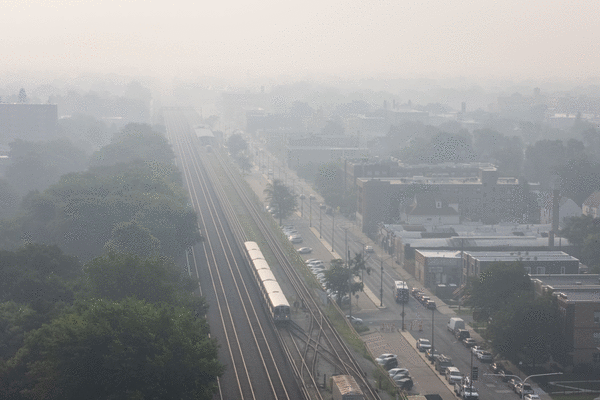
CHICAGO — Thick haze settled over northern Illinois on Thursday morning as dangerous levels of wildfire smoke from Canada and Minnesota rolled into the area, and it might get worse tonight, according to the National Weather Service.
Particulate matter levels in the Chicago area had reached an index of 355 on a scale of 500, which is considered hazardous for the general public.
Also in this category for Illinois were Aurora, Elgin and Lake County.
Levels between 200 and 300 are “very unhealthy,” and anything between 300 and 500 is “hazardous,” according to AirNow, a website that combines data from county, state and federal air quality agencies nationwide. When the forecast is hazardous, everyone should stay indoors and reduce activity levels.
According to Swiss air quality company IQAir, as of 9 a.m. Chicago was the third most-polluted major city in the world, behind Detroit and Minneapolis.
Fine particles known as PM2.5, which can be emitted by factories, power plants, diesel and gasoline vehicles, residential fireplaces and wildfires, are the main driver behind Thursday’s elevated air quality. PM2.5 can harm human health and sometimes be deadly. Initially, fine particulate matter may cause a burning sensation in the eyes and nose. But because of its small size, it can settle deep in the lungs and cross into the bloodstream.
Ricky Castro, meteorologist for the National Weather Service, said the haziest conditions could develop Thursday night.
Wildfire smoke is exacerbating pollution issues already present in northern Illinois earlier this week, he said. The Illinois Environmental Protection Agency issued an alert for ground-level ozone Tuesday. Ozone can cause coughing, damage airways and aggravate lung diseases, according to the U.S. Environmental Protection Agency.
Castro said the pollutant often accumulates more in hot summer conditions when it’s not as windy. Without wind, it’s more difficult for ozone to move away from the ground and out of an area.
“Winds are what really do cause dispersion of pollutants or emissions like ozone,” Castro said. “When you don’t have winds to serve things up, they tend to get trapped.”
As for the smoke blowing in Thursday, Illinois State Climatologist Trent Ford said air often moves in from Canada this time of year due to a high pressure system in the central U.S. This leads to air from central Canada getting pushed into the Great Lakes, along with wildfire smoke.
Ford said hazy conditions such as those Thursday and in 2023 aren’t necessarily a “new normal,” although wildfire smoke is something northern Illinois will likely deal with more often in coming summers.
In 2023, smoke from intense Canadian wildfires made Chicago the second-most-polluted major city in the country that year.
Ford said the primary reason for these conditions is climate change. First, human-caused climate change creates conditions where there’s more extreme variation in rain. Even in places like Minnesota where it’s raining more, Ford said, there’s short-lived droughts creating conditions suitable for wildfires.
Second and more importantly, higher temperatures create a drier atmosphere, he said. Large wildfires not only remove a source of climate-change mitigation by destroying trees; they can also actively make things worse by releasing carbon dioxide from trees into the atmosphere.
“We think of forests as a sink for that carbon for that to reduce the amount of carbon dioxide or hopefully limit warming,” Ford said. “But when we have these large wildfires, they are sort of reversing that process.”
Chicago Park District spokesperson Irene Tostado said the parks will be taking safety precautions for both summer camp participants and outdoor employees. In Evanston and Winnetka, city beaches were closed to swimming. The Naperville Park District closed Centennial Beach for the day due to poor air quality. Summer camps in Evanston, Carpentersville and Naperville reported changing scheduled outdoor activities to inside or canceling them altogether.
—Chicago Tribune’s Evgenia Anastasakos and Daily Herald’s Jake Griffin contributed.
____
©2026 Chicago Tribune. Visit at chicagotribune.com. Distributed by Tribune Content Agency, LLC.





Comments