Hegseth says US war against Iran has cost $37.5 billion
Published in News & Features
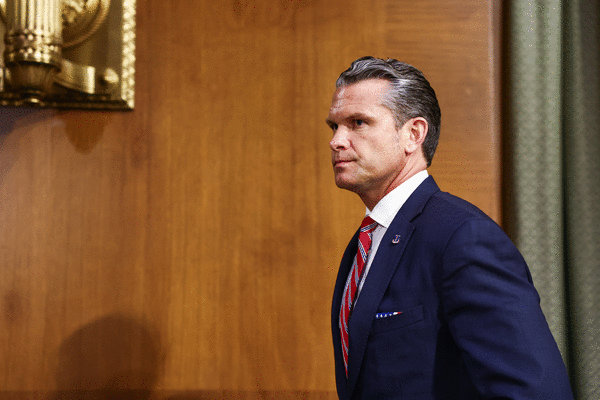
WASHINGTON — The U.S. war against Iran has cost the United States about $37.5 billion, Defense Secretary Pete Hegseth said, giving the most up-to-date official estimate for a conflict that shows no signs of ending soon.
Hegseth gave the estimate in an appearance before the Senate Appropriations Committee on Tuesday that was focused on President Donald Trump’s request for an additional $67 billion in defense funding. Pentagon officials had said in mid-May that the war had cost around $29 billion — a figure that didn’t account for damage to U.S. bases.
At the hearing, Hegseth faced criticism from Democrats over the growing costs of an unpopular conflict that has raised energy prices as it has intensified in recent weeks after a fragile ceasefire between the U.S. and Iran unraveled.
“I would hope for some perspective in this town of the historic nature of what President Trump is undertaking,” Hegseth told the committee. “Do you want radical Islamists to have a nuclear bomb?”
Hegseth said the $37.5 billion estimate covered military operations through today “for certain aspects,” and some anticipated costs such as pay through Sept. 30. It was unclear whether the figure accounted for damage to bases.
In written remarks submitted to lawmakers, Hegseth revealed that the funding request includes $21 billion to speed up the acquisition of high-end missiles and other munitions that U.S. forces used in large numbers during the war.
He also said the Pentagon wanted $2 billion to replace “equipment lost or damaged during combat operations,” as well as $11.6 billion to invest in drones, satellites and other technologies.
Trump has played down the prospect of more diplomatic talks with Iran, with Iran-backed Houthi militants in Yemen now threatening shipping in the Red Sea — an alternative to the Strait of Hormuz that’s been largely shut by Tehran’s retaliation since the war began on Feb. 28.
Hegseth, who declared victory in the war against Iran in April when the ceasefire was announced, faced tough questions about why the war was expanding rather than winding down.
“This war is now spiraling out of control again, the president is threatening escalation and war crimes and suggesting this could be another forever war,” the committee’s top Democrat, Senator Patty Murray of Washington, said. “He has told us over 40 times now that a deal is near, and the war will be over soon. But now he is asking for $70 billion more, and for us to just trust him it’ll work out fine.”
Democrats have repeatedly suggested the big funding requests signaled the administration was planning for a longer conflict. Hegseth rejected their negative characterizations of the U.S. strategy, saying the large defense budget requests were a “generational” investment required to modernize the Defense Department’s weapons and capabilities.
Hegseth was also asked about his comments earlier in the war claiming victory and suggesting Iran’s military had been rendered “combat ineffective,” even as it was able to attack Gulf nations with one-way attack drones and keep the Strait of Hormuz largely closed to commercial traffic. “No one ever stated that every single missile was gone,” Hegseth said at one point.
Chairman of the Joint Chiefs, General Dan Caine, who testified alongside Hegseth, also faced questions about the U.S. strategy of relying mostly on long-range munitions and whether the U.S. could defeat Iran through air power alone.
“Academically, as you look across the totality of history, air power’s got limits, and we always have to be mindful of those,” Caine replied.
Although Hegseth was calm and composed throughout most of the hearing, he grew combative during a tense exchange with Senator Gary Peters, Democrat of Michigan, near the end of a roughly three-hour hearing.
“Shame on you and others who call this a quagmire and a failure, and then you want to turn around and say you support the warfighter,” Hegseth said.
“You, sir, are the failure,” Peters said. “Not the men and women who are on that front line.”
“Why don’t you show some leadership and stand up to your fellow Democrats, who won’t fund the troops?” Hegseth said. “You have Trump derangement syndrome and can’t actually commit to anything meaningful.”
_____
With assistance from Sonya Dymova.
_____
©2026 Bloomberg L.P. Visit bloomberg.com. Distributed by Tribune Content Agency, LLC.






Comments