Trump asks court to shield Venezuela leader Delcy Rodríguez from US lawsuit
Published in News & Features
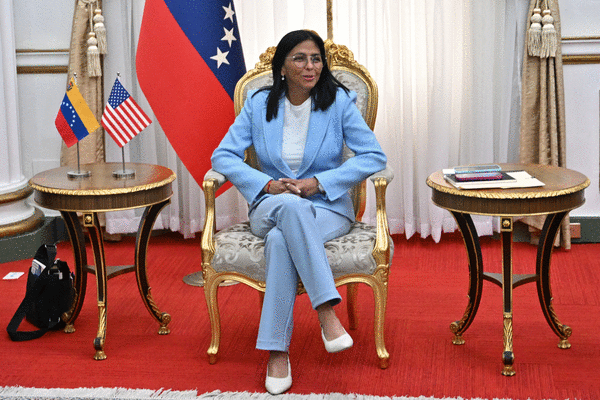
The Trump administration has taken the extraordinary step of asking a federal court in Miami to dismiss a lawsuit against Venezuelan interim President Delcy Rodríguez, underscoring how fully Washington has embraced her government as the legitimate authority in Caracas.
The request, filed this week by the Justice Department in the U.S. District Court for the Southern District of Florida, follows a formal determination by the State Department that Rodríguez is entitled to head-of-state immunity after the United States recognized her government earlier this year.
The case involves allegations by three men that they were tortured while imprisoned in Venezuela.
The Justice Department submitted what is known as a Suggestion of Immunity, a filing through which the executive branch advises federal courts that a foreign leader is entitled to immunity under U.S. law because of his or her official position.
“The Executive Branch has determined that President Rodríguez, as the sitting head of state of Venezuela, enjoys head of state immunity from the jurisdiction of U.S. courts based on her current status,” Justice Department attorneys wrote. “President Rodríguez is entitled to immunity from the jurisdiction of this Court over this suit while she holds that office.”
The department asked the court to dismiss all claims against Rodríguez without prejudice, meaning the lawsuit could potentially be revived after she leaves office.
The filing does not dispute the allegations against Rodríguez or address the merits of the case. Instead, it focuses exclusively on the legal question of whether a sitting foreign head of state may be sued before a U.S. court.
The filing represents more than a routine legal maneuver. By asking a federal court to extend one of international law’s strongest protections to Rodríguez, the administration is reinforcing a policy shift that began with its recognition of her government in March. The move suggests that, at least for now, Washington places a higher priority on preserving its working relationship with Rodríguez’s government than on allowing the civil claims against her to proceed, even though those claims stem from alleged human-rights abuses committed during the Nicolas Maduro era.
The filing also marks the latest development in a closely watched civil lawsuit accusing senior members of Venezuela’s former Maduro government of kidnapping, torture, terrorism and other human-rights abuses, while illustrating the Trump administration’s evolving relationship with Venezuela’s transitional government.
State Department request
The Justice Department’s action came after State Department Legal Adviser Reed Rubinstein formally asked the department to intervene in the case.
In a July 11 letter to Acting Assistant Attorney General Brett Shumate, Rubinstein said the State Department had determined that Rodríguez is entitled to head-of-state immunity because she currently serves as Venezuela’s president.
The letter notes that the United States has officially recognized Rodríguez as Venezuela’s head of state since March 5, following her assumption of the presidency after Maduro was captured by U.S. forces on Jan. 3.
“As a result, the Department of State requests that the Department of Justice submit a suggestion of immunity to the district court at the earliest opportunity,” Rubinstein wrote.
The letter also reveals that Venezuela’s embassy in Washington asked the State Department to certify Rodríguez’s immunity in the Florida case.
State Department officials further emphasized the diplomatic significance of the issue, telling the Justice Department that dismissal of the claims against Rodríguez carried “significant foreign policy implications.”
That language reflects the executive branch’s longstanding position that decisions regarding the immunity of foreign heads of state are closely intertwined with the conduct of U.S. foreign relations.
Torture allegations
Rodríguez is one of several defendants named in a lawsuit filed by Jerrel Kenemore, Jason Saad and Venezuelan citizen Edgar Marval.
The plaintiffs accuse Maduro, Rodríguez, businessman Alex Saab and several senior officials of responsibility for kidnappings, arbitrary detention, torture and acts of terrorism allegedly committed by Venezuelan security forces during the Maduro era.
The three men say in court filings that they were subjected to severe beatings, electric shocks, prolonged isolation, stress positions and other forms of physical and psychological abuse while imprisoned in Venezuela.
The lawsuit portrays those abuses as part of a broader campaign of political repression carried out by the country’s security apparatus.
Earlier this month, U.S. District Judge Darrin P. Gayles entered a default judgment exceeding $314 million in favor of the three men and against Maduro, Saab and several former Venezuelan officials after they failed to respond to the lawsuit.
The court found the plaintiffs’ evidence sufficient to establish liability and awarded damages for the torture and abuse they allegedly suffered.
Rodríguez, however, was excluded from that judgment while the court awaited guidance from the executive branch on whether she was entitled to immunity as Venezuela’s sitting head of state.
Monday’s filing answers that question.
The Justice Department does not dispute the plaintiffs’ allegations or the judge’s earlier findings. Instead, it argues that Rodríguez’s current office prevents the court from exercising jurisdiction over her while she remains president.
If the judge agrees, the claims against Rodríguez would be dismissed, while the judgment against the remaining defendants would remain intact.
Longstanding legal doctrine
Head-of-state immunity is a well-established principle of international law that U.S. courts have recognized for decades.
The doctrine generally protects incumbent heads of state, heads of government and foreign ministers from being sued before domestic courts in other countries while they remain in office.
In its filing, the Justice Department argued that the U.S. Constitution assigns the president primary responsibility for conducting the nation’s foreign relations and that determinations regarding the immunity of foreign leaders belong to the executive branch.
Federal courts have historically treated such executive branch determinations as controlling, rarely second-guessing the government’s assessment that a foreign leader should receive immunity.
The filing emphasizes that Rodríguez’s immunity derives solely from her current status as Venezuela’s head of state and does not constitute a judgment on the merits of the allegations against her.
Nor would it permanently shield her from civil liability. Because the government requested dismissal without prejudice, the plaintiffs could seek to revive their claims after Rodríguez leaves office.
Reflects broader policy shift
Beyond its legal significance, the filing also illustrates the Trump administration’s changing approach toward Venezuela following Maduro’s removal from power.
For years, Washington refused to recognize Maduro as Venezuela’s legitimate president after his disputed 2018 reelection and instead recognized opposition leader Juan Guaidó as the country’s interim president.
That policy effectively ended after Guaidó’s interim government dissolved and Venezuela entered a new political transition earlier this year.
Following Maduro’s capture on Jan. 3, Rodríguez, who had served as Maduro’s vice president, became interim president. On March 5, the United States formally recognized her as Venezuela’s head of state.
Since then, the Trump administration has maintained diplomatic contacts with Rodríguez’s government while also expressing support for a broader democratic transition in Venezuela.
The evolving relationship has generated criticism from some Venezuelan opposition figures, who have continued to argue that the country’s transition should ultimately be led by democratic forces and has insisted on returning to Venezuela to help shape its future.
©2026 Miami Herald. Visit at miamiherald.com. Distributed by Tribune Content Agency, LLC.





Comments