Aldermanic opposition rams through referendum questions for 2027 Chicago city election ballot
Published in News & Features
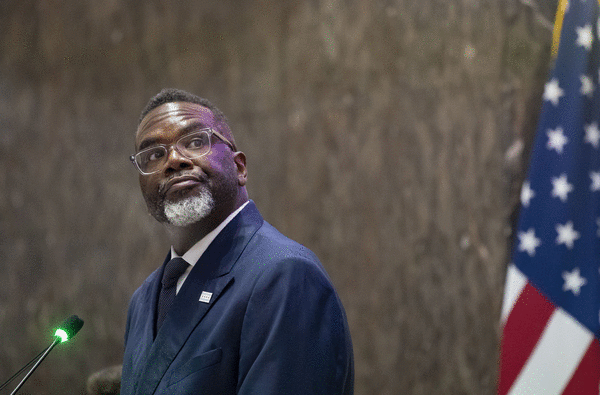
CHICAGO — The City Council on Wednesday approved a slate of non-binding referendums favored by opponents of Mayor Brandon Johnson for Chicago voters to consider in next year’s citywide election, the most contentious of which asks whether aldermen should have their own lawyer to advise them during conflicts with the city Law Department.
The special council meeting called specifically to deal with the referendum fight was the latest front in an increasingly heated struggle between Johnson and his aldermanic foes. The questions carry no legal weight but could help drive voter turnout for the upcoming election that will surely pit Chicago’s left and moderate flanks against each other.
The body also approved a question for the November ballot, proposed by Johnson, asking voters whether the city should go after the federal government to try to recoup local money spent dealing with President Donald Trump’s immigration enforcement. Voters will consider that in the general election in which federal, statewide and all Chicago school board seats are up.
But the main argument was over three proposed questions to go on the February city ballot: Should the city build a monument dedicated to Chicago’s music and arts, should aldermen get their own lawyer and should the city withhold funding from sister agencies like the CTA and Chicago Public Schools to claw back debt.
After the defeat for Johnson, the mayor held a news conference where he blamed his council critics for being “out of touch” and heartily laughed off questions about whether he has lost his grip on the legislative body.
“This idea that I’m responsible to control 50 human beings, even as a former public school teacher, CPS did not have that expectation of me when I taught middle school,” Johnson told reporters. “However, I have not lost control. I haven’t, and I won’t. And I haven’t lost the plot.”
The final questions for next year’s municipal election were put forth for a floor vote by Ald. Samantha Nugent, 39th, and all introduced by her or other members of her opposition coalition, which prevailed over Johnson ally Ald. Jason Ervin’s attempts to stall the items.
Because Chicago only allows three referendums per election, that essentially crowds further questions off the February ballot. It’s an age-old dance in City Council ahead of contentious races, as the subject matters can shore up enthusiasm from various voter bases, and the results can be used to point to support for future policy changes.
Though the questions are essentially symbolic, both Johnson and aldermen clearly think they’re important.
On the referendum over separate legal representation for aldermen, Johnson said only the state’s General Assembly has the power to create such a position. That led to protest from progressive critic Ald. Andre Vasquez, 40th, who pointed out a referendum question about taxing millionaires that Johnson ally Ald. Byron Sigcho-Lopez, 25th, hoped to force a vote on Wednesday also concerned a change that Springfield would have to approve.
Johnson retorted that he never said Chicago voters couldn’t be asked about the council lawyer, while noting the question asked specifically if the City Council should establish and fund an independent counsel. The millionaire tax question, on the other hand, asked voters if Springfield should take action, he added.
“Listen, if you want to debate my tone, we can do that,” Johnson said. “But don’t intend for my emotions to be brought into this conversation.”
Ervin, 28th, came to Johnson’s defense, noting the city corporation counsel legal position that already exists “represents the corporation, of which we are part of the corporation.”
Vasquez responded that “there’s nothing more urgent” given the ongoing differences between the council and mayor’s office.
Aldermen ultimately voted 32-16 to place that question on the ballot.
Later on, the millionaire tax referendum failed to garner a vote because Sigcho-Lopez did not file the item in time. He told reporters afterward, “we’re gonna keep fighting for this question to appear” in February, though it was unclear what remaining avenues he had.
Progressives also expressed discontent over the referendums on the music monument, which passed 24-23, and the withholding of funds for sister agencies, which passed 29-20.
The special meeting during the council’s usual summer recess came after the regular July meeting last week ended with a flurry of parliamentary maneuvers from both sides to delay the other’s referendum questions from advancing. Johnson opponents then forced Wednesday’s meeting to press the issue.
The meeting adjourned with some final pot shots from Sigcho-Lopez, who condemned “the lack of integrity from some people who continue to block the millionaire tax” and was met with a round of mayoral opponents complaining he was out of order.
“It’s good to know we have all these parliamentarians here today,” Johnson said before gaveling out.
Also on Wednesday, Johnson kept mum on potential plans to address the looming closures of several grocery stores on the South and West sides, with his team saying it was still exploring options. His remarks came after Save A Lot recently notified the city that it expects to terminate its license agreement with Yellow Banana at the end of the month, the Tribune reported on Tuesday.
Johnson also told reporters that while he still believes in “the spirit of the city-owned grocery store,” his administration is pursuing “other ways in which we can create access” to fresh food. It was not clear what form that might take, however, or what the immediate fate of the Yellow Banana stores would be.
“People suggest that somehow that if it’s not my way, then I’m not willing to capitulate. The reason why we moved away from a city-owned grocery store is because we heard from smaller chains, and they said, ‘Look mayor, we can actually help accomplish that by creating public and private partnerships,'” Johnson said.
The mayor also demurred on the latest fallout from the 2026 budget fight, as well as his political future.
On fiscal issues, Johnson said his administration remains noncommittal on making the second half of an advance payment to help address the city’s pension shortfall, due to “delayed property tax disbursements” from Cook County. He also blamed a potential $90 million budget gap by the end of this year on the aldermanic opposition, which he said should wear the hat if layoffs come to pass to address the hole.
And he endorsed a pledge backed by a dozen progressive aldermen demanding their colleagues reject future contributions from corporations tied to federal immigration enforcement.
“Certainly you know where my resources come from: Working people, labor,” the mayor said when asked whether other aldermanic — and mayoral — candidates in the 2027 cycle should sign on. “Any corporation that has ties to ICE, I think that people should reject those contributions.”
____
©2026 Chicago Tribune. Visit at chicagotribune.com. Distributed by Tribune Content Agency, LLC.



Comments