US, Iran exchange strikes as Trump mulls wider offensive
Published in News & Features
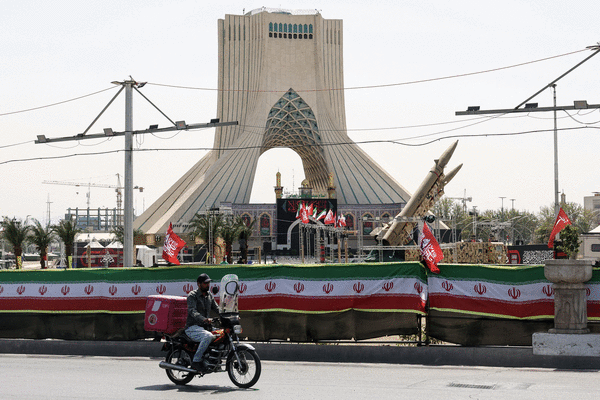
The U.S. and Iran exchanged limited strikes as the latest round of hostilities passed the two-week mark, after President Donald Trump warned of a potential “massive attack” to try and force through a peace deal.
U.S. Central Command said it launched a 13th consecutive night of strikes intended to degrade Iran’s ability to attack commercial shipping in Strait of Hormuz, the focal point in the breakdown of negotiations between the sides. Iran has continued to target U.S. bases in the region, including in Kuwait and Bahrain.
Trump told Axios in an interview Thursday that he was “close to making a decision” on attacks that would be “bigger than ever before.” Iran isn’t ready to make a deal and “they haven’t received enough pain yet,” Trump was reported as saying.
It’s not clear whether such deliberations are being made alongside Israel, which joined the U.S. in attacking Iran at the start of the war in late February. Israeli Prime Minister Benjamin Netanyahu will meet Trump in Washington on Tuesday, his office said in a statement.
Trump’s remarks underscore the bind he finds himself in after renewed fighting caused an interim peace deal to collapse and all but closed the Strait of Hormuz. In a Truth Social post Thursday, Trump threatened “major military punishment” on Iran and the Houthi militant group if they target commercial ships.
The Yemen-based Houthis claimed strikes on Saudi oil tankers this week, opening a new front in a conflict that has driven oil prices above $100 a barrel and U.S. retail gasoline prices over $4 a gallon. Brent crude declined on Friday, but is on track for a weekly gain of about 10% as the conflict simmers.
Mediation efforts faltered after Iran on Thursday rejected a ceasefire proposal from Trump carried to Tehran by Iraq’s prime minister, the New York Times reported, citing Iranian and Iraqi officials. Details of the plan were not clear, the newspaper said. The Iraqi prime minister’s media office said the report “bears no relation to the truth.”
The strikes came hours after the U.S. president warned “that from this point forth, any and all damages done to Ships, Cargo, or anything related thereto, will be paid for by Iranian Money that the United States has in its possession, and controls.”
The U.S. has about $2 billion of blocked Iranian funds inside its borders. A much larger portion is in other countries and is prevented from being transferred by U.S. sanctions — estimates vary from $24 billion to more than $100 billion. Iranian Foreign Minister Abbas Araghchi said in a post on X that “seizing another nation’s assets to pay for unrelated future claims is an incendiary precedent.”
The war has entered a new phase of escalation after last month’s truce collapsed. The fighting remains less intense than at its peak, but Iran has threatened to target regional infrastructure, including energy sites, if Trump carries out his threat to destroy one bridge or power plant each time Tehran attacks shipping in Hormuz. Traffic through the strait, which before the war carried about one-fifth of global energy supplies, has slowed to a trickle.
The Houthis’ actions this week threaten another maritime chokepoint, with some vessels already avoiding the Bab el-Mandeb Strait. Still, two China-owned oil tankers loaded with Saudi crude have exited the Red Sea via the strait.
Trump last month cited the risk of a global economic crash as a key reason for him agreeing to a truce. He faces growing political pressure before November’s midterm elections, with Republicans struggling to retain control of Congress. Polls show the war isn’t popular. The House of Representatives on Thursday passed its second resolution calling on Trump to stop the war, although the measure is largely symbolic.
Iranian state TV reported a strike on the passenger terminal at the Shalamcheh border crossing with Iraq that killed two people.
The Houthis, part of Tehran’s so-called Axis of Resistance, control much of northern Yemen, including Sanaa and the Red Sea port of Hodeida. They have repeatedly disrupted Red Sea shipping since 2023 with drone and missile attacks launched after Israel’s war against Hamas began in Gaza. Trump ordered airstrikes against the group last year before ending the campaign after a partial truce.
©2026 Bloomberg L.P. Visit bloomberg.com. Distributed by Tribune Content Agency, LLC.






Comments