Why did judge delay sentencing of 4 men in plot to kill Haiti's president?
Published in News & Features
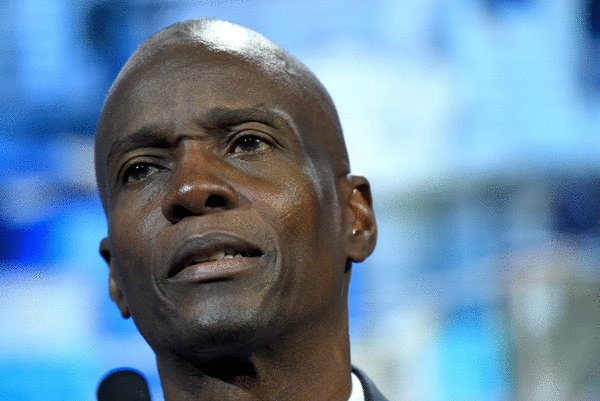
MIAMI — Four South Florida men found guilty in May of conspiring with ex-Colombian soldiers to assassinate Haiti’s president, Jovenel Moïse, will be sentenced in early February 2027, according to a Miami federal judge’s order on Friday.
All four face up to life in prison.
U.S. District Judge Jacqueline Becerra pushed back the original sentencings set for late October because of a conflict with the looming trial of the final defendant in the killing of Moïse, 53, who was shot in his home outside Port-au-Prince on July 7, 2021. In her order, Becerra said she didn’t want the sentencings and trial going on at the same time, so she postponed both without setting a new trial date.
In May, a 12-person jury in Miami federal court convicted the four men in the plot following testimony during almost nine weeks. Arcángel Pretel Ortiz and Antonio “Tony” Intriago, owners of Counter Terrorist Federal Academy and Counter Terrorist Unit Security in Doral — collectively known as CTU — were convicted of conspiring to kidnap or kill Moïse. James Solages, who worked for CTU, and Walter Veintemilla, a Broward-area mortgage broker whom prosecutors said helped finance the plot, were also convicted along with Pretel Ortiz and Intriago.
Before the trial, eight co-defendants had pleaded guilty to the main assassination conspiracy charge or lesser charges — including Keegan Harricharan, 42, of Coral Springs, who last week was sentenced to 20 years after a money-laundering conspiracy plea deal with the U.S. Attorney’s Office in Miami. In a factual statement, Harricharan admitted that he fleeced a COVID-19 government loan program in 2020, and the following year, he transferred $255,000 to Veintemilla to help fund the assassination plot.
The four men who stood trial were accused of plotting in South Florida and hiring a squad of former Colombian soldiers to violently overthrow Haiti’s president in a coup scheme that turned from his ouster to his assassination a couple of weeks before his death. The defense teams challenged those allegations by asserting that Haitian police and presidential-security details killed Moïse before the Colombian hit squad arrived at his hillside home in the middle of the night.
But prosecutors argued that the South Florida group, in collaboration with a few key Haitians starting in April 2021, wanted to replace Moïse with a new president willing to hire them for lucrative security and infrastructure contracts in Haiti.
“This case is very simple,” lead Assistant U.S. Attorney Sean McLaughlin told jurors during closing arguments. “This is a case about greed, arrogance and power.”
The jury found the four defendants guilty of five counts, including a conspiracy to kidnap or kill a foreign leader, a conspiracy to provide material support to kill Haiti’s president, and a conspiracy to lead a military expedition against a friendly nation, a violation of the U.S. Neutrality Act, which bans American citizens from waging war against any country at peace with the United States.
Intriago also faced four additional counts related to shipping bulletproof vests to Haiti for about 20 former Colombian soldiers whom CTU recruited and sent to Port-au-Prince roughly a month before the killing. The jury found him guilty of three of those counts, but acquitted him of a fourth charge of violating U.S. export-control laws.
A fifth defendant, Christian Emmanuel Sanon, a Haiti-born doctor and pastor who lived in South Florida, was not tried with the other four men because of health issues. His trial was scheduled for October but will now be delayed, according to Judge Becerra’s Friday order, which reset the sentencings for the defendants to Feb. 2-3, 2027. No new date for Sanon’s trial has been set.
Initially, the South Florida plotters backed Sanon to succeed Moïse after his removal, but they abandoned him for another political candidate, a Haitian Supreme Court justice, Windelle Coq Thélot, in the weeks before the president’s assassination. She died in 2025.
After Judge Becerra read the verdicts in a packed courtroom and excused the jurors, she told both sides that “it was an emotional day.”
“This is a case of great significance,” she said.
Federal prosecutors presented a sweeping case — one that ran parallel to and intersected with a still-unresolved sprawling investigation by Haitian authorities, who have charged more than 50 suspects, including the former first lady, Martine Moïse. The U.S. case focused on more than 40 witnesses, photos of the crime scene borrowed from the Haiti National Police, as well as some of the weapons used by the Colombian commandos.
There were 8,000 gigabytes of data gathered by FBI agents from more than 100 electronic devices in the United States, Colombia and Haiti. The evidence was part of a 900-page summary of text messages and voice notes showing the evolution of the plot, which included, at various times, plans to use gangs, to poison the president or to detain him at the airport after he returned from an overseas trip.
©2026 Miami Herald. Visit miamiherald.com. Distributed by Tribune Content Agency, LLC.



Comments