Trump renews tariff onslaught with a whirlwind week of threats
Published in News & Features
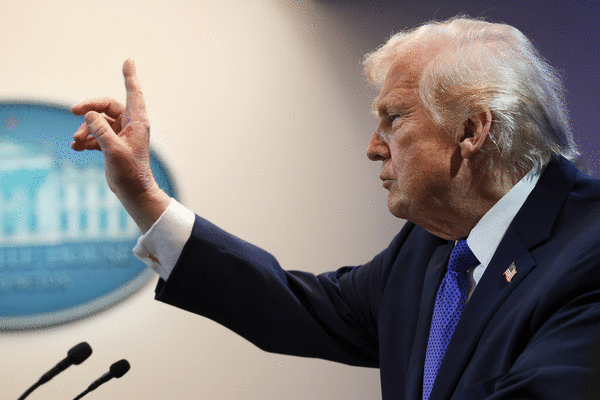
President Donald Trump had gone mostly quiet on trade wars since the Supreme Court struck down his tariffs and the start of the Iran conflict in February, making many think his campaign of import taxes would fade until after the U.S. midterm elections in November.
“What we learned this week was that’s not true,” Josh Lipsky, vice president and chair of international economics at the Atlantic Council, told MS NOW on Friday. “Donald Trump is committed to rebuilding the tariff wall.”
Lipsky argued in a New York Times essay earlier this week that Trump’s duties on imports are here for the long haul and that the obstacles to removing them won’t be legal challenges — they’ll be worries about spooking the bond market because of the revenue tariffs generate.
“America’s financial markets went from hating tariffs to being able to live with them to needing them to help cope with the country’s deficit,” Lipsky wrote.
Chad Bown, a senior fellow at the Peterson Institute for International Economics and co-author of the book "How to Win a Trade War," saw a missed opportunity during Trump’s week of trade headlines. “The Trump administration continues to impose tariffs on partners and allies and not dealing with the bigger challenge of China,” Bown told BBC News.
Here’s a rundown of how the week unfolded:
Monday
The White House announced a 50% tariff on about $20 billion worth of Canadian imports, equivalent to about 5% of the total coming across the border from the U.S.’s northern neighbor each year. Unless Canada addresses Washington’s grievances on autos, dairy and alcoholic beverages, the levies would take effect Aug. 19.
This was a surprise because Trump invoked Section 338 of the 1930 Tariff Act, which gives the president the power to impose duties on countries deemed to discriminate against U.S. commerce. That provision in the law — better known as Smoot-Hawley and made famous in the movie "Ferris Bueller’s Day Off" — has never before been used to impose tariffs.
“We expect this latest move is likely a test run, and Section 338 could emerge as Trump’s go-to tool for international disputes,” Chris Kennedy of Bloomberg Economics wrote in a research note this week.
Tuesday
In a social media post, Trump gave generic drug manufacturers two years to move production to the U.S. or face a 100% duty starting August 2028. The move would upend a global supply chain that keeps generic medicines affordable for Americans. Off-patent drugs run the gamut from everyday painkillers and antibiotics to cholesterol and cancer drugs, and they’re mostly produced at factories in India, Europe and China.
Wednesday
Additional 25% tariffs on imports from Brazil took effect under Section 301 of the Trade Act of 1974. Shipments of coffee, beef, and certain ethanol products are exempt. Bloomberg Economics said Brazil now faces the steepest tariff increase among top U.S. trade partners relative to the end of 2024.
Brazil’s government unveiled a relief package worth 18.5 billion reais ($3.6 billion) in credit for exporters hit by new U.S. tariffs.
Meanwhile, U.S. Trade Representative Jamieson Greer testified before the Senate Finance Committee and fended off attacks from Democrats on the panel blaming tariffs for stoking inflation and hurting American consumers.
Thursday
Greer announced duties of 10% and 12.5% on imports from most major trading partners, effective Friday. The reason cited: The 60 economies targeted either don’t have rules forbidding forced labor in their supply chains, or they don’t enforce them adequately, according to a USTR investigation under Section 301.
The move effectively held the U.S.’s baseline tariff at 10% because a duty at that same level — imposed as a stopgap after Trump lost at the high court — lapsed Friday after 150 days.
Bloomberg Economics calculated the U.S.’s average effective tariff rate edged up 0.1 percentage point to 10.7%.
Friday
Small businesses filed a pair of lawsuits in the U.S. Court of International Trade accusing Trump and U.S. officials of unlawfully using Section 301 to replace his previous tariffs struck down by the Supreme Court.
Separately, the U.S. president threatened new tariffs on goods from the European Union in retaliation for a $1 billion fine imposed on Alphabet Inc.’s Google, injecting fresh uncertainty into the two sides’ trade relationship just as the worst of the strain appeared to be over for now.
In a social media post, he said a Section 301 investigation would start immediately, though that process can take anywhere from four to 18 months.
A day earlier Greer had issued a statement blasting the EU for the Google fine and for a recent loan to Airbus SE, potentially reviving a transatlantic dispute over subsidies between the planemaker and its biggest rival, Boeing Co.
_____
©2026 Bloomberg L.P. Visit bloomberg.com. Distributed by Tribune Content Agency, LLC.




Comments