'Deportation factory': Chicago's immigration court epicenter for US spike in removal orders, analysis shows
Published in News & Features
CHICAGO — On a May morning, Immigration Judge Peter Kim’s Loop courtroom offered a scene that would help explain how Chicago would soon lead the nation in deportation orders.
In notes kept by a volunteer group of court observers, they described an overflowing courtroom, with people standing two rows deep up to an interpreter’s desk. One observer jotted down: “I’ve never seen this before.”
Neither, apparently, had Kim, a recently transferred judge from Los Angeles. According to the notes, he said, “this is so hard. This is not going to work.”
It was the first recorded instance of dozens of so-called “mega-master” hearings: enlarged versions of early-stage hearings where immigrants appear in large groups. Combined with a massive turnover in judges on the Trump-controlled court and less-immigrant-friendly rules, the hearings helped fuel a dramatic rise in the number of removal orders issued by judges there — turning what once was a large but average court into a national trendsetter for the president’s push for mass deportations.
A Chicago Tribune analysis of Department of Justice data has found that, rather than repeating Operation Midway Blitz’s military-style street-level sweeps, the Trump administration this year has supercharged its Chicago efforts in immigration courts it oversees — another arm of deportation system that primarily operates on one floor of a nondescript Loop high-rise that serves as the region’s hub for immigration cases.
The Chicago Tribune analyzed immigration court data obtained and refined by the research group Deportation Data Project. The analysis focused on Chicago’s immigration court, which covers cases in Illinois and Wisconsin, and it found that the Chicago court issued nearly 7,100 removal orders last month.
That was the most of any court in the country and seven times the monthly average during President Joe Biden’s last year in office. While Chicago is seeing the most removal orders of anywhere in the country right now, the local spike is in tune with a national wave as the Trump administration seeks to reshape the country’s immigration courts in line with President Donald Trump’s hard-line immigration agenda.
In a statement to the Tribune, the Justice Department did not directly comment on the Tribune’s figures but said it has prioritized reducing case backlogs, which nationally topped 3 million cases early in Trump’s second term.
“The Justice Department is restoring integrity to our immigration system by hearing cases fairly, expeditiously, and uniformly, in accordance with the law,” according to its statement.
But immigration attorneys and advocates question the level of due process that immigrants are now getting through the expanded hearings.
Stephanie Spiro, the associate director of protection-based relief for the National Immigrant Justice Center, said the push in Chicago fits in with broader efforts across the country to remake the system into a “deportation factory.”
Spiro and other attorneys point to a host of factors fueling the spike in removals, but none more significant than the administration choosing Chicago as one of the earliest adopters this spring of mega-master hearings — funneling large groups into courtrooms for mass hearings, such as on Thursday.
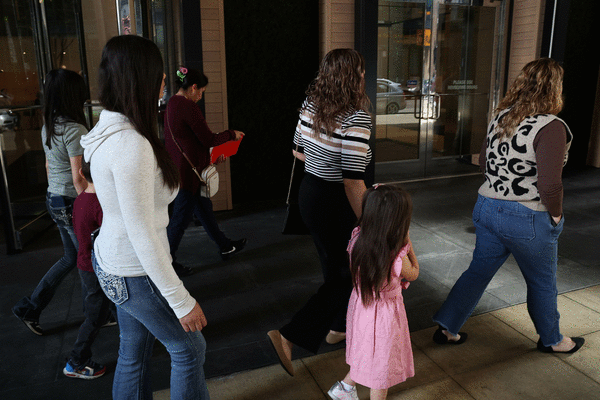
By 8 a.m. Thursday morning, people were already streaming inside the high-rise that houses the main location of Chicago’s immigration court. By 8:30 a.m., the number of people in the waiting room dwarfed the available chairs. By 9 a.m., lines outside each courtroom wrapped around the hallways.
Weaving between the families was Clare Kirwan, an intern with the Illinois Coalition for Immigrant and Refugee Rights’ Court Watch program. Remarking on the lengthening lines, she said she had seen worse.
“It’s been a long time since I saw any available wall space,” she said.
Kirwan said that court observers and advocates have so far been classifying mega-master hearings based on sheer numbers — anything more than 75 people would get the label — but in her eyes, it’s more about the procedures in use in the hearings than the size.
The hearings are typically dedicated to Spanish-speaking immigrants who do not have attorneys representing them, she said. Instead of addressing individual cases one by one, they look to see if a judge addresses the whole room as a group and have people raise their hands to notify the court if they want more time to hire an attorney or don’t understand an instruction.
“They’re basically being checked that they’re here,” Kirwan said. “Which is concerning because if they’re marked in absentia, they’re ordered removed by the government.”
Kirwan said she’s seen as many as 80 or 100 people ordered removed in absentia at a single hearing. And the Tribune’s analysis confirms that the vast majority of those ordered to be deported are deemed not to have shown up at hearings.
Beyond their concerns about people who miss court getting an automatic removal order, attorneys and advocates worry that immigrants who are already at a disadvantage without a lawyer are losing out on the chance to ask questions and fully understand what they’ll need to have the best shot at arguing their case.
“If you show up without an attorney, with another 200 people, and 12 courtrooms, you don’t know where you’re going, what you’re supposed to do, and even if you’re handed a piece of paper to fill out, you don’t know what to do,” lawyer Julia Sverdloff said.
For immigrants with attorneys, Sverdloff said hearings that used to take several years to hold are now being set six months to a year out.
“Things are moving for represented clients,” she said. “And the nonrepresented clients are not getting their day in court at all.”
Immigration lawyers said they can’t point to one single thing to explain why Chicago has become the national epicenter of removal orders. But they suggest it’s likely many factors.
Across the board, people who work in and around immigration courts are observing pressure to get cases resolved as quickly as possible, whether that’s through removal orders, shortening the timeline to a final trial on the merits of someone’s case or boosting the number of people who sign voluntary deportation forms.
Also fueling the significant rise in removal orders, immigrant lawyers say, are a series of new tactics employed in the long-backlogged court — forcing quicker hearings with less notice while requiring more in-person attendance — that combine to make it more likely immigrants can’t or won’t show up to their hearings. In some cases, they report seeing immigrants who show up in person have their hearings before a judge who is teleconferencing in from Maryland or Texas.
Even those immigrants who can arrange for time off work and child care may choose to skip after hearing stories of federal agents previously swarming some immigration courts across the country to arrest those who showed up to hearings.
And on the other side, the composition of the city’s immigration court is also changing. Unlike traditional judges, immigration judges are direct employees of the president in office.
The Tribune reported in March on a wave of buyouts, firings and resignations in the first year of the Trump administration. Over the last 18 months, they were replaced by new judges willing to push deportations, while the Tribune analysis found that judges who predated the second Trump administration became far less likely to rule in immigrants’ favor.
Immigrants’ odds were already unlikely under Biden. In Biden’s last year, immigrants in Chicago’s court were 51/2 times as likely to be issued a removal order than to win a ruling. With Trump, in the first half of this year, immigrants were nearly 38 times as likely to be issued a removal order than win their cases.
The orders themselves do not necessarily mean immigrants are immediately deported — particularly with many issued to people who didn’t show up to court. For those not taken into custody immediately, the removal orders are fed to federal agents who can either hunt down those named in the orders or, often, detain and deport those with orders whom agents come across while searching for deportable immigrants.
And, the analysis found, the jump in removal orders doesn’t necessarily tie into the jump in detentions from last fall’s Operation Midway Blitz, with barely any of the removal orders tied to people detained during the blitz. Many of those detained were jailed outside the Chicago court’s jurisdiction, and — regardless — the Trump administration has said it has power to deport many of them without needing an official immigration court removal order.
Rather, the jump in removal orders signals another front in the Trump administration’s push for mass deportations, along with enforcement efforts that — while not at the level of last year’s blitz — have grown this summer in the Chicago area and across the country.
Immigration court cases ordinarily have moved very slowly, creating massive backlogs in the system. But in Chicago’s court, under the Trump administration’s push to expand deportation, judges have been speeding through cases that are typically 2 to 3 years old, the Tribune analysis found.
In just one day last month, the court issued 551 removal orders. Another way to look at it: For the eight hours the court was open that day, it averaged one new deportation order every 52 seconds. During the Biden administration, even the busiest days barely topped 100 removal orders issued.
Some of that speed came from judges stationed outside Illinois hearing some Chicago cases remotely. Of 23 judges who concluded at least 50 cases in Chicago’s immigration court last month, three were based out of an immigration court in Maryland, handling cases there too, the data show.
Of those 23, all but one judge had the majority of their cases end in removal orders. And the outlier judge was because nearly half of her cases ended with the immigrant agreeing to leave before she made a ruling.
As for the others, most ended at least 90% of their cases with an order for the immigrant to be deported.
For one of those Maryland-based judges, every single one of her 253 Chicago cases ended in a deportation order.
The immigration courts are overseen by a branch of the Justice Department called the Executive Office for Immigration Review. And, in a statement, that branch defended the changes as past due to ensure cases don’t “languish” while balancing its legal obligations in a system that still follows the rule of law.
“Unnecessary delay hurts both aliens with meritorious claims and the American public who wish to see aliens with non-meritorious claims removed as quickly as possible,” the statement said. “As it continues to add new immigration judges, EOIR will continue to make scheduling adjustments to ensure all cases are handled in a timely and lawful manner.”
Still, the department’s evolving tactics drew alarm from immigration advocates who monitor the courts and lawyers who represent the immigrants summoned there.
When volunteers first reported back from mega-master hearings on May 18, Emily Wheeler sent up a flare right away.
“I sent a big HELP email to everyone I could think of,” she said.
Wheeler, the administrative coordinator for an organization called Sanctuary Working Group, said she and other advocates “have been continually grasping for straws” as they try to equip people for the rapidly evolving world of immigration court.
“When we try to reach out to experts in the field, (they) don’t even know what to do, because this is outside of anything that they have experienced before,” she said.
They’re concerned about a brief period where judges were passing out pleading declarations — hugely consequential paperwork where immigrants respond respond to allegations contained in their notices to appear and answer specific questions about the nature of their cases — and requiring immigrants to mail them back to the court within 20 days.
They hadn’t seen them distributed since the spring, advocates said, but the documents had been getting handed out again in recent days.
“The pleadings documents are so in depth that in order for a lawyer to fill them out, they would need to review the entire case and be ready to defend that case,” she said.
In fact, she continued, the answer to almost every question is that people need lawyers — “and there’s simply not enough lawyers to go around.”
Her group, which coordinates volunteers to accompany people to court, is “a last resort… and it’s devastating to just tell people the same advice and know that the advice is not going to help them.”
They’re also trying to debunk rumors that could land people in detention. Many people have skipped court in fear of encountering ICE agents at their appearance — but while arrests at check-ins with the agency are common, arrests at Chicago’s immigration court are not, even if such arrests happened in other parts of the country.
Others have heard about agents arresting people at county courthouses, like domestic violence court at 555 W. Harrison St., and get the two court systems confused.
“All court ends up melding into one ‘court,’ and so people aren’t aware that where people are being arrested is actually not immigration court,” she said.
It was against that backdrop of swirling rumors and uncertainty that about 75 people waited outside Immigration Judge Marc Stahl’s courtroom Thursday morning as Stahl worked through his list of clients with attorneys.
They waited for more than two hours before Stahl’s clerk opened the courtroom door. Immigrants filled in the rows of benches and began to crowd against the walls. One couple pushed a double stroller in front of them. Others held sleeping children splayed across their laps.
There were so many people that several groups crossed the wooden fence separating the judge and staff from the audience and sat right down at the table meant for the Department of Homeland Security attorney.
Stahl needed to be able to see each person in the room, pushing the lines up onto the dais where he sat flanked by an interpreter and a clerk.
Once he could see everyone, he introduced himself and told the crowd that they had been called to court to answer to allegations from the Department of Homeland Security that they were not lawfully residing in the United States. The attorney representing DHS typed at his computer, about a foot away from one of the respondents.
“As the judge in your case, I will decide if you are not lawfully present,” Stahl said. He explained that they may be eligible for asylum or other forms of relief, but that they’d need to build a case to make that argument.
“You each have a right to have a lawyer represent you in court,” he said. “The government does not provide or pay for lawyers. You have a right to examine and object to evidence against you. If you understand all of these rights, please raise your hand and keep it raised.”
Every adult in the room put their hand in the air. Stahl got up from his bench and scanned the room to see each person. Over the next 30 minutes, he repeated that process several more times as he explained how to submit evidence, how to notify the court if they moved and asylum fees, among other requirements.
Kirwan, the observer with the Court Watch program, stood against the wall by the dais, taking down people’s alien numbers and names as best she could. She was able to count 39 cases among the 70-odd people in the room. After the hearing, as respondents lined up for paperwork from Stahl’s clerk, she remarked that the hearing had been a departure from other, similarly sized ones she’s witnessed.
She’d never heard other judges walk through the translation requirements for evidence, for example, or set more than one court date in advance. In her view, Stahl had gone “above and beyond” the level of explanation she’d heard other judges give at mega-master hearings.
“In terms of a mega, that’s the best you could get,” she said.
But she was still far from convinced that everyone in the room was prepared for what lay ahead.
©2026 Chicago Tribune. Visit chicagotribune.com. Distributed by Tribune Content Agency, LLC.






Comments