Illinois cellphone ban signed by Gov. JB Pritzker with 'bell-to-bell' law affecting public and charter schools
Published in News & Features
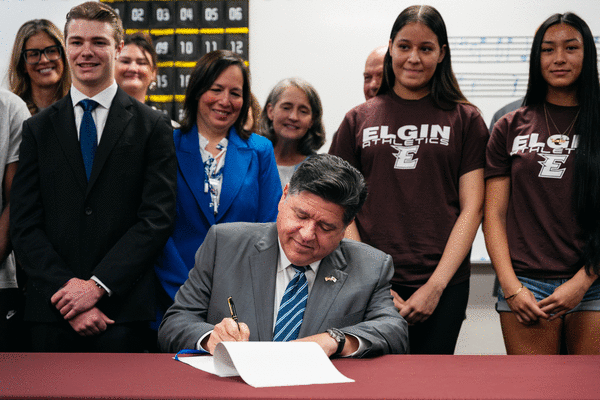
ELGIN, Ill. — Illinois public and charter school students will be barred from using cellphones during the school day starting in fall 2027, under a law Gov. JB Pritzker signed Tuesday.
The new law requires districts without an existing phone policy to adopt a “bell-to-bell” ban for elementary and middle school students. High school students may use phones during breaks at the discretion of individual districts.
“Illinois is taking a major step forward in creating classrooms, libraries and learning environments free from distractions by banning the use of cellphones during the school day,” Pritzker said at the bill signing at northwest suburban Elgin High School. “We want to make sure that every hour of school time can have the greatest possible positive impact.”
For elementary school and middle school students, the ban means that with limited exceptions “from the minute the kids get into the schools,” they won’t use their phones and will store them in pouches or another method chosen by the district, said Democratic state Sen. Cristina Castro of Elgin, a key sponsor.
High schools can adopt a full bell-to-bell ban, but the law gives districts flexibility to allow exceptions during breaks — “a point of contention” in negotiations, according to another bill sponsor, Democratic Rep. Michelle Mussman of Schaumburg.
“For many advocacy groups, they would indicate that the data is clear, and that high schools should be encouraged to maintain a full bell-to-bell ban,” she said.
Private schools are not required to implement a phone ban under the bill.
While some students and parents have raised concerns about the ban’s potential impact in emergencies, districts can permit phone use during emergencies, and the law includes exceptions for educational purposes and mandatory carve-outs for students with medical needs, individualized education programs or primary caregiving responsibilities for a family member.
In addition to potentially reverting the look and feel of cafeteria conversations to that of a pre-iPhone era, the bill signing also marks a key political win for Pritzker, who initially fell short on his push for the policy change last year.
Pritzker reintroduced his support for a cellphone ban in schools earlier this year during his State of the State address. His tweaked version of the bill expanded the ban from instructional time to a bell-to-bell policy. Many Illinois school districts already have their own phone bans in place. Those with existing policies that differ from the statewide ban can keep them until the 2030-31 school year.
The new law mandates phone storage guidelines but does not specify exactly what those must look like. Pritzker signed the bill while sitting near a hanging board of phone pockets and four Yondr pouches, a magnetic-locking phone storage system that the Tribune previously reported can run about $20 to $25 apiece.
Elgin-based School District U-46 spent more than $170,000 last year on 6,625 locking pouches and the accompanying magnetic bases, the Tribune previously reported. Those same pouches cost the Danville School District $70,000 in 2025 and Peoria Public Schools spent nearly $250,000 the year before.
Schools can also use lower-tech solutions like keeping phones in lockers, Mussman previously noted.
Following concerns about enforcement disproportionately affecting students of color and other underserved groups, the law prohibits fines, fees, the involvement of local police or school resource officers, and suspensions or expulsions as enforcement tools.
More than 30 states already have some kind of limit or ban on cellphones in schools.
The goals of Illinois’ ban are wide-ranging, from reducing bullying and wasted time to improving students’ grades, Mussman said.
“I also think this is a very opportune time for all of us to learn from our students,” Mussman said. “We should be reflective as adults on how cellphone usage impacts our daily lives — how it impacts our emotional state, our relationships with other people.”
_____
©2026 Chicago Tribune. Visit chicagotribune.com. Distributed by Tribune Content Agency, LLC.





Comments