Fujimori sworn in, giving Peru shot to break cycle of chaos
Published in News & Features
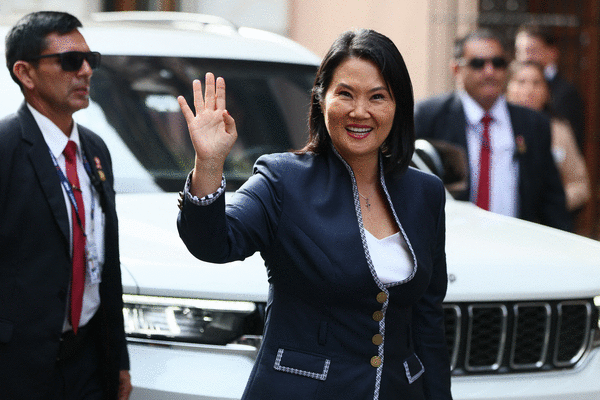
Keiko Fujimori has just taken on one of Latin America’s most perilous political jobs as the new president of Peru.
The 51-year-old conservative was sworn in just past midday Tuesday to become the ninth president in a decade in a nation where every leader elected since the 1990s has been impeached, imprisoned or targeted in criminal investigations.
Fujimori finally clinched the presidency after years of legal troubles and dogged criticism over her role in Peru’s political upheaval as the power behind her party’s influential lawmakers. And yet her inauguration may prove to be the copper-rich nation’s best shot at ending the country’s chronic presidential turnover.
During her first address to the nation, Fujimori pledged to ensure fiscal sustainability, eliminate unnecessary spending and cut the regulatory burden to boost investment. She also announced an increase in the monthly minimum wage to 1,300 soles ($382) from 1,130, support for small businesses to boost formalization, and plans to raise some social spending, including higher pensions for poor seniors.
“We will offer domestic and foreign investors stability, legal certainty and clear rules,” Fujimori said. “We will reduce unnecessary red tape and restore predictability to government decisions.”
She said she would allocate “extraordinary” resources to tackle crime and brace for El Niño, the weather phenomenon expected to pummel the country’s agriculture industry this year. She also said her administration will reform the prison system, strengthen the police and temporarily put the armed forces in charge of security operations during states of emergency.
Peru’s dollar bonds were among the best performing in emerging markets Tuesday. Notes due in 2050 rose 0.6 cents during Fujimori’s inauguration, trading above 95 cents on the dollar, according to indicative pricing data compiled by Bloomberg.
Fujimori, the eldest daughter of former president Alberto Fujimori, brings her divisive family dynasty back to power and thrusts Peru into Latin America’s rising conservative tide, as Donald Trump seeks to reassert U.S. dominance in the hemisphere.
Among the dignitaries who traveled to Lima for her inauguration are the right-wing presidents of Argentina, Bolivia, Chile, Ecuador and Panama, along with US Deputy Secretary of State Christopher Landau.
Fujimori has reason to feel more confident than her ill-fated predecessors. Her five-year term will begin as Peru restores a bicameral Congress for the first time in more than three decades, a change that’s designed to check the legislature’s impeachment frenzy. She will also enjoy stronger legislative backing than the previous leaders, with her party holding enough Senate seats to block any early attempt to oust her.
Her Popular Force party narrowly secured enough support on Sunday to lead the upper chamber alongside an allied far-right party. Still, an opposition coalition won control of the lower house, signaling the government will need to build alliances to push its agenda through a polarized, fragmented Congress. That makes the centrist Good Government party a key power broker, as its support would give either the governing bloc or the left-led opposition a working majority.
Good Government is likely to remain broadly constructive, said Luis Ramos, head of equity research at LarrainVial brokerage, in a note. “We view the outcome as an early validation of the coalition framework underpinning Fujimori’s governability and her ability to advance a growth-friendly legislative agenda,” he added.
Despite lingering political noise, the new administration points to a more predictable macroeconomic environment, likely boosting investment confidence and improving the growth outlook, Moody’s credit rating agency said in its latest report.
Divided Nation
Fujimori won June’s runoff by a razor-thin margin in her fourth presidential bid, campaigning on law-and-order promises to tighten border control and deport migrants who commit crimes.
Like her regional counterparts, she has pledged to cut red tape, speed up permits for delayed mining and infrastructure projects, and preserve fiscal discipline and central bank independence under veteran Governor Julio Velarde. Since her election, investors have reembraced Peruvian assets and all business confidence indicators have surged.
To lead her economic agenda, Fujimori picked consultant and former central bank director Elmer Cuba, who was sworn in as finance minister in a ceremony at Lima’s presidential palace later on Tuesday, alongside the rest of the cabinet led by Vice President Luis Galarreta. Fujimori appointed former deputy mines minister Guillermo Shinno as the new energy and mines minister, and named Carlos Espá, a former employee of the U.S. Embassy in Peru, as foreign minister.
Among the new administration’s early challenges will be El Niño, which risks causing catastrophic flooding in the farm sector — Peru’s second-largest source of foreign exchange after mining — and the threat of renewed social unrest in a country still riven over the Fujimori legacy.
Fujimori, who became Peru’s first lady at just 19, has spent most of her life in politics and has long been one of the country’s dominant political figures. She now returns to the presidential palace where she grew up, 26 years after her father — later convicted of corruption and human rights abuses — fled Peru and resigned by fax from Japan.
Her political career has been choppy. She successfully faced down a years-long money laundering investigation into the financing of her 2011 and 2016 campaigns, and spent several months in pretrial detention before a top court dismissed the case last year.
Fujimori has long invoked memories of her father’s administration, highlighting his economic and security credentials, which helped pull Peru back from the brink of economic collapse in the 1990s and crush Maoist guerrillas. But her legitimacy is certain to be challenged by victims of the rights abuses committed under her late father.
“Her promise to govern like her father raises the threat of a return to an authoritarian and corrupt regime that used the state apparatus to commit serious human rights abuses,” a group of civil society organizations said in a manifesto. “It is a memory the country cannot and must not forget.”
____
(With assistance from Nicolle Yapur.)
©2026 Bloomberg L.P. Visit bloomberg.com. Distributed by Tribune Content Agency, LLC.



Comments