Washington Supreme Court rules in WSU hazing death
Published in News & Features
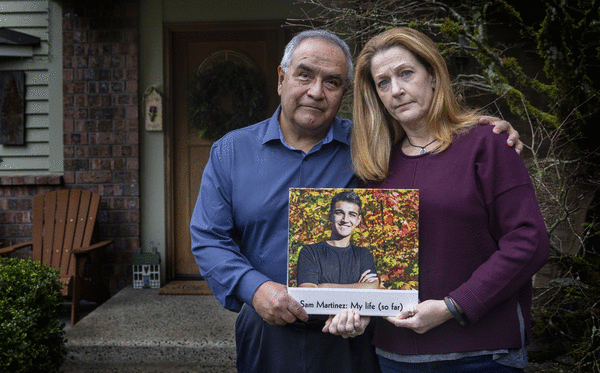
SEATTLE — Washington State University is obligated to protect students from harm foreseaably caused by fraternity hazing, the state Supreme Court ruled Thursday.
The decision arises from a case brought by the parents of Sam Martinez, a 19-year-old WSU freshman who died in 2019 after consuming most of a half-gallon bottle of rum with another student during a pledging event for fraternity Alpha Tau Omega. He became unconscious within hours, and no one called for medical help until the next morning. His family’s advocacy after his death led to several laws targeting hazing at the state and federal level.
The case, which has zigzagged through courts for six years, stems from a suit filed in 2020 by Martinez’s parents, who argue that WSU, along with the fraternity and others, bore responsibility for a pattern of hazing that led to their son’s death. They say the university knew of previous dangerous incidents associated with Alpha Tau Omega. Months before Martinez died, the fraternity’s president sought guidance from university administrators because its off-campus house was putting the organization at risk, according to the suit.
The current legal battle turns on the question of whether the case should be allowed to go to trial. A King County Superior Court judge initially dismissed the suit. But the appellate, and now the state’s highest court, have decided the case warrants a trial.
Thursday’s ruling instructed the trial court to reconsider the case under the new determination that WSU owed Martinez a “duty of care.” Now the case can be heard by a jury for the first time.
“Wow,” Jolayne Houtz, Martinez’s mother, said in response to the ruling. “For six years, we’ve waited for the chance to tell Sam’s story to the jury. … It’s a big win, no doubt.”
Justices said the “duty of care” stems from the “special relationship” the university has with fraternities and sororities, evidenced by the university’s promotion of Greek life and activities in student recruitment, its sponsorship and endorsement of Greek life events and residences both on- and off-campus, and the agreements the university and national Greek organizations have entered into, according to the ruling.
“It should surprise no one that a house run by young men and full of other young men, many away from home for the first time in their lives, is fertile ground for abusing alcohol and engaging in dangerous initiation rituals,” the ruling’s conclusion states. “It was certainly no surprise to WSU.”
The majority decision was authored by Justice Salvador A. Mungia and joined by Justices Debra L. Stephens, Steven C. González, G. Helen Whitener and Mary I. Yu. The dissent was written by Justice Barbara A. Madsen and joined by Justices Charles W. Johnson, Sheryl Gordon McCloud and Tracy A. Staab. Three justices did not participate in the case.
A spokesperson for WSU did not immediately return a request for comment. In court filings, the university argued it can’t control what students do off-campus, and can only discipline its affiliated student groups after the fact for violating contract terms. Greek life organizations operate independently of the college, the university argued.
The ruling rejects that argument, saying that a truly independent organization would only be subject to its own rules. Instead, fraternities and sororities agree to university oversight beyond what is stated in law, and can be subject to sanctions if they commit infractions.
According to the lawsuit, fraternity pledges were subjected to a series of hazing rituals in the weeks leading up to Martinez’s death, including forced drinking, physical intimidation and degrading tasks.
©2026 The Seattle Times. Visit seattletimes.com. Distributed by Tribune Content Agency, LLC.






Comments