Minnesota Supreme Court weighs return to paper voter rosters
Published in News & Features
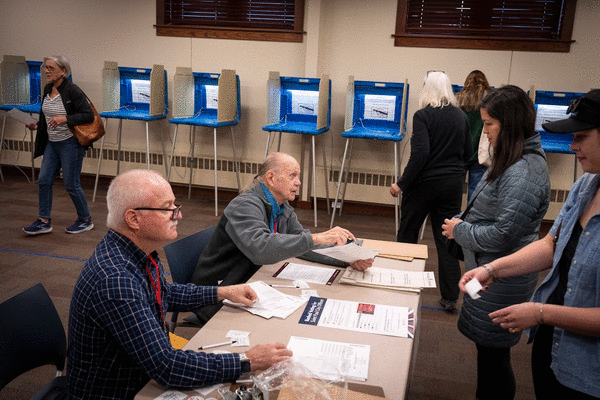
MINNEAPOLIS — A small city in Anoka County is asking the Minnesota Supreme Court for permission to use paper voter rolls, a change that critics argue could create long lines during this fall’s midterm election and set a precedent to allow other cities to follow suit.
The state’s high court is weighing a petition from Oak Grove, which wants to use paper rosters to check voters at its four polling locations rather than the electronic tablets it has been using in partnership with Anoka County since 2018.
According to Oak Grove’s petition, it terminated a contract with Anoka County for the tablets, but the county said it must still use the electronic voter rosters. Minnesota Secretary of State Steve Simon sided with the county.
Now, the Supreme Court will weigh whether cities can override county decisions. If the court sides with Oak Grove, it would set a precedent allowing other Minnesota cities to follow suit.
Those who want to see elections administered through paper voter rolls argue they are more secure and assuage concerns about election integrity. But critics argue they’re vulnerable to human error and will force voters to wait in longer lines to cast their ballots, potentially leading some of them to give up.
A hearing is not yet scheduled in the case, so it will not affect the Aug. 11 primary.
Election integrity and voting rights are already top-of-mind ahead of the midterms as President Donald Trump pushes federal lawmakers to pass restrictions on voter registration after repeatedly espousing lies about voter fraud. One of his most strident supporters in the claim that the 2020 election was stolen from him, MyPillow CEO Mike Lindell, is a leading candidate in the GOP primary for Minnesota governor.
The Upper Midwest Law Center, a conservative legal group, is representing Oak Grove without cost and argues state law leaves the decision up to the city.
“We don’t think that bureaucrats should be in a position, even elected secretaries of state, should be in a position to say we want to do it some other way if the law says they have to allow this decision to be made by the city,” said the organization’s president, Doug Seaton.
Seaton noted paper voter rolls had been used previously.
“If anything, the electronic version is, I guess, the innovation and our people in this city, Oak Grove, simply want to keep doing it the way they’ve done it,” Seaton said.
The city’s petition says: “The format of the voter roster for a given precinct should be determined by the same officials who are responsible for other aspects of election administration in that precinct.”
Simon’s office argued, in a brief, that counties get to make the decision when county, state or federal offices are on the ballot. The Secretary of State’s Office said the electronic voter rosters are secure and more efficient than using paper.
Anoka County makes the same argument in a separate brief and says Oak Grove has tried for years to “rewrite Minnesota election law” and undermine the county.
“Around the same time that Anoka County decided to begin using electronic rosters, the national political discourse began to include what can only be described as conspiracies about the administration of federal, state and local elections,” the brief says.
Groundwork Legal, a nonprofit legal organization, filed a brief in court on behalf of the League of Women Voters warning that the Supreme Court siding with Oak Grove would have substantial consequences.
The group’s brief argues a return to paper voter rolls could result in longer lines. With electronic rolls, officials can point voters who show up to the wrong polling location in the right direction, the brief argues.
“This is going to shape not just how a very critical election, the 2026 midterms, will play out, but how all elections moving forward will look in Minnesota,” said Irina Vaynerman, the organization’s co-founder and CEO.
Vaynerman called Oak Grove’s effort “part of a broader national pattern of challenges to safe and secure election administration.”
“If a city could invalidate what the county has decided ... it would have devastating consequences and lead to lack of uniformity within the county,“ she said. ”And so voters within the same county would be experiencing drastically different voting experiences."
©2026 The Minnesota Star Tribune. Visit startribune.com. Distributed by Tribune Content Agency, LLC






Comments