Behind the scenes of the Comey '86 47' case: How the feds built investigation in North Carolina
Published in News & Features
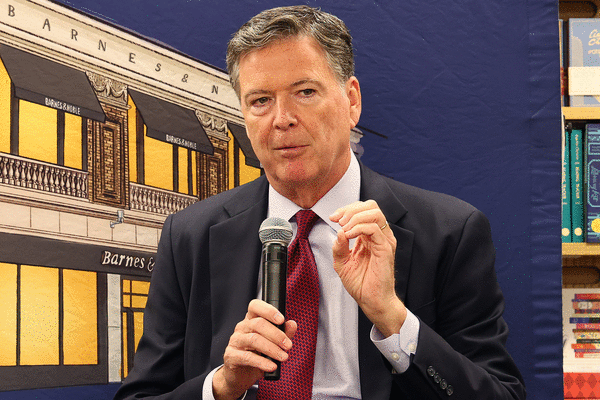
The text arrived shortly after James Comey Jr. posted a photograph of seashells he said he had found on North Carolina’s Crystal Coast.
“I have held my tongue for a long time,” the writer, an estranged acquaintance, wrote Comey’s wife, Patrice.
But the photo of the seashells arranged to read “86 47” had compelled the acquaintance to speak.
“‘86 47’ is a call for violence no matter how you spin it,” wrote the acquaintance, identified as Person One in court documents.
The “47” referred to Donald Trump, the nation’s 47th president, while “86” commonly means to remove or get rid of something. Person One saw the Instagram photo as a call to harm Trump.
Patrice Comey googled the phrase, warned her husband about the violent interpretation and asked him to remove the post, she later told federal officials. Comey removed the photograph.
But by that time, federal officials had already flagged the post, launching an investigation that has drawn North Carolina into a criminal case that critics say tests the boundaries between free speech and criminal conduct.
Comey’s recent motions in the case challenge the legality of the investigation and the two federal charges accusing him of threatening the president. He argues they are part of a yearslong political campaign to punish one of Trump’s prominent critics.
The court filings include search warrants, federal reports and emails among North Carolina prosecutors and agents that reveal, for the first time, how officials pursued the case after Comey posted the photo in May 2025. Their investigation included searching Comey’s Google searches and emails, gathering information from an Emerald Isle police chief and a former Gambino crime family member.
Comey had made political enemies before Trump was elected. President Barack Obama appointed him FBI director in 2013, and he later drew Hillary Clinton’s blame for contributing to her 2016 loss to Trump.
Trump fired Comey in 2017 amid the FBI’s investigation into Russian election interference and possible ties to Trump’s campaign. He has since called Comey a traitor and accused him of breaking the law.
Comey argues in court filings that Trump pressured acting Attorney General Todd Blanche, current FBI Director Kash Patel and U.S. Attorney Ellis Boyle to prosecute him. In a May interview, Boyle called the allegation that the prosecution was politically motivated “categorically false.”
“We approach every potential threat prosecution individually and regard it on its merits,” he said.
May 15, 2025: 1 to 4 p.m. ‘Cool shell formation’
The seashell post traces back to James and Patrice Comey walking along the soft white sand near Emerald Isle’s western end on May 15, 2025.
They spotted the shells arranged to read “86 47,” they told investigators, according to federal reports. Patrice Comey wondered whether the numbers formed an address. Then they realized it was a political message.
At his wife’s suggestion, Comey photographed the shells around 2 p.m. They walked back to the house where they were staying, and Comey shared the image on Instagram with his roughly 200,000 Instagram followers.
“Cool shell formation on my beach walk,” he captioned the post at 3:14 p.m.
5:52 p.m.: A warning arrives
A little more than two hours after Comey shared the photograph, Person One sent Patrice the text calling “86 47” a “call for violence.”
“I am thoroughly embarrassed to have ever defended the absolute coward that is your husband,” the text said, adding that the Comeys were “some of the least accepting, most hypocritical people I’ve had the displeasure of knowing.”
Patrice Comey responded just after 6 p.m.
“Now that you said what you said and I googled and saw the right-wing narrative about the numbers, Jim will take down the post,” Patrice Comey texted. “Thank you.”
Around 8 p.m., a neighbor approached the porch where Comey was sitting and gave him “the double bird.” Comey called Emerald Isle Police Chief Michael Panzarella and, when the chief did not answer, left a voicemail explaining what had happened.
Comey said he had accidentally caused “some sort of excitement on social media” and “didn’t realize that some people interpret it in a dark way.”
“I hope that’s the end of it, but I wanted to flag it for you,” he said.
It was just the beginning.
6 p.m. The investigation begins
By the time Comey called the police chief, Washington- and Wilmington-based Secret Service agents had flagged the post, according to federal reports and emails among officials.
By 9 p.m., agents were trying to find Comey. A Washington Field Office agent left him a voicemail, and Comey returned the call, explaining he didn’t know 86 had a violent meaning and that he had not intended to threaten the president, Secret Service reports on the interview state.
Comey declined to say where his family was staying or to meet with agents that night because they were in their pajamas and preparing for bed, reports state. Instead, Comey agreed to meet with agents in Virginia the next day. Federal agents were sent to Comey’s Virginia home that night, but received no answer when they knocked on the door, an agent wrote in a report.
After speaking with Comey on the phone, the Washington-based agent received a call from another Secret Service agent asking how quickly they could locate Comey’s phone through an emergency request. Typically investigators need a warrant, but they can act without one when they need to pursue a fleeing suspect, protect individuals from imminent harm, or prevent the destruction of evidence, the U.S. Supreme Court has found.
“I said we could do it quickly, but I argued against taking this option,” the unnamed agent wrote. “I suggested that pinging the cellphone is legally questionable.”
The person on the other end agreed, the agent wrote, “but said we might anyway.”
May 16, 2025: Comey phone found, agents trail him to Virginia
The next morning, on “Fox & Friends,” Trump accused Comey of calling for his assassination.
In Emerald Isle, Secret Service agents had located Comey’s phone and begun trailing the couple as they drove on Interstate 95 from North Carolina toward Virginia at the request of a high-ranking Justice Department official, according to Comey’s court filings. The Comeys lost the agents when they exited the I-95 to visit the gravesite of their son, Colin, who died days after his birth. But the electronic surveillance continued.
Meanwhile, Panzarella, the police chief, sent the Secret Service screenshots of text messages, a voicemail and an image of a residence.
Around noon, a Secret Service official told the agent who had interviewed Comey that Trump wanted the agent’s notes before a 6 p.m. news conference, according to a report of the agent’s phone activity.
At 5:50 p.m., six agents and prosecutors questioned Comey for 44 minutes at the Secret Service’s Washington Field Office. One of his attorneys joined by speaker.
Agents asked Comey what message he intended to send.
“That it was cool that people could express their political reservations about President Trump in expressive ways,” Comey said, according to a report summarizing the interview.
May 17, 2025: Secret Service agents widen the investigation, report to Trump
The next day, a Washington-based Secret Service agent called Patrice Comey, who gave an account consistent with her husband’s.
The agent also called the person who had texted Patrice Comey and followed up with an in-person interview a few days later.
In the first interview, Person One initially told the Secret Service that they had immediately perceived the post as violent, an agent wrote in a report.
In the second interview, however, the acquaintance said their first reaction had been benign because they associated “86” with removing an item from a restaurant menu, Comey contends in court filings summarizing the recorded interview.
Person One’s interpretation changed after they considered that impeaching Trump was not an option in the current political environment, Comey states in court filings.
Person One also said they had not spoken to Comey in two years, disagreed with his family’s politics and hoped he would be jailed for his actions as FBI director.
Changing leadership, building the North Carolina case
The investigation unfolded as leadership changed inside the federal Eastern District of North Carolina, or EDNC, which includes Wake and 43 other counties and stretches east to the Atlantic coast.
After Trump’s 2024 reelection, Michael F. Easley Jr., an appointee of President Joe Biden, resigned as U.S. attorney for the district in February 2025. Daniel P. Bubar led the office in an acting role when Assistant U.S. Attorney Gabriel Diaz was assigned to the Comey investigation in May 2025.
On May 21, 2025, Diaz told a Secret Service agent in an email that he had been “ordered to open this case in the EDNC.” Diaz proposed preserving Comey’s social media, locating the shells, identifying possible cameras and finding the person who had confronted Comey on Emerald Isle.
Boyle became interim U.S. attorney on Aug. 11. Eleven days later, the Secret Service served Meta with a warrant for data associated with Comey’s Instagram account.
Meanwhile, a Virginia grand jury indicted Comey on Sept. 25 on two charges that he lied to Congress about leaking information to the media. Diaz and fellow EDNC prosecutor Tyler Lemons joined that case, which a judge dismissed in November after finding that the interim U.S. attorney in Virginia had been unlawfully appointed.
Diaz left the U.S. attorney’s office in December 2025 and Lemons left in January, according to their LinkedIn profiles. Both declined to comment when The News & Observer reached out to them earlier this year.
Other NC federal prosecutors linked to case
While the Virginia charges were being challenged, the North Carolina investigation intensified.
On Oct. 30, the U.S. attorney’s office formally requested the FBI’s help investigating Comey’s Instagram post. Six days later, the bureau opened a “Sensitive Investigative Matter” into the post, federal reports show.
First Assistant U.S. Attorney Philip Aubart was the point of contact on the case, federal documents state. Aubart, who still appears to be with the office, joined an interview with Person One, sought sealed access to Comey’s digital accounts and directed agents to search historical court records for terms including “eight-six,” “assassinate” and “fix.”
Matthew Petracca became an assistant U.S. attorney two days before he successfully sought a North Carolina grand jury indictment of Comey on April 28, according to Comey’s court filings. Petracca withdrew from the case about a month later. Boyle told the N&O then that Petracca had transferred to the civil division.
Assistant U.S. Attorney Tim Severo took over the prosecution.
In response to media reports about career federal prosecutors being pressured to prosecute Trump’s perceived enemies, Boyle said he would never force a lawyer in his office to take an action the lawyer considered improper.
“Even if I tried, they wouldn’t,” Boyle told the N&O. “I haven’t, and I wouldn’t.”
After Comey’s April 28 indictment
After a North Carolina grand jury indicted Comey on two federal charges in April, North Carolina agents and prosecutors continued investigating whether Comey knew “86” could be interpreted as a reference to murder.
FBI Special Agent April Floyd, who is based in North Carolina, interviewed two retired agents who had spent decades investigating organized crime, including the Gambino family. In the 1990s, as a federal prosecutor in Manhattan, Comey was involved in prosecuting the Gambino family on racketeering, murder and drug-trafficking charges.
Neither of the retired agents recalled hearing “86” used to refer to murder, Comey said in court documents.
The investigation then led agents to Salvatore “Sammy the Bull” Gravano, the former Gambino underboss who had cooperated with prosecutors during the case.
During a 25-minute interview on May 13, Gravano said law enforcement officers would recognize “86” as a reference to murder, Comey said in court documents. Yet Gravano also said a gangster would never use it because organized-crime figures knew police understood it.
Gravano did not recall discussing “86” with Comey during the Gambino trial or preparations for it.
“It certainly wouldn’t be brought up by me,” he said, according to court documents.
Retired North Carolina Supreme Court Justice Robert Orr, a former Republican who is now unaffiliated, is following the Comey case because of his concerns that the power of government is potentially being abused in this case and others across the country.
In general, Orr said agents have a duty to investigate information that could support criminal charges. Orr, who hasn’t seen all the evidence in the Comey case, however, says prosecutors should only pursue cases in which they believe they can convince a jury of a defendant’s guilt beyond a reasonable doubt.
What’s next in the Comey case?
Federal prosecutors will get to respond to Comey’s motions before U.S. District Judge Louise Flanagan decides whether to dismiss the charges, hold a hearing or allow the case to proceed toward trial.
In motions, Comey argues the indictment doesn’t describe an actual threat to the president, that federal officials violated his constitutional rights of free speech and protection from unlawful searches, and that he is a victim of vindictive and selective prosecution.
Sarah Krissoff, a former federal prosecutor in New York, said the simplest path would be for the judge to first consider whether Comey’s Instagram post was an actual threat to the president.
That would allow Flanagan to decide whether the alleged conduct amounted to a crime without examining the government’s motives or investigative methods, said Krissoff, now a New York-based attorney at the firm Cozen O’Connor.
Comey’s selective- and vindictive-prosecution claims would likely require a deeper inquiry into why he is being prosecuted and whether he is being targeted because of his criticism of Trump. Judges generally prefer to resolve cases on narrower grounds that do not require such a fact-intensive examination, said Krissoff.
If the case survives the challenges, it could move forward to Comey’s Sept. 30 arraignment, a hearing in which he would plead guilty or not guilty, and possibly his Oct. 21 trial in New Bern.
_____
©2026 Raleigh News & Observer. Visit newsobserver.com. Distributed by Tribune Content Agency, LLC.



Comments