Florida law banning kids at drag shows is constitutional, appeals court says
Published in News & Features
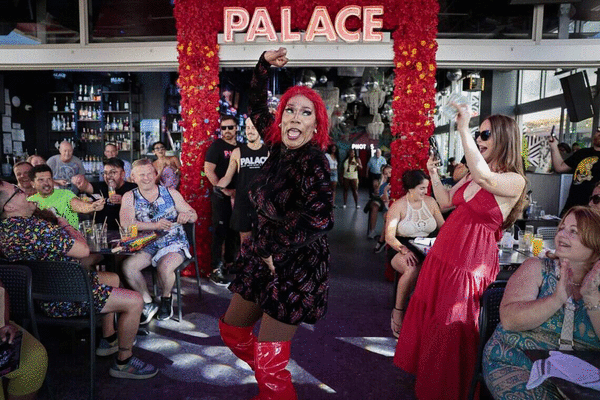
MIAMI — After nearly three years of legal battles, a federal appeals court has upheld a Florida child-protection law — sometimes referred to as the "drag ban" — which drew strong criticism from Democrats and LGBTQ advocates and sparked nationwide discussions about censorship.
In an 8-5 opinion Tuesday, the majority of the full panel of the 11th Circuit Court of Appeals vacated a decision by a lower court that had stopped the administration of Gov. Ron DeSantis from enforcing the law, and affirmed that the 2023 Protection of Children Act was not unconstitutional.
The majority did, however, agree with critics that the law passed by the Florida Legislature was in fact aimed at drag performances. But they opined that the law did not target “drag shows writ large,” just those they say were obscene for children.
“There is no doubt the Act is rational. We will not second-guess the Florida Legislature’s decision to regulate obscenity,” wrote U.S. Circuit Judge Andrew Brasher on behalf of the majority.
The ruling means Florida can fine, jail or strip licenses from businesses who expose children to “lewd” live performances, including drag.
Brasher, who was appointed to the bench by President Donald Trump, wrote that “preventing children from attending adult live performances obscene for them is rationally related to Florida’s interest in safeguarding the well-being of minors.”
But the judges who dissented agreed with advocates who have argued that the law was vague and encroached on their First Amendment rights.
Judge Robin Rosenbaum, a Barack Obama appointee, wrote in her dissent that the circuit court had embraced a “mess-around-and-find-out” posture toward the First Amendment.
Rosenbaum said the Florida law required many “unconstitutional things” and meant that all live performances — including concerts, even backyard shindigs — now had to be tailored based on the age of any child who happens to be there. She wrote that the law’s language provided little guidance on what it deems appropriate “for the age of the child present” and that her peers in the majority had glossed over Florida’s “disingenuous” preemptive efforts to close down venues that had drag shows and strip their liquor licenses.
She said the infringement extended to political speech, which she said included drag performances.
“Here’s the bottom line: the Act is a hammer. And under its vague language, law enforcement can treat lots of protected speech as nails. Its vague language purporting to address obscenity serves as an especially pernicious club to silence political speech,” she wrote.
A drag ban push
In 2023, as Gov. Ron DeSantis sought the Republican presidential nomination, he signed into law Republican-led legislation that barred children from attending adult live shows with “lewd” performances, which he described as including drag shows. Violators could lose their liquor licenses and face fines or jail time.
Following the passage, Hamburger Mary’s, an Orlando-based restaurant with drag shows, sued the state, arguing that the law was vague, overbroad and violated its right to free speech.
U.S. Middle District Judge Gregory Presnell agreed with the business and found the law unconstitutional, and the state appealed the decision and lost. But the state then requested that the full appeals court reconsider the decision, leading to Tuesday’s ruling.
Judge Nancy Abudu agreed with Rosenbaum in her dissent. She said the majority of the judges had disregarded Florida legislative history when making the law. She said though the law was being presented as protecting children, others viewed it as “manifestations of increasing hostility toward LGBTQIA+ expression and identity and as efforts to weaponize obscenity doctrine against protected speech.”
Abudu, who was appointed by Joe Biden, pointed to comments made by DeSantis and the law’s sponsor, then-state Rep. Randy Fine, as having “anti drag motivations.”
Leading up to the bill’s passage, DeSantis had targeted bars hosting drag performances. In July 2022, his administration filed a complaint against Miami’s R House, accusing the bar, which has drag performances, of exposing minors to sexually explicit shows.
In another event in 2023, the state sent undercover agents to observe a drag show in Orlando — the agents reported they saw nothing “lewd.”
With the circuit court’s decision, Florida is all-but solidified as one of five states that bar minors from adult performances, along with Arkansas, North Dakota, Texas and Tennessee.
Florida GOP leaders celebrated the decision.
Fine, now in Congress, said on social media that he was “proud to have led the fight to ban disgusting drag shows for kids!”
Florida Attorney General James Uthmeier, who is seeking election for the first time after being appointed by DeSantis, called Tuesday’s decision a “huge victory” for affirming the “ban on children attending sexualized drag shows.”
He was joined by DeSantis.
“This shouldn’t even be controversial, yet our law protecting kids required us to fend off lawsuits and win a case before a divided appellate court,” the governor said.
_____
©2026 Miami Herald. Visit miamiherald.com. Distributed by Tribune Content Agency, LLC.






Comments