Texas Gov. Greg Abbott holds the keys to Minnesota's prosecution of ICE agent in shooting
Published in News & Features
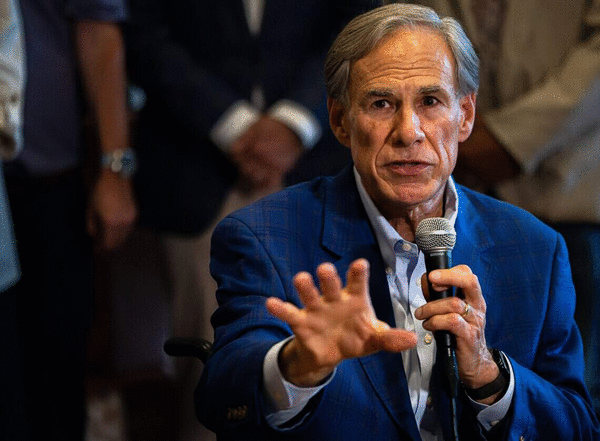
MINNEAPOLIS — It remains unclear when Immigrations and Customs Enforcement agent Christian Castro will appear in Minnesota to face criminal allegations that he shot Julio Cesar Sosa-Celis in north Minneapolis during the height of Operation Metro Surge earlier this year and later lied about it.
Castro, 52, has been held in the Cameron County jail in Hubbard, Texas, for more than two months since being arrested by the Texas Rangers on May 29. Last week, Hennepin County Attorney Mary Moriarty sent a letter to Texas Gov. Greg Abbott requesting that he “sign the extradition paperwork immediately” so that Castro can be sent to Minnesota to face charges.
In her letter, Moriarty praised the Texas Rangers who aided the arrest of Castro and the prosecutors in Cameron County who helped file the fugitive complaint against him.
“The final step is for you as the Governor to sign the extradition paperwork so that we can proceed with the case in Minnesota,” Moriarty wrote to Abbott.
Abbott’s office said in a statement to the Minnesota Star Tribune that it does not comment on pending extradition matters, but the ultimate decision on whether or not to release Castro to Minnesota law enforcement resides with the Texas governor.
Moriarty said Texas law provides a clear process for initiating interstate extradition under the Uniform Criminal Extradition Act and that Castro’s extradition process had been done “in full compliance” with Minnesota and Texas Law.
The Extradition Clause of the U.S. Constitution bars “any state from becoming a sanctuary for fugitives from justice” and enables states to “bring offenders to trials as swiftly as possible in the state where the alleged offense was committed.”
Texas law gives Abbott the authority to have the “Secretary of State, Attorney General or any prosecuting officer in the state” investigate the allegations against a defendant to determine if they should be surrendered to another state. There is no indication that Abbott has initiated an independent investigation of the charges against Castro or what has delayed Abbott from determining whether to release Castro to Minnesota authorities.
Abbott is currently seeking a fourth term as the Republican candidate for governor in Texas and is locked in a tight race with Gina Hinojosa, the Democratic nominee.
Moriarty’s pursuit of criminal charges against federal agents who allegedly carried out criminal acts during Operation Metro Surge, including Castro, has been labeled political by members of the Trump administration for months.
At the time of Castro’s arrest, a Department of Homeland Security spokesperson referred to it as a political stunt by “Minnesota sanctuary politicians.”
The spokesperson said the U.S. Attorney’s Office is currently investigating Castro and other agents over lying under oath about the shooting of Sosa-Celis and that “this is a federal issue, and it must be handled at the federal level.” The spokesperson added that the officers may face disciplinary action “including termination of employment, as well as potential criminal prosecution” once the investigation is complete.
Castro was charged by the Hennepin County Attorney’s Office on May 18 with four felony counts of second-degree assault with a dangerous weapon and one misdemeanor count of falsely reporting a crime for the chaotic situation that developed in north Minneapolis on Jan. 14 after Castro allegedly shot Sosa-Celis.
The shooting came one week after Renee Good was fatally shot by ICE agent Jonathan Ross.
Last month, when Moriarty announced that evidence sharing for use of force incidents during Operation Metro Surge had resumed between the federal government and state law enforcement, she noted that the evidence sharing went both ways and included the state sharing evidence related to the shooting of Sosa-Celis that the federal government did not have.
In the immediate aftermath of the shooting, then-DHS spokesperson Tricia McLaughlin said Sosa-Celis and his roommate, Alfredo Alejandro Aljorna “began to resist and violently assault the officer” and that Castro — whom they never identified — fired a defensive shot while on the ground because he feared for his life.
That initial narrative of the shooting, provided by Castro and another ICE agent and amplified by the Trump administration, unraveled when city security footage of the shooting was turned over to the BCA.
Aljorna, who was making a DoorDash food delivery, called home in the middle of a car chase after he fled a traffic stop by Castro and another ICE agent in an unmarked vehicle. The federal agents believed they were stopping an immigration enforcement target, but it ended up being a case of mistaken identity. One of the adults in the duplex called 911 to report what was happening. Moriarty said an emergency dispatcher turned a city security camera to face the duplex.
The video evidence showed Aljorna racing to the house after he crashed his car into a light pole. Castro pursued him. Sosa-Celis was waiting outside. There was a brief scramble in the yard as the three men were entangled. A snow shovel and broom were near the area, but there was no indication they were used as weapons.
“He was not hit at all,” Moriarty said when charging Castro. “His own boss, ICE director Todd Lyons, acknowledged that two ICE agents lied in the aftermath of this incident. Mr. Castro was one of them.”
Moriarty said a BCA investigation of the bullet trajectory along with the video showed that Castro was standing when he fired a single shot through the door, striking Sosa-Celis, before the bullet embedded in a wall inside the duplex.
The shooting prompted a standoff between protesters and federal agents while local police tried to ease tensions and get Sosa-Celis medical aid.
ICE agents ultimately broke down the door and detained several people inside. Sosa-Celis and Aljorna were charged federally. Gabriel Alejandro Hernandez-Ledezma, a third man who lived in a different part of the duplex and had nothing to do with the situation, was publicly identified as attacking the officer and sent to Texas. He was detained for weeks without charges. Two women in the home, who had no criminal record and were never accused of a crime, were shackled and sent to a Texas detention facility where they remained for two weeks, separated from their two small children.
Sosa-Celis and Aljorna were charged with assaulting a federal officer as Trump administration officials widely publicized their mug shots. Former Department of Homeland Security Secretary Kristi Noem accused them of “attempted murder.”
The charges were later dropped.
©2026 The Minnesota Star Tribune. Visit at startribune.com. Distributed by Tribune Content Agency, LLC.






Comments