Disability advocates march on Gov. JB Pritzker's office demanding more alternatives to nursing homes
Published in News & Features
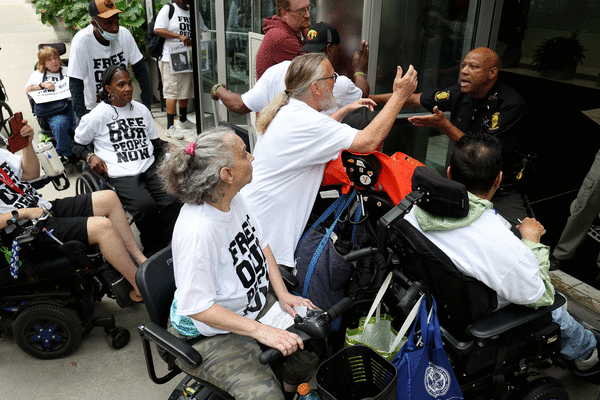
CHICAGO — Advocates urged the state to invest in community-based alternatives to nursing homes for people with disabilities before attempting to enter Gov. JB Pritzker’s Chicago office in the West Loop on Wednesday.
More than a dozen activists, mostly those in wheelchairs and on mobility scooters, raised a chant of “let us in” as they blocked the building’s doorway at 555 W. Monroe St. Illinois State Police pushed back, telling the crowd to leave.
The standoff lasted more than 20 minutes until a representative from Pritzker’s office arrived to speak with Jose Ocampo, one of the advocates, in the building’s lobby.
“I said, ‘I’ll give you two weeks, and if we’ve not heard from you, we’ll be back,’” Ocampo said when he returned to address the protesters.
Members of the Humanize Long Term Care campaign say they’ve been trying to secure a meeting with Pritzker since April, even hand-delivering letters to both his Chicago and Springfield offices. Representatives from Pritzker’s office didn’t respond to a request for comment Wednesday afternoon.
The campaign is demanding a statewide “Freedom Fund,” which would designate $40 million for housing assistance for individuals transitioning into community housing from long-term care facilities. The program would be funded by an increase in the state real estate transfer tax.
“All we want is to have the freedom to decide to live in the community,” Ocampo said.
Advocates say that, even with housing assistance, community-based care would cost roughly $10,000 to $30,000 less per person each year than institutional care. A 2023 study by the Center for Medicare and Medicaid Services found that home- or community-based services cost on average $37,000 less per person than institutional services.
Members of the campaign allege that the state is failing to meet its obligations under the Colbert and Williams consent decrees, two Illinois court settlements that required the state to transition eligible institutionalized adults into community-based settings.
They also said the state is failing to comply with the Olmstead v. L.C. decision, a 1999 Supreme Court ruling that held that public entities must provide community-based services when appropriate.
“Living in the community is the best option for people like myself,” said Ebony Payne, who recently moved from an institution to her own apartment in Woodlawn.
Payne, 43, said she was in and out of nursing homes for more than 20 years. She said the experience was isolating, “looking at four walls all day.” And, because residents often live in close quarters, Payne said the institutions could be like “petri dishes” with illnesses like COVID-19 and the flu spreading rapidly.
Last year, Illinois’ nursing homes were ranked among the worst in the nation, based on federal reports of health inspections, staffing and other quality measures. Residents reported unhygienic conditions, with rodents, mold and delayed care. Early this year, two deaths at Chicago-area nursing homes prompted lawsuits against the facilities.
Since moving, Payne said she’s needed fewer doctor’s visits and is “thriving.”
“It’s amazing,” she said. “I love it.”
“Independence is not just for people who don’t have disabilities,” she added.
_____
©2026 Chicago Tribune. Visit chicagotribune.com. Distributed by Tribune Content Agency, LLC.






Comments