Florida is executing prisoners at a rapid clip. How did we get here?
Published in News & Features




The window shade rose promptly at 6 p.m. The gallery was silent, apart from the humming of an air conditioning unit. A man lay flat on a gurney, covered in a white sheet and bound by six leather straps.
Twenty-seven people watched as he took his last breath.
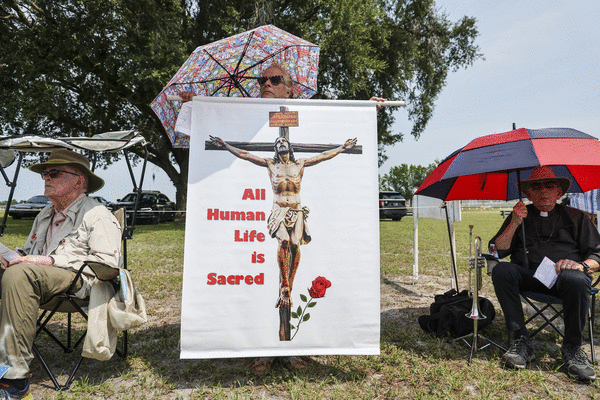
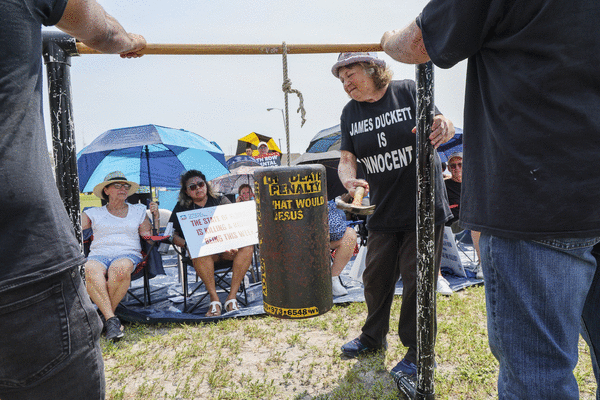
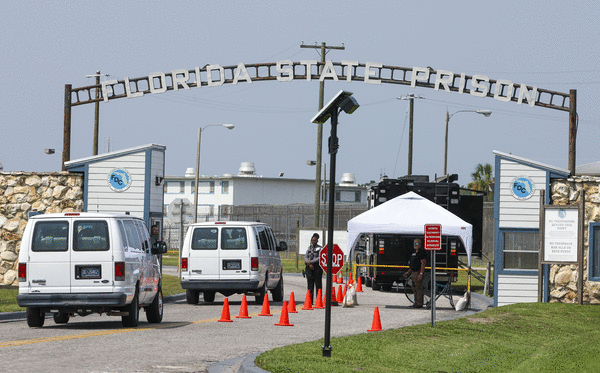
On July 28, Dominick Occhicone became the 12th inmate to die by lethal injection in Florida this year, and the oldest person put to death since the state resumed capital punishment in 1979. The 80-year-old died five hours after James Duckett was put to death in the same room.
The back-to-back executions were the first in Florida since 1964 — another record amid an unprecedented rise in executions. Gov. Ron DeSantis has ordered more executions than any of his predecessors, totaling 33 since the start of 2025 and 42 since he took office in 2019.
There are 239 inmates on Florida’s death row.
The governor has not publicly explained how he chooses which inmate is next to die, or whether he’s concerned about the strain the accelerated pace of killing has on the prison staff tasked with carrying it out.
His office declined to comment. Instead, a spokesperson referred to comments DeSantis made at the Florida Sheriffs Association summer conference, held in Miami on the night of the executions.
“I just presided today over two executions in the same day, first time that’s happened in a long time,” the governor said. “I don’t take joy in doing that. It’s a weighty thing.”
The pandemic delayed the scheduling of executions, he said, and victims’ families have been waiting a long time.
“We do owe it to them to do it. The process is way too long,” DeSantis said. “You shouldn’t be going for 20 years. You should be able to try and maybe appeal, but then at some point we’ve got to get cracking here. ... That makes a big difference for a lot of people out there who suffered really serious tragedies.”
‘It’s something that never leaves your mind’
Ron McAndrew was once a staunch supporter of capital punishment. He has since joined a chorus of advocates who seek to abolish the death penalty.
The 87-year-old Air Force veteran said he grew up believing “an eye for an eye, a tooth for a tooth.”
In 1996, the secretary of the prison system asked McAndrew to serve as the warden of Florida State Prison, home to the execution chamber. McAndrew remembers telling the agency leader, Harry Singletary, that he had no problem overseeing executions.
“That’s how I was raised,” McAndrew said. “Far removed from that dirty little room where they kill people at Florida State Prison, it’s easy to feel that way.”
The state had reinstated capital punishment 20 years before McAndrew took over as warden.
The U.S. Supreme Court in 1972 issued a nationwide ban on executions, finding the inconsistent application of the death penalty across states constituted “cruel and unusual punishment” under the Eighth and 14th amendments.
Florida was the first state to write new guidelines that same year, adding a separate penalty phase after a trial to respond to the high court’s claim of arbitrary application. The Supreme Court upheld the new statute in 1976.
The first execution in the state’s modern era of capital punishment was John Spenkelink in 1979. Thirty-five more electric chair executions occurred in the nearly two decades before McAndrew became warden.
During executions, the warden’s job is to stand next to the inmate and watch. They make the final call to the governor to make sure the state hasn’t granted last-second clemency to an inmate and announce updates to the witnesses in the gallery.
McAndrew oversaw his first electrocution in October 1996. When he left work that day, he said, he wasn’t the same person as when he’d walked into the prison.
“There was definitely something in my mind, and it kept spinning around and refusing to go away,” he said.
The third and last execution McAndrew oversaw was Pedro Medina on March 25, 1997. After the first jolt of electricity, flames engulfed the man’s head, according to Tampa Bay Times reporting. It was the second time in Florida that a man’s head had caught fire in the electric chair.
A state report found that copper wiring inside the leather skullcap ignited. The wiring, which held sponges in place to increase electrical conductivity, had never been cleaned.
After Medina’s botched electrocution, McAndrew said Gov. Lawton Chiles sent him to the execution chamber in Huntsville, Texas, to learn about the lethal injection process and purchase equipment. It was after that trip that he said he called Singletary and asked to get “the hell out of” the state prison.
Now, McAndrew has been watching the escalation in executions from a retirement home in Rainbow Springs.
“Anytime you sign a death warrant, it activates a number of people that are going to be in charge of killing another person that is already in captivity. It’s not war, it’s not in defense of somebody else, it’s someone who is already captured and locked up in a little cage,” he said. “It’s hard to swallow. It’s something that never leaves your mind.”
‘More like a rubber stamp now than it used to be’
Until 2016, juries in Florida could recommend the death penalty by a simple majority vote. That’s when the Florida Supreme Court ruled that nonunanimous verdicts violated the Sixth Amendment. All 12 votes were required to send a defendant to death row.
Three years later, the state’s highest court dramatically reversed its opinion, finding that Florida could rejoin the few states that don’t require a unanimous jury to impose the penalty.
In 2023, DeSantis signed a bill permitting people to be sent to death row on an 8-4 vote. When Occhicone was sentenced to death in 1987, his jury vote was 7-5.
Today, Florida is one of two states that allows a nonunanimous jury verdict to impose the death penalty. Alabama’s threshold is 10-2.
But a death sentence is just one step in a lengthy legal process critiqued by supporters and opponents of capital punishment.
After Duckett’s execution, family members of 11-year-old Teresa McAbee spoke at a news conference in a grass pasture across from the prison.
“At least we did get a little bit of closure — not much,” said Shirley Lancaster, McAbee’s aunt. “Forty years later, that’s not nothing. We’ve lived all that time without that baby.”
After a defendant is sentenced to die, cases undergo a mandatory review by the Florida Supreme Court. Then, attorneys for the condemned can file a motion for post-conviction relief to argue about matters such as ineffective counsel or newly discovered evidence. Once all state remedies are exhausted, a defendant can appeal to higher courts and seek a federal legal order for possible constitutional violations.
The U.S. Supreme Court is the last legal resort for death row inmates. Duckett’s execution was delayed an hour while he awaited rulings on outstanding appeals. Once the Supreme Court denies appeals, the only power to halt the execution comes from the governor. Bob Graham was the last to grant clemency to a death row inmate in 1983.
Some capital defense lawyers feel the changing makeup of the Florida Supreme Court has aided the accelerated pace of executions.
In 2000, all seven justices were Democratic appointees. DeSantis’ three appointments shifted a 4-3 liberal majority to a 6-1 conservative majority.
Tania Alavi, who has done capital trial work since 2008, said she’s noticed that the conservative-leaning court has “continuously denied relief” in death row cases.
“It’s done more like a rubber stamp now than it used to be,” she said.
Roseanne Eckert is a former lawyer for the Capital Collateral Regional Counsel, part of a state agency that appoints attorneys to defend death row inmates in their final pleas. She worries the number of death appeals to the Florida Supreme Court could be taking attention from other important matters.
“They’re pressuring them from all ends in terms of doing these mass executions,” she said.
When Eckert worked at the counsel, Jeb Bush was governor. Bush signed 21 warrants during his eight years in office.
“He was much more careful about who he decided to sign on,” she said. “He recognized the solemn nature of that responsibility of the governor.”
As discourse around the death penalty grows, some states have turned away from capital punishment.
In June, Ohio Republican Gov. Mike DeWine announced he no longer believes the death penalty is a deterrent to murder and asked the state Legislature to abolish the punishment.
“The moral justification I had for voting for the death penalty simply no longer exists,” he said in a statement at the time. “Our money and energies are much better spent focusing on keeping these repeat violent offenders out of society, than focusing on the death penalty.”
Gerod Hooper, chief assistant of the Capital Collateral Regional Counsel, sat in a gray tweed jacket next to a row of state officials. He was among the 27 witnesses at Occhicone’s execution. He described it as a “solemn occasion.”
The windowless chamber has white walls and a red digital clock that hangs above the gurney.
Under state law, two civilians are selected by the warden to serve as executioners, according to the Florida Department of Corrections. The one chosen as the “primary executioner” is somewhere behind the wall and is responsible for administering the flow of lethal chemicals. The second one is also present and can assume the primary role if needed.
The selection process is highly secretive, and the identities of those in the chamber are protected. The warden, two state officials and sometimes a spiritual adviser are the only people in the small room with the inmate.
The first syringe contains etomidate, a drug used to render the inmate unconscious. Next comes 2,000 milligrams of rocuronium bromide, which paralyzes the inmate and stops their breathing.
Finally, potassium acetate is administered to stop the heart.
Occhicone’s eyes darted back and forth for about a minute before his body went still.
The warden then shook him and shouted his name twice. There was no movement.
A doctor checked Occhicone’s eyes with a penlight and his heart with a stethoscope. The doctor gave a nod.
The warden made another call to the governor. Then he faced the gallery and announced that the sentence was carried out at 6:13 p.m.
The window shade rolled back down.
©2026 Tampa Bay Times. Visit at tampabay.com. Distributed by Tribune Content Agency, LLC.






Comments