Cuba's reforms are not capitalism, Díaz-Canel tells communist gathering in Havana
Published in News & Features
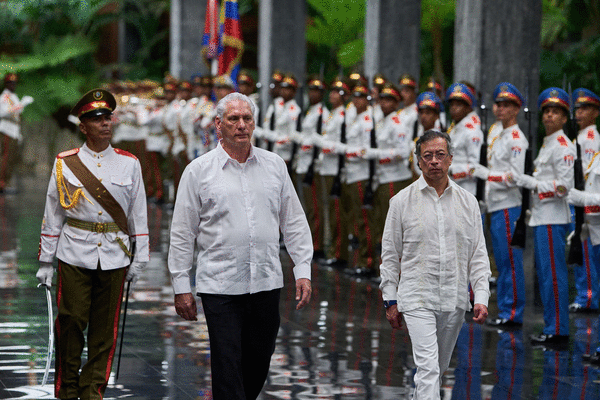
Economic reforms recently announced in Cuba do not entail a return to capitalism and will be closely controlled by the Communist Party, Cuba's leader told a gathering in Havana of representatives of communist organizations around the world in a speech in which he trashed the U.S. government as “fascist.”
Speaking Saturday at Havana’s Convention Palace to close the 24th International Meeting of Communist and Workers’ Parties — a two-day gathering of more than a hundred delegates from 48 parties worldwide – Miguel Díaz-Canel said an economic reform package his government announced earlier this year was not intended to “install capitalism.”
The changes, he said, aim to “energize the economy, not to install capitalism; there will not be privatization at any cost, the fundamental means of production remain in the hands of the people, and above all, national sovereignty and independence are preserved.”
He stressed Cuba’s Communist Party is in the driver seat when it comes to reforms.
“For such a complex process, the Communist Party of Cuba — as the superior leading force of the state and society — stands as the entity primarily responsible for its direction, coordination, and oversight,” he said.
Díaz-Canel devoted the rest of his speech to blasting U.S. sanctions and pressure by the Trump administration, and to portraying Cuba as the victim of a “millimetrically calculated genocide.”
The communkit gathering took place at a time residents in Havana and other areas of the island have a scarce few hours of electricity, if any, every day amid blackouts, as well as food and fuel shortages that have devastated the country’s economy. Two other large international-left gatherings, one with activists tied to the Bolivarian Alliance for the Peoples of Our America and another to commemorate the hundredth anniversary of Fidel Castro’s birth on Aug. 13, have been scheduled to take place days apart.
The gathering of communist activists also took place days after the U.S. State Department published a report accusing Cuba of building a sophisticated espionage and influence network focused on penetrating and undermining U.S. interests, and labeling Havana as “the ideological capital of the modern radical left.”
Díaz-Canel appeared to respond to the report by asserting that “Cuba does not need to indoctrinate anyone” and that “Cuba has defended itself, as is its legitimate right, just as any country in the world would do,” against U.S. aggression and “criminal” policies.
“The resurgence of McCarthyism in its worst form—and with a transnational reach that places Cuba at the center of an irrational crusade—seeks not only to criminalize solidarity with Cuba or fabricate a new pretext for aggression, but also to silence voices that dissent from the world order they aim to impose,” he added.
Cuba’s handpicked president also responded to Secretary of State Marco Rubio’s comment to Axios that Havana has no way out of U.S. sanctions, calling it an open admission that Washington is trying to break the island through hunger and blackouts.
“It is an unreserved acknowledgment that a difficult situation exists in Cuba as a consequence of an unprecedented economic war,” he said. “This statement constitutes the open threat of the extermination of an entire people if it does not submit to the designs of the empire.”
Rubio told Axios on Friday that every time Havana devises a new mechanism to slip the sanctions, Washington closes it, and that Cuba cannot wait the administration out.
When the U.S. military captured Venezuelan strongman Nicolás Maduro in January, it cut Cuba’s main source of subsidized oil. Since then, the Trump administration has targeted Cuban government and military enterprises and foreign companies doing business with Cuba with sanctions, to press Cuban leaders to enact economic and political reforms.
The pressure has dramatically worsened what was already a dire humanitarian crisis, mainly resulting from years of economic mismanagement, failed policies, and the military conglomerate GAESA redirecting the country’s foreign revenue to failed hotel investments.
But Díaz-Canel cited figures on pending surgeries, cancer patients and infant deaths that he attributed solely to the U.S. pressure campaign.
“Those who sadistically devise an energy blockade against an entire nation can be described as nothing less than criminals and fascists,” he said.
He ended his speech invoking Fidel Castro's ideological legacy and calling on communist organizations to do more than issue statements and mobilize “parliaments, unions and social movements” to defend Cuba.
“In a world that seeks to convince us there are no alternatives, our shared task is to demonstrate through action that there are,” he said, “that socialism remains the only realistic and humane way out of capitalist barbarism, as scientific Marxism taught.”
_____
©2026 Miami Herald. Visit miamiherald.com. Distributed by Tribune Content Agency, LLC.




Comments