CEOs pushed White House to delay ultra-processed food policy
Published in News & Features
Food company executives intervened in recent weeks to persuade the Trump administration not to release a proposed definition of ultra-processed food, according to people familiar with the discussions.
Chief executives and trade group representatives sent letters and called the White House in a bid to delay the release of a white paper marking the first federal effort to define the controversial food category. The industry argued that laying out the definition would open it up to litigation, increase costs and hurt business, according to the people, who weren’t authorized to speak publicly.
Leaders have been airing their concerns for several weeks, arguing the definition could make processed food more expensive and impact federal nutrition programs, an industry official said.
The administration has been working on a definition of ultra-processed food that is expected to focus on whether it includes certain “cosmetic” ingredients aimed at altering a food’s appearance, according to others familiar with the discussions, who asked to remain anonymous because the conversations aren’t public. The definition is also expected to take into account whether the products include ingredients that aren’t commonly used in home kitchens, they said.
The effort to define ultra-processed food remains on track, an administration official told Bloomberg. The only special interest guiding the effort is the best interest of the American people, they said.
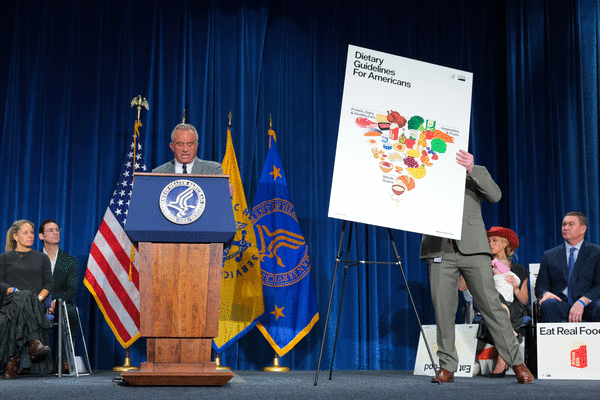
The Health and Human Services Department held an event Monday billed as a celebration of two major food policy announcements, but then unveiled only one proposal targeting new food ingredients.
At the event, supporters on a raised stage held signs, including one that touted “defining ultra-processed foods” as among the administration’s policy wins. But no details of the proposed definition were released.
“For the first time, we will have a consistent federal framework to study these foods, to understand their effects on human health and to build stronger and lasting nutrition policy,” Health Secretary Robert F. Kennedy Jr. said at the event.
Acting Food and Drug Administration Commissioner Kyle Diamantas told reporters on a call Monday that the administration has “submitted for final review a proposed definition of ultra-processed foods aimed at creating a stronger foundation for future federal nutrition research.” Additional information will be shared “at a future time,” he said.
The white paper with the definition has not yet been cleared by the White House budget office, leaving many in the food industry uncertain as to when the administration is planning to release it.
Top health officials have said Americans are getting sick from ultra-processed food, a broad category of largely packaged products that account for much of what’s sold in U.S. supermarkets. But the federal government has not yet mapped out what it considers ultra-processed food.
The definition will take the form of a white paper, rather than a formal regulation, according to a regulatory notice published when HHS submitted it for review to the White House budget office.
The food industry criticized the decision to release a definition through a white paper, which is typically less rigorous than the formal regulatory process.
“Any so-called definition that captures 80% of the nation’s food supply while picking winners and losers is fundamentally flawed, not based on sound science and politically motivated,” Rhonda Bentz, executive vice president of public affairs at the Consumer Brands Association, the main trade association for the food industry, said in a statement Monday. “We are confident that this definition won’t move forward once the President is made aware of it and the disastrous consequences it will have on his affordability agenda.”
Vani Hari, an activist known as the Food Babe, said industry concerns wouldn’t be able to derail the definition from being released.
“The food industry is running scared, but the ultra-processed food definition is going to come out,” Hari, an ally of Kennedy’s food policy, told reporters at the Monday event.
The definition is expected to include an exemption for foods that meet an already-established “healthy” criteria by the Food and Drug Administration. That carve-out may spare foods with nutritional benefits, such as some yogurts and whole-grain breads, from being classified as ultra-processed.
White House and HHS spokespeople said discussions about any changes should be considered speculation unless they are officially announced.
“The policy remains under interagency review and has not been finalized,” the HHS spokesperson said.
Americans currently get more than half of their daily calories from ultra-processed foods, which account for about 62% of childhood diets, according to a nutrition survey from the U.S. Centers for Disease Control and Prevention.
The food industry has been closely watching the administration’s efforts to craft the definition that could affect a broad swath of packaged foods. More than 92% of U.S. retail sales from Hershey Co. come from ultra-processed foods, according to an analysis from BNP Paribas. It found that at least 77% of retail sales for Kraft Heinz Co., Mondelez, Conagra, General Mills and Campbell’s Co. come from ultra-processed products.
(With assistance from Rachel Cohrs Zhang.)
©2026 Bloomberg L.P. Visit bloomberg.com. Distributed by Tribune Content Agency, LLC.






Comments