California sets aside $250 million for public hospitals. Bay Area officials say it falls far short
Published in News & Features
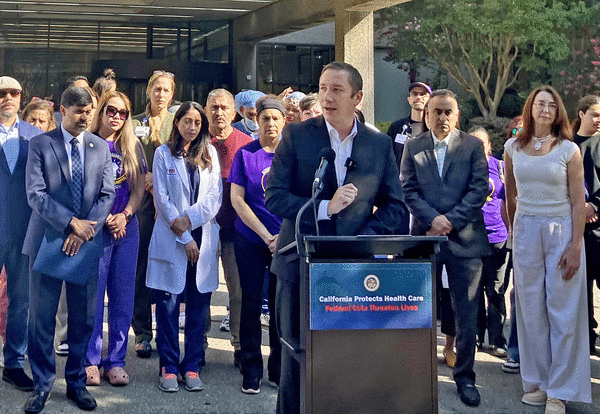
Faced with federal cuts that slashed billions annually from public healthcare, state legislators touted $250 million Monday in funding to help salvage California’s public hospital system. But Santa Clara County expects only $20 million to $30 million from this funding against a projected $1 billion loss, while other counties continue to grapple with the fallout from the cuts.
Officials called the funding a first step but warned that billions more would be needed to prevent service reductions, longer waits and diminished access to care.
“We still remain on a collision course with millions of Californians losing their healthcare next year … We will continue to fight. This is just one investment of the many that are needed,” said California State Assemblymember Patrick Ahrens, who serves on the Health Committee and was a key proponent of the state investments, at a press conference celebrating the funding. “This is not a fight that we asked for, but it’s a fight we will win.”
After the Trump Administration’s landmark 2025 spending bill made $1 trillion in cuts over 10 years to Medicaid — the public program that provides health insurance to low-income and disabled individuals and is known as Medi-Cal in California — public safety-net hospitals were especially hard hit across the state and the Bay Area. Without further aid, the cuts could result in millions of low-income Californians losing healthcare.
The public hospitals — mandated by state law to provide healthcare regardless of whether someone has insurance — comprise only 8% of the hospitals in the state but serve over 1 in 3 of those on Medi-Cal or without insurance.
At Monday’s news conference, Santa Clara County Supervisor Susan Ellenberg said the “manufactured healthcare crisis” stemming from the federal cuts could open a Pandora’s Box of downstream effects: longer wait times for emergency rooms and ambulances, less access to specialty care and care for chronic conditions, and “in too many cases, untreated illness or trauma that leads to otherwise preventable death.”
“These cuts have opened a great crack in our healthcare system — a crack that threatens every community across the state,” said Ellenberg.
To help stave off the worst of the cuts, California legislators fought for $250 million to help support public hospitals. The state budget also included $300 million in healthcare subsidies and $200 million in loans to protect distressed hospitals.
Despite the investments, local leaders across the board said it was not nearly enough. The $250 million would be distributed across county hospital systems around the state, so local counties would get only a fraction of that.
Santa Clara County Executive James Williams estimated that the amount of money the county will receive from the state is just a few percent of the roughly $1 billion in lost funding to the county healthcare system. The county already passed a temporary sales tax measure to help fill the gap and has cut hundreds of jobs in its most recent budget to help address the deficit. Even so, county officials expect hundreds of millions more in budget shortfalls in coming years.
In Alameda County, the Alameda Health System receives over 70% of its funding from federal and state healthcare reimbursements. While the county managed to avoid layoffs in its most recent budget, it expects further cuts to the healthcare system in future years and will likely consider layoffs in the next fiscal year. The county health system serves two-thirds of the county’s low-income population.
Many of the most vulnerable patients in California are directly affected by the cuts. Dr. Joseph David Cooper treats patients with infectious diseases and HIV at Santa Clara Valley Healthcare. “I care for some of the most marginalized and stigmatized patients in our community and society,” said Cooper. Often those patients express concerns about keeping access to healthcare and life-saving medicine like antiretroviral therapy for HIV in the face of the cuts. With more funding, however, many of those patients can “rest easier” and feel “a bit less vulnerable,” he said.
Williams estimates that filling the funding gap statewide would require billions of dollars from the state. Even so, California has faced its own challenges in balancing its $350 billion budget, with legislators pushing back against an initial proposal by the governor that did not include the investments in healthcare.
Assemblymember Ahrens, however, sees a path forward to securing more funding. The state is netting billions more than expected in revenues from business, largely from the AI and technology boom. That windfall, in addition to finding savings in the budget and reprioritizing funding towards healthcare next year, could allow the state to find the funding needed to protect healthcare for its most vulnerable.
Ahrens notes that local and state funding “are all things that just stop the bleeding,” and that ultimately, winning the U.S. Senate or the House in upcoming midterm elections could give Democrats the political leverage to negotiate for more federal funding. Republicans have defended the healthcare cuts, arguing that they addressed waste, fraud and abuse in the system and could help pay for the administration’s other legislative priorities.
County Executive Williams puts the need for that money in stark terms.
“Our investment is a matter of life and death,” said Williams. “It’s a necessity. People would not be discussing how feasible it is to rebuild a bridge that collapsed after an earthquake. We are talking about something of even greater magnitude … The state simply cannot allow these critical hospital systems to not continue to operate.”
©2026 MediaNews Group, Inc. Visit at mercurynews.com. Distributed by Tribune Content Agency, LLC.






Comments