Colombia to declare economic emergency as quake toll tops 180
Published in News & Features
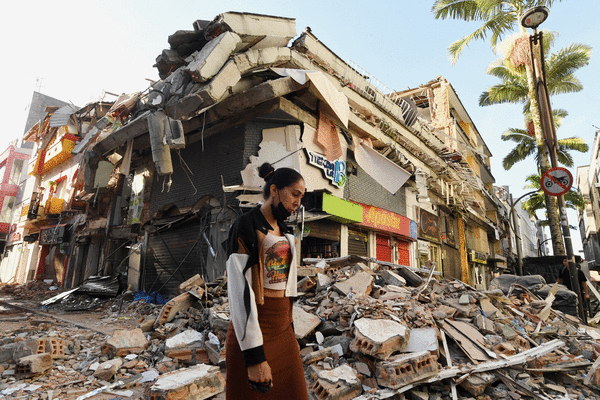
BOGOTA, Colombia — Colombia’s government plans to declare an economic emergency to bolster its response to a massive earthquake, as the country’s new president faces a tough and early test of his abilities to handle a crisis.
An emergency order would give President Abelardo de la Espriella, who began his four-year term on Friday, temporary authority to issue economic and tax decrees without the need for congressional approval.
That will significantly expand his ability to respond to the 7.4-magnitude quake that hit Monday, leaving more than 180 dead in Colombia’s Pacific region and the central Andes.
The official declaration, which needs approval of the full Cabinet, could come as soon as Tuesday, Finance Minister Miguel Gómez said during an appearance in Congress. The Colombian peso closed stronger for the fifth straight day.
The quake is likely to amplify the nation’s fiscal strains, complicating De la Espriella’s efforts to deliver on promises to curb rising budget deficits with an ambitious austerity drive.
Gómez nonetheless pledged not to raise taxes, telling lawmakers in Bogota he is beginning his mandate as finance chief “during the worst economic crisis in Colombian history.”
De la Espriella, who is visiting the areas struck by the tremor, has yet to deliver on his promise of quake updates every two to three hours. That’s left organizations like Asocapitales, an association of capital cities, and local authorities to fill in the gaps of information on those wounded or dead.
Colombians have turned to social media to find missing people. Colombia Te Busca, a website that was previously used during devastating earthquakes that struck neighboring Venezuela in June, currently lists nearly 3,900 people as missing.
De la Espriella traveled first to Choco province, near the epicenter of the quake, on Monday, where he announced that his government will provide temporary rental subsidies to families whose homes were damaged. Immediate economic aid has already been delivered to support more than 1,400 families, he said.
“My commitment is with each and every one of the affected families,” the president said Tuesday in a post on X before heading to the main coffee growing region, which was also hit hard. “We remain on the ground, working for our people.”
The tragedy presents a challenge to the president. The earthquake raises the prospect of wider economic damage, with coffee exports now paused thanks to disrupted operations at the nation’s main coffee export port and roadblocks along key highways, according to the head of coffee industry group.
Arabica coffee futures in New York whipsawed from multiweek highs to slight losses as traders weighed the potential supply and logistics impacts of earthquake that struck the world’s second-largest producer of the premium beans.
“The quake likely gives De la Espriella an early opportunity to strengthen his political position,” analysts at Aurora Macro Strategies wrote in a report Monday. But, they added, “the fiscal costs of disaster relief could complicate his promised adjustment over the longer term.”
The conservative leader had pledged to slash public spending in an effort to curb Colombia’s growing budget deficits, while also decentralizing power by governing outside the capital of Bogota. Now he must contend with the challenge of costly relief efforts and rebuilding. Thousands of homes and buildings have been damaged in multiple cities, airport operations were disrupted and highways have been shut down as a result of the quake.
“Recovering from earthquakes is difficult, and De la Espriella has no experience in governance,” James Bosworth, author of the Latin America Risk Report, wrote on Tuesday. “He is fortunate that Colombia has a professional civil service capable of assisting, but the public will blame any errors on the person at the top.”
De la Espriella, however, continues to express confidence, saying Monday that his government has the necessary resources and funding to respond to the tragedy. “Centralism abandoned this region to its fate for many years,” he said in Choco, vowing to address “an enormous historical debt” owed to the region. “Anyone might think that debt is impossible to repay, but I am used to being told that things cannot be done. I make the impossible possible.”
Cali’s international airport resumed operations late Monday, Colombia’s aviation authority said on social media. Facilities in Quibdó and Armenia are operating normally, while runways in Pereira, Buenaventura, Cartago and Manizales are available for humanitarian and government flights but remain restricted for commercial operations, the Transport Ministry said Tuesday.
The U.S. State Department announced Monday that it would send $15.5 million to Colombia for emergency shelter, food, protection, and earthquake assessments. Brazil’s Luiz Inácio Lula da Silva, Mexico’s Claudia Sheinbaum, Ecuador’s Daniel Noboa and other foreign leaders also pledged to help in the immediate aftermath of the quake.
—With assistance from Mie Dahl, Nicolle Yapur and Vivien Ngo.
©2026 Bloomberg L.P. Visit bloomberg.com. Distributed by Tribune Content Agency, LLC.






Comments