Massachusetts Gov. Healey faces Catholic excommunication threat over abortion bill
Published in News & Features
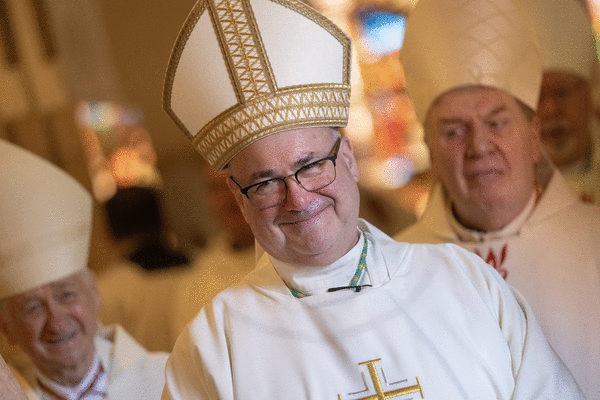
BOSTON — Calls for the excommunication of Gov. Maura Healey are mounting after she signed a bill removing restrictions on abortion access — though the Archdiocese of Boston has not yet stated how it will respond to the demands.
While church leaders have condemned the new law as “gravely immoral,” the Archdiocese has not declared whether it will pursue canonical discipline against the Catholic governor or take any formal action regarding her standing in the Church.
An online petition calling on Boston Archbishop Richard Henning to excommunicate Healey has collected more than 19,000 signatures since pro-life advocacy group LifeSite launched it on Wednesday.
The petition accuses Healey of sinning “gravely against God by legalizing the killing of babies until birth” and urges Henning to declare her excommunicated following her “scandalous betrayal of God’s law.” It argues that such penalties exist to “prompt the repentance of sinners and the salvation of souls.”
When a person is excommunicated, they are barred from participating in Church rituals, such as receiving Holy Communion.
Adding to the pressure, Kelsey Reinhardt, president of the independent lobbying group CatholicVote, sent a letter to Massachusetts bishops describing excommunication as a “censure whose explicit purpose is not retribution but conversion.”
Pointing to the legislation as a “horrendous lesson taught by a Catholic governor,” Reinhardt wrote that church law offers an opportunity to inform Healey “that she has gone somewhere she cannot remain without consequence. The purpose is to bring back her soul.”
While external groups demand formal censure, the Archdiocese has kept its public statements focused strictly on the moral weight of the law itself.
An Archdiocese spokesperson reiterated to The Boston Herald the Church’s moral opposition to the bill without outlining any prospective canonical steps regarding Healey.
“The speed at which this legislation was passed in the final days of the legislative session, with little notice, does not diminish the fact that this measure is gravely immoral,” the spokesperson said.
The spokesperson recalled how Henning and state Bishops Robert McManus, Edgar M. da Cunha, and William D. Byrne issued a joint plea in late July urging lawmakers not to advance the bill, which they described as a “radical measure.”
“We continue to reaffirm the Church’s call to its own community and to civil society to provide the resources to welcome and cherish the gift of life,” the spokesperson added Friday, “as well as to accompany women and families who have known the pain of abortion.”
The spokesperson stated that the Archdiocese will continue working to “uphold Catholic teaching prohibiting the direct attack on innocent human life from conception to natural death.”
The statement echoed previous comments from Archbishop Henning, who called the law a “grave offense against the sanctity and dignity of every person” shortly after Healey celebrated signing the bill alongside supporters at the State House.
A governor’s spokesperson told the Herald that Healey is a “governor for all people of all faiths.”
“As a proud Catholic, she believes everyone is deserving of kindness and empathy, especially in their time of need,” the spokesperson said of Healey. “She believes that those women and families should have been able to get the care they needed here in Massachusetts, and it was unfair to force them to travel to other states.”
The legislation removes previous restrictions that enabled abortions at or beyond 24 weeks of gestation only in a specific, four-pronged set of life-threatening situations for the patient or fetus.
The bill allows physicians to perform abortions at any time during pregnancy based on their “professional judgment.”
While the law opens the door for patients to receive care locally, procedures at this stage of pregnancy remain rare.
According to Department of Public Health data, there were 99 abortions performed at 24 weeks or later in 2024, compared to 84 in 2023.
Public health officials noted a sharp increase in the total number of all abortions in Massachusetts in 2024, driven heavily by out-of-state patients accessing early abortion care through telehealth.
Some Democratic state lawmakers broke party ranks in opposing the bill during the legislative process which took just two weeks.
State Rep. Jeffrey Turco is one of the nine Democrats who voted against the bill, which he has criticized for being “rushed through, … without an opportunity for the public to weigh in.”
“This new law represents an extremist and dangerous position,” Turco said. “To be clear, it allows abortion anytime, unrestricted, and in many cases, publicly funded until the moment of birth.”
“The new law is barbaric,” he added.
©2026 MediaNews Group, Inc. Visit at bostonherald.com. Distributed by Tribune Content Agency, LLC.





Comments