South Chicago Chapel families may never know the truth about the cremated remains of loved ones, experts say
Published in News & Features
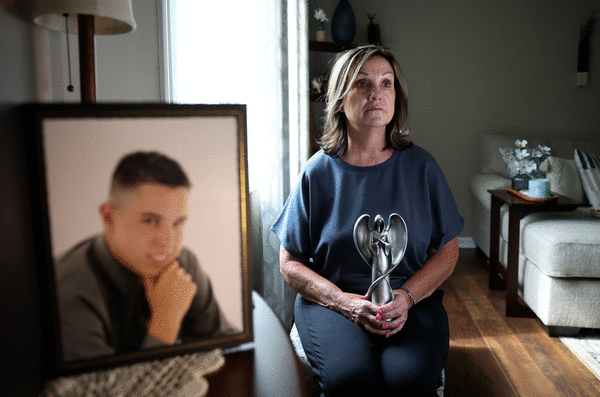
After Malissa Smith hired a funeral service company operating out of South Chicago Chapel to cremate her mother’s remains in late May, she was told that it could take two to three months to receive the ashes. But only two weeks later, she held her mother’s remains — or what she was told were her mother’s remains.
Now, after the news broke on Aug. 6 that authorities discovered 56 bodies improperly stored and in varying stages of decomposition in the basement of South Chicago Chapel, Smith is not so sure what to believe.
Smith’s late mother, Melody Johnson, was cremated at the Bohemian National Cemetery and Crematorium, which is also under investigation for mishandling remains in a case related to the problems at South Chicago Chapel.
“I haven’t opened the urn yet because I didn’t think I should,” Smith said. She is not alone.
As the Cook County medical examiner’s office undergoes the painstaking process of identifying the bodies, families like the Smiths are now in the unenviable position of second-guessing the final resting places of their loved ones.
The medical examiner’s office is also storing another 56 sets of cremated remains found inside South Chicago Chapel along with the corpses while Chicago police locate next of kin for those remains, the office said.
And experts say, for the latter, there is no sure-fire way for families to ever know for sure.
Any trace of DNA that could help forensic scientists identify the cremated remains is burned during the cremation process, when corpses are put into a special oven that typically heats up to between 1,400 and 1,800 degrees Fahrenheit. The high temperatures ensure that the body is completely turned to ash, according to Fallon Williams, owner of Oak Lawn-based Identra DNA. Any bone marrow, hair or nail clippings that could be used for standard post-mortem DNA tests are scorched.
“Once someone is cremated, they just turn to ashes, so all that (DNA) is gone,” Williams said.
Records identified the owners and operators of the funeral home as Clark and Johanna Morgan, who have a history of allegations of misconduct in the course of their work in the local funeral industry. Clark Morgan owned Heights Crematory in south suburban Chicago Heights, which the Illinois comptroller shut down in 2025 after authorities found improperly stored bodies at the facility.
Since receiving her son’s ashes in 2016, Marianne Boyle has never felt like they truly belonged to her son, Sean. Boyle contracted Planet Green Cremations to care for her son’s remains. State business records show Johanna Morgan as an officer of the business.
Boyle later found out her son was actually cremated at Heights Crematory.
“I never did get a feeling I did get my son’s remains,” Boyle said.
Once a corpse is cremated, it becomes nearly impossible to distinguish who it was without the proper identification, typically a small, stainless steel tag that is engraved with the deceased’s ID number, experts say. This tag is vital to identification efforts and is meant to stay with the body through the cremation process.
But Boyle said she received no such metal tag, just a box filled with her son’s ashes. A decade later, and in light of the recent events, she is still concerned about whether her son’s cremation process was handled properly and where her son’s ashes ended up.
“I just don’t think my son left this world being cremated properly,” Boyle said.
A standard cremation process begins when the funeral home removes a body from the place of death. After a viewing or funeral services, families typically are asked to look and confirm the body again before cremation, according to Melissa Connor, retired forensic anthropologist and emeritus professor at Colorado Mesa University.
Corpses are then placed into either a cardboard box or casket at the crematorium and left to burn for several hours.
Following the burning process, any larger bone pieces and metal that passed through the burning process, like metal hip replacements or staples from the casket, are removed. Some funeral homes use a magnet to ensure all metal has been extracted, Connor said. The rest are ground into a fine, gray powder.
The only chance of identification for cremated remains is if bits of metal, like prosthetics, earrings or metal dental fillings, are not well filtered out of the ashes, which can sometimes happen in funeral homes that don’t take as much care, according to Connor.
“In a good funeral home, the ashes are sorted through, the bodies are burnt, but any kind of metal survives: the fillings in people’s teeth, dental prosthetics, pins. Generally, large things like replacement hips, replacement knees. … Those can be easily taken out,” Connor said. “In a funeral home that is not taking as much care, a lot of that might end up in the ash.”
Specializing in human remains, Connor was among a team of scientists who tried to identify ashes from the Sunset Mesa Funeral Home. In 2023, the Colorado funeral home operators were sentenced to 20 years in prison for illegally selling human body parts without consent, sometimes giving families fake ashes in lieu of the real thing.
She knows better than most that the probability of getting a positive ID from ashes, even with the small bit of metal ingrained, is incredibly limited.
“I would never discount that there is a one in a million shot that there might be enough organics left in some bone that they didn’t burn correctly,” Connor said. “But it’s a one in a million chance.”
While DNA technology has continued to improve over the past decades, it’s not yet well-honed enough to identify burned remains, leaving families to rely on crematory records and issued identification tags to confirm the owner of the cremated remains.
“Unless they have reason to suspect that they don’t have the correct cremains, I think the odds are that they do,” Connor said. “There’s no reason for them to have been switched.”
It’s small consolation for Smith, whose mother sat in the South Chicago Chapel funeral home just weeks ago.
“I was hurt, betrayed; I felt confused, and then I couldn’t sleep. I didn’t even sleep until Sunday,” Smith said. “We paid you for a proper burial and a proper cremation, to put her body away in the way it should have been.”
_____
©2026 Chicago Tribune. Visit chicagotribune.com. Distributed by Tribune Content Agency, LLC.






Comments