Trump chases Kim Jong Un talks as ties fray with South Korea
Published in News & Features
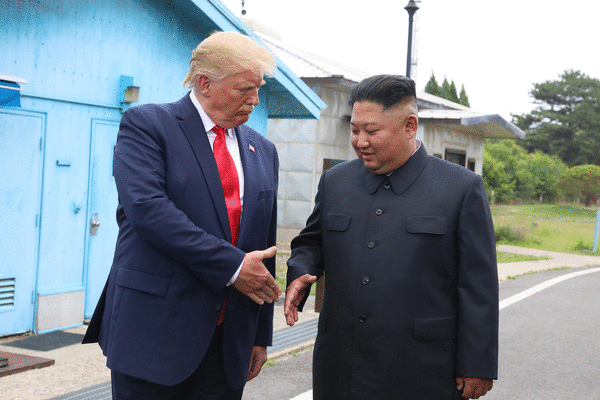
President Donald Trump is pressuring longtime American ally South Korea over trade and security while, once again, making public overtures to Kim Jong Un.
On Sunday, Trump ordered the Pentagon to scale back annual military drills with South Korea, branding them “inappropriate” for his “good friend” in North Korea, while slamming Seoul for not supporting him sufficiently over Iran. One day later, the Republican leader claimed Kim had responded to his outreach for talks, calling it a “very positive” development.
South Korean President Lee Jae Myung followed up by airing his own grievances over stalled talks with the U.S. about Seoul’s ambitions to acquire its first nuclear-powered submarine. “Please accelerate efforts,” he said on Tuesday, at a cabinet meeting that was broadcast live. “The stronger we become on our own, the greater the value and necessity of the alliance will be,” he added.
Rising tensions between the two allies come against a backdrop of complaints in Washington that Seoul is slow-walking its $350 billion investment pledge, and one media report that the U.S. now wants South Korean chip giants to feature in the package. Putting additional SK Hynix or Samsung plants on American soil could detract from Lee’s plans to build more hubs at home to help spread the AI windfall among more of the public.
The spat is presenting Lee’s administration with a balancing act, as officials weigh certain trade decisions against security interests — an area where Seoul relies heavily on the U.S. nuclear umbrella for protection against Kim’s growing atomic arsenal.
“South Korea could find itself with insufficient input in a potential diplomatic process that affects its security and prosperity,” said Mason Richey, a professor at Hankuk University of Foreign Studies, referring to any Trump-Kim talks without Lee’s consultation. “This would undermine broad South Korean public belief in the reliability of the U.S. as an ally, at least under Trump.”
Trump is pushing aides for a high-stakes meeting with Kim as soon this autumn during his next trip to Asia, the Wall Street Journal reported citing people familiar with the matter. The U.S. president is expected to gather with world leaders in the southern Chinese city of Shenzhen during November for the Asia-Pacific Economic Cooperation summit.
The U.S. leader tried to meet Kim during his Asia tour last year and Pyongyang quietly signaled its openness, but the timing was too tight, the WSJ reported citing U.S. officials.
In a potential sign of backdoor diplomacy, South Korea announced on Tuesday that Chinese Foreign Minister Wang Yi will this week make his first visit to Seoul in nearly five years to discuss North Korea and other global issues.
Trump held talks with Kim three times during his first presidency, but the engagement failed to persuade the North Korean leader to abandon his nuclear ambitions. Since then, Kim has emerged as a key partner of Russian President Vladimir Putin and stated he’ll only return to such engagement if Washington officially recognizes Pyongyang as a permanent nuclear power.
Kim has far fewer reasons to engage with Trump this time around. His family-run dictatorship has overcome United Nations sanctions to rake in as much as $22 billion in foreign revenue between 2022 and 2025, according to Bloomberg Economics, meaning he has little incentive to negotiate with the U.S. over his prized nuclear deterrent.
Lee has publicly asked the U.S. president to play peacemaker in bringing North Korea back to the table, as he tries to defuse tensions with an increasingly strong neighbor. The bigger question is whether Seoul was informed of the reported recent U.S. interaction with Pyongyang, or plans to downsize joint training.
For Lee, any broadside brings political risk. Diplomacy has been an area where South Korea’s leader has won praise at home, even as his overall approval ratings sag amid simmering frustrations over soaring housing costs. Now, the opposition is accusing his government of a “diplomatic disaster.”
“The North Korean regime will become even more entrenched, while the U.S.-South Korea alliance will unravel,” said Jang Dong-hyuk, head of the main opposition People Power Party. “With President Trump as he is now, he may even push for the withdrawal of U.S. troops from South Korea.”
The U.S. leader’s decision to cut back joint drills came as the lone American aircraft carrier in the Asia-Pacific region, the USS George Washington, was being diverted to the Middle East, underscoring how U.S. military power is being stretched by ongoing operations in Iran.
Lee avoided commenting directly on Trump’s recent remarks, but said South Korea’s military drills were not aimed at raising tensions on the peninsula or attacking North Korea. He also called for efforts to complete the transfer of wartime operational control to South Korea by the end of his five-year term.
During Trump’s first stint in office, he also pulled back on joint exercises with Seoul while trying to court Kim, and downplayed the impact of that decision. In December, however, the top U.S. commander on the Korean Peninsula said regular exercises between the allies were “absolutely” necessary to maintain peace and put pressure on North Korea.
“Whenever someone talks about — I don’t care who it is — talks about exercising less or exercising differently, and they need to understand that there are two times in a year where we absolutely need some support,” General Xavier Brunson, the commander of U.S. forces in South Korea, said at that time. The U.S. and South Korea traditionally conduct two major exercises each year: one in the spring and one in the summer.
U.S. Forces Korea referred questions to the White House when reached by Bloomberg News.
For Trump, dangling the prospect of resumed dialogue with Kim could be a tactic to get South Korea moving on trade. Trump unexpectedly gave the green light for South Korea to pursue its first nuclear-powered submarine after getting Seoul to sign off on the $350 billion investment deal that capped U.S. tariffs on South Korean goods at 15%.
The allies, however, have made little visible progress on either commitment amid Washington’s accusations that South Korea discriminates against American firms, with tensions flaring over Seoul’s handling of a massive data breach at U.S.-listed Coupang Inc.’s South Korean operations.
Ultimately, the kerfuffle over drills and trade isn’t likely to upend Washington’s enduring relationship with Seoul, analysts said.
“U.S.-South Korea relations face many sources of turbulence — tariffs, investment delays, defense procurement and business regulation,” said Leif-Eric Easley, a professor at Ewha University in Seoul. “But the alliance is much more likely to adjust altitude than suffer a crash.”
_____
(With assistance from Heesu Lee and Alastair Gale.)
_____
©2026 Bloomberg L.P. Visit bloomberg.com. Distributed by Tribune Content Agency, LLC.





Comments