Quartz industry splits as Trump tariffs fuel affordability fears
Published in News & Features
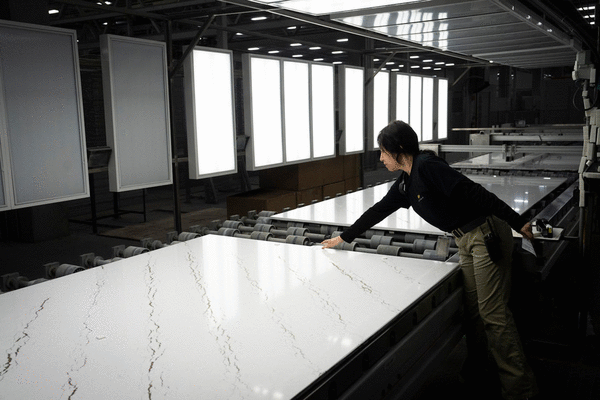
The U.S. started collecting tariffs last Saturday on imported quartz slabs used for countertops, backsplashes and bathroom tiles, dividing the industry among opponents who warn of added consumer strains and backers who argue the protections will create jobs.
Some foreign-produced quartz will be subject to a levy ranging from 19% and 50% over the next four years, depending on which year the imports occur and whether it exceeds a predetermined threshold.
It’s the latest move in the administration’s effort to use trade levers to boost U.S. manufacturing jobs. But critics worry about the downside: It risks increasing the cost of homebuilding materials for consumers already concerned about affordability ahead of the November midterm elections.
Adding to the tension is the perception of political favoritism. Among the vocal supporters is Marty Davis, the CEO of a major Minnesota quartz processor and a donor to President Donald Trump.
The president’s “trade remedies will kick the Trump Trade Doctrine into high gear and reverse the devastating effects of previous administrations’ disastrous trade policies,” Davis said in a statement earlier this month issued by the Quartz Manufacturing Alliance of America.
The alliance referred to the Aug. 5 statement in response to a request for comment on Davis’ relationship with the White House.
Davis runs Cambria, which owns mines in Canada and produces quartz products for kitchens and bathrooms and has long complained of foreign competition undercutting its business.
Midterm donations
He has given more than $1 million in the current election cycle, according to Federal Election Commission data. That includes the maximum $443,000 to the Republican National Committee and $176,050 to Representative Tom Emmer’s committee that raises money for House candidates and the party. In the 2024 presidential cycle, he gave at least $112,000 to committees supporting Trump’s campaign.
There’s no evidence that Davis’ donations had a causal effect on the tariffs. The White House said “the only special interest guiding the Trump administration’s decision-making is the best interest of the American people.”
“Securing and reshoring America’s critical supply chains has been a top priority for President Trump, and the entire Administration continues to take historic action to safeguard America’s national and economic security to ensure America is no longer dependent on foreign countries,” White House spokesman Kush Desai said.
Privately held Cambria had revenue of more than $500 million and employs about 1,800, according to a 2025 article posted on its website.
Several countries are exempted from the new duties, including South Korea, Canada, Mexico and dozens of developing countries.
The tariffs will operate on a quota level basis. For example, during the first year, a tariff rate of 25% will apply to imports that are within the annual threshold of 13 million square meters. That tariff rate increases to 50% for imports that exceed the threshold.
The Quartz Manufacturing Alliance of America, which submitted a petition to the U.S. International Trade Commission last September, and Democratic Sen. Amy Klobuchar — who’s running for governor of Minnesota — have supported Cambria’s efforts. The commission agreed to conduct an investigation and concluded that the tariffs were a sound remedy. Trump had the authority to disapprove of the conclusion.
The new levies are being imposed under a legal authority under Section 201 of the Trade Act of 1974, which are intended to act as temporary safeguards to protect domestic industries.
While imports from China sharply dropped after previous tariffs took effect in 2019, quartz shipments from other countries continued to trend upward. Output largely shifted to India and Southeast Asia. Global imports to the U.S. crested in 2024 at more than 20 million square meters.
Daniel Vaz De Melo Sa, business development manager for Guidoni USA, said the flood of imports devastated operations at the company’s site in McRae, Georgia. Since launching a half-decade ago, the plant has laid off roughly 100 workers and now operates at 8% capacity, he said, with just under 20 employees.
‘Thank God’
The company is now “optimistic” that the tariffs will prompt a reversal in the decline, allowing them to build up operations again.
“There’s no way now that we won’t start growing. Thank God. We’re very grateful for that,” Sa said in an interview.
Not everyone in the industry welcomes the latest barriers to low-cost imports. The Save Quartz Jobs coalition, which represents businesses that measure, cut and install quartz surfaces, has been one of the most outspoken opponents.
The group said that “thousands of small businesses across the country” were “disappointed” by Trump administration’s decision.
The anti-tariff coalition also singles out Cambria for criticism, saying the company “already dominates the luxury segment and does not need government protection.”
“At a time when Americans are already struggling with housing affordability and rising living expenses, this decision will make homes and home-improvement projects more expensive while placing additional strain on the small businesses that depend on access to a reliable and competitively priced supply of quartz,” the group said in a statement.
(With assistance from Bill Allison.)
©2026 Bloomberg L.P. Visit bloomberg.com. Distributed by Tribune Content Agency, LLC.





Comments