'Child deserves privacy': Florida Gov. Ron DeSantis faces heat for outing victim in Caruso sex case
Published in News & Features
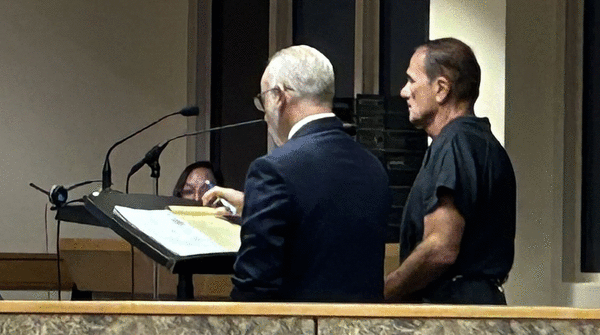


MIAMI — The family of the young boy who alleges he was molested by former Palm Beach County Clerk of Courts Mike Caruso hoped to protect his identity.
Living with the alleged assaults would be difficult enough, they reasoned. Having others know about it would make it worse.
That hope fizzled Tuesday.
Shortly after Florida Department of Law Enforcement officers arrested Caruso, Gov. Ron DeSantis’ office mass-emailed and posted on the Internet Caruso’s eight-page arrest affidavit, with lurid details of the allegations.
Only the child’s name was redacted. But his relationship to Caruso and county of residence makes it easy for people to discern who he is. The document contained other information that identifies the child and mentions separate sex abuse allegations from another person.
Within hours of the governor’s announcement, news outlets, reporters and social media users were posting about the child and the allegations against Caruso. The Herald did not publish identifying details about the child.
The disclosure drew outrage from sex abuse survivors and advocates, who described it as unnecessary and cruel.
‘Child deserves privacy’
Spencer Kuvin, a Palm Beach attorney who has represented victims of Jeffrey Epstein, told the Miami Herald that this case will come up whenever anyone looks up basic information about the child. There was no need for the governor’s office to include the full document when announcing Caruso’s suspension from office Tuesday, he said.
“This will cause trauma for the victim for the rest of his life, not just now,” Kuvin said. “As he grows older, he will forever be tied to these allegations.”
Though Lisa Haba, the victim’s attorney, initially issued a press release calling the revelations “abhorrent,” she told the Herald Wednesday that even if some information is disclosed as part of the legal proceedings, she appreciates those who handle it with discretion.
“A victim, especially a child, deserves privacy,” she said.
The affidavit the governor’s office released says that Caruso in three incidents exposed himself to the child, touched the boy’s genitals and put his penis in the child’s mouth. The child, the Herald learned, was less than 5 years old at the time of the incidents.
Caruso, through his attorney, said Wednesday he is innocent. He was moved Wednesday to the Orange County jail.
Caruso was arrested Tuesday morning on charges of molestation, kidnapping, luring and enticing a child, lewd and lascivious exhibition and child abuse, according to his arrest affidavit.
Under Florida law, “any information that may reveal the identity of a person who is a victim of any sexual offense” is exempt from public record and can be redacted.
In addition, the 2018 constitutional amendment Marsy’s Law provides crime victims “the right to prevent the disclosure of information or records that could be used to locate or harass the victim or the victim’s family.”
The Florida Supreme Court ruled in 2023 that anonymity is not guaranteed, but state lawmakers and DeSantis enacted a law to strengthen the provision in April. The law created a public records exemption for government agencies to withhold victims’ identifying information.
But the governor didn’t seem to apply the newly expanded exemptions to Caruso’s young alleged victim.
Even in an age of over-disclosure on social media, some readers were offended.
“My heart is broken for this young boy,” one woman commented on a Facebook post about the case. “His identity should have been kept secret.”
The Florida Attorney General’s Office directed questions about the redactions to the governor’s office.
Alex Lanfronconi, a spokesperson for the governor, told the Herald that DeSantis’ office had consulted with the Attorney General’s Office about the redactions and “maintains that it complied with applicable Florida law.”
‘I was deeply, deeply triggered’
Lauren Book, a former Democratic state senator who is running again for office, told the Herald she cried Tuesday night as she thought about what this means for the young victim. She was flooded with bad memories.
“I was deeply, deeply triggered because the same thing happened to me,” she said. Book was the victim of childhood sexual abuse; her abuser, the family’s nanny, was sentenced to prison.
Because she’s the daughter of influential lobbyist and Miami-Dade Homeless Trust chair Ron Book, the story was everywhere. Book remembered being called names at school.
Book called the disclosure from the governor’s office “disgusting” and “horrific” and said it would have a “freezing effect” on other potential victims coming forward.
“This was a complete revictimization of this child and this family in a way that was completely and totally unnecessary,” she said.
Book said the media also “had a responsibility to protect the identity of that child” and should not have spread “trauma porn” far and wide.
The Code of Ethics of the Society of Professional Journalists — journalism’s most-cited ethical code — calls for journalists to “show compassion for those who may be affected by news coverage,” especially juveniles and sex crime victims. The code also asks reporters to “recognize that legal access to information differs from an ethical justification to publish.”
“As we all hopefully learn when we are children, ‘can’ doesn’t mean ‘should,’” Dan Axelrod, chairman of the SPJ Ethics Committee, told the Herald.
Kuvin, the attorney, told the Herald that releases like that in the Caruso case are part of a larger issue in the legal world where officials from the executive branch tend to “forget victims.”
“All they care about is prosecuting criminals and they forget that there are victims who are involved in the entire process and have rights,” he said. “This is trauma that is irreversible.”
©2026 Miami Herald. Visit at miamiherald.com. Distributed by Tribune Content Agency, LLC.






Comments