15 years of FBI headquarters delays have cost taxpayers millions
Published in News & Features
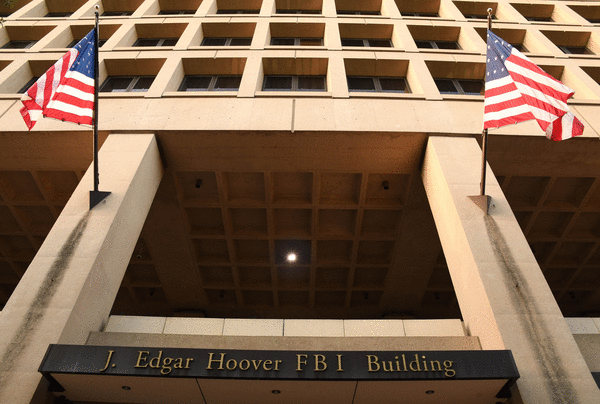
Fifteen years after the federal government set out to replace the FBI’s aging Washington headquarters, taxpayers are still paying to maintain the deteriorating building as construction costs rise and work on a relocation site has yet to begin.
Federal officials warned Congress years ago that delays would come with a price.
In 2018, the General Services Administration (GSA), which oversees federal land development projects, estimated that each additional year of inaction would add about $84 million in short-term repairs and escalating construction costs. Eight years later, the FBI remains in the J. Edgar Hoover Building.
Why it has taken so long depends on whom you ask. Maryland Democrats blame the Trump administration for repeatedly disrupting a project Congress deemed ready to advance. Republicans point to broader bureaucratic dysfunction and political jockeying over the headquarters.
Economists and political analysts say the answer lies somewhere in between: Building a massive, high-security federal facility is inherently complicated, and repeated changes in direction have made the process longer and more expensive.
How much those delays have cost taxpayers, however, remains unclear. The FBI reported spending roughly $157 million on Hoover maintenance and repairs from fiscal 2016 through 2023. But adding government expenditures or multiplying GSA’s eight-year-old estimate to calculate the price of delay would fail to account for inflation, tariffs and the time value of money, J.P. Krahel, an accounting professor at Loyola University Maryland. “Uncertainty is always a costly thing,” he told The Baltimore Sun.
GSA and the FBI did not respond to The Sun’s requests for spending figures covering headquarters planning and procurement, the canceled 2017 procurement or work on the Greenbelt and Ronald Reagan Building proposals. GSA also did not provide an updated estimate of the annual cost of further delays.
Over a decade of delays
The effort dates back to at least 2009, when then-FBI Director Robert Mueller approached U.S. Rep. Steny Hoyer, who was House majority leader at the time, seeking help finding a new headquarters.
“Our building is literally falling down,” Hoyer recalled Mueller telling him. The FBI wanted a suburban campus that could provide greater security than its downtown Washington headquarters. Congress formally directed GSA to pursue a replacement in 2011.
Hoyer acknowledged that some of the lengthy timeline was unavoidable. Selecting a site and procuring a facility of this size requires bidding, reviews and other safeguards, he said.
By 2016, Hoyer said the government was “essentially ready” to select a site, but that procurement was canceled in 2017 amid a funding shortfall. The government revived the search and selected Greenbelt in 2023 over competing sites in Landover and Springfield, Va. The Trump administration reversed that decision in 2025, announcing plans to renovate Washington’s Ronald Reagan Building instead.
A federal judge this week struck down that move and restored Greenbelt as the selected site, though the administration could appeal.
Hoyer estimated a headquarters that might once have cost about $2 billion could now cost roughly $4 billion because of inflation and new tariffs.
“Every time we do something like this and don’t do either what the law says or what the decision that has been made and move ahead and do it, it costs a lot of money,” he told The Sun.
Anirban Basu, CEO of Sage Policy Group, called the delays “sheer unadulterated waste,” saying rising labor and material costs mean taxpayers will ultimately pay more whenever construction begins.
Congress has appropriated more than $1.1 billion toward the headquarters effort since 2016, though that does not mean all of the money has been spent. In 2024, GSA reported having $845 million available for the project and sought another $3.5 billion from the Federal Capital Revolving Fund. Congress did not approve the request. How much remains available today is unclear.
The blame game
The repeated changes have prompted bipartisan criticism in Maryland, although lawmakers disagree over where to place the blame.
Hoyer and U.S. Sen. Chris Van Hollen, another Democrat, blamed President Donald Trump for “slow-walking” a project Congress repeatedly funded and said the delays have wasted taxpayer money. They warned that appealing the ruling restoring Greenbelt — which both expect the administration to do — would bring further delays and costs.
Maryland House Minority Leader Jason Buckel, a Republican, instead called the saga “an example of government dysfunction.” He said politicians in Maryland and Virginia became more focused on winning the headquarters for their jurisdictions than determining “what’s best for the FBI and for American taxpayers.”
Washington College political scientist Flavio Hickel argued that “inefficiency” better describes the problem, rather than solely blaming politicians for dysfunction. Procurement rules can slow projects, he said, but they also exist to ensure fairness and responsible spending. Hickel added that the bigger problem comes when the government changes course after years of work, potentially requiring studies, surveys and contracting work to be repeated.
The saga has also drawn comparisons to Baltimore’s Red Line, which underwent years of planning before former Republican Gov. Larry Hogan canceled it in 2015, leaving $900 million in committed federal funding on the table. The project was later revived under Democratic Gov. Wes Moore. Still, Buckel said both illustrate waste associated with government planning that fails to produce completed projects.
However, economists said the analogy has limits. Unlike a transit project policymakers can decide not to build, Basu said, the federal government ultimately has to address the FBI’s headquarters needs.
For Hickel, the cost also extends to public confidence. “Confidence the government can get things done declines when you hear about all these repeated delays and shifting priorities,” he said.
_____
©2026 Baltimore Sun. Visit baltimoresun.com. Distributed by Tribune Content Agency, LLC.






Comments