Maryland judge 'troubled' by redistricting amendment ballot process
Published in News & Features
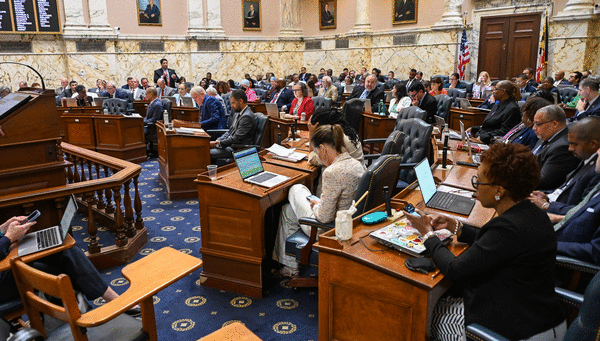
BALTIMORE — An Anne Arundel County judge reserved a decision Tuesday on whether Maryland’s proposed congressional redistricting amendment can remain on the November ballot, but raised concerns about the state’s defense of how lawmakers placed the measure before voters.
At the heart of the case is whether the General Assembly must follow a July 1 deadline it enacted earlier this year when proposing a constitutional amendment. Thompson said he expects to issue a written decision by Wednesday afternoon, leaving the amendment’s fate uncertain as the state prepares to finalize ballots for the Nov. 3 election.
Thompson said he was “troubled” by the state’s argument that the deadline does not apply when lawmakers exercise their power under the Maryland Constitution to propose an amendment.
“It bothers me that the argument that’s put forth is, ‘Well, you know, if the statute is inconvenient, we’ll just fall back on the general Constitution,’” he said. “That doesn’t seem right to me.”
Legislature’s authority at center of dispute
The plaintiffs argue the July 1 deadline applies to the General Assembly’s effort to put the amendment before voters.
Attorney Jeff Clark, former U.S. Assistant Attorney General for the Civil Division, said lawmakers could not avoid that deadline by writing the ballot question themselves or declaring that it would move forward “notwithstanding any other provision of law.”
“The General Assembly blew the deadlines, went way past the deadlines, and it’s created this emergency,” Clark said. “It’s an emergency of its own making.”
Assistant Attorney General Daniel Kobrin countered that the July 1 requirement only applies to duties assigned to state officials, including the secretary of state. In his view, it does not limit the legislature’s separate power under the Maryland Constitution to propose amendments directly to voters.
“The Constitution wins. The statute cannot defeat the Constitution,” Kobrin said, adding that a regular state law cannot create a blackout period or deadline for constitutional amendments when the Constitution itself does not establish one.
Del. Kris Fair, a Frederick County Democrat who chairs the Maryland House election law subcommittee, defended the legislature’s handling of the timeline after the hearing.
“Do I think we botched the deadlines? No, not at all,” he told reporters. “I think we actually met exactly the constitutional requirements we were set here to do.”
Oversight Project President Mike Howell, the lead plaintiff, said the case comes down to whether lawmakers must follow the laws they enact.
“What they can’t do is just run roughshod over the very rules that they lay out,” Howell said. “That’s what this case comes down to: Are there rules, and does the General Assembly have to obey them?”
The two sides also clashed Tuesday over whether the ballot question gives voters a clear explanation of the proposed constitutional change. Clark said calling the proposal a “clarification” understates the significance of the change, while Kobrin said the language fairly describes an effort to settle conflicting interpretations of Maryland law.
Redistricting and the November ballot
The dispute stems from a two-day special session held earlier this month, when lawmakers approved the proposed constitutional amendment. The measure would clarify that Maryland’s constitutional requirements for compact, contiguous districts and consideration of existing geographic boundaries apply to state legislative districts, not congressional districts. It also would give the General Assembly the ability to grant the Maryland Supreme Court original jurisdiction over challenges to congressional maps.
Fair said Tuesday that lawmakers had been considering a response to the 2022 Battaglia ruling, which applied Maryland’s constitutional redistricting requirements to congressional districts.
Republicans, however, say the measure could clear the way for Democrats to redraw Maryland’s congressional map before the 2028 elections, potentially putting the state’s lone Republican-held congressional seat at risk. A second Republican challenge is proceeding separately in Dorchester County.
The legal fight is unfolding on a tight timeline. The State Board of Elections plans to certify ballots for printing Aug. 31, and the amendment is scheduled to appear as Question 3 in the Nov. 3 general election if it survives both challenges.
What happens next?
Even a ruling for the plaintiffs Wednesday would not immediately remove the amendment from the ballot.
Kobrin asked Thompson to temporarily pause any order blocking Question 3 while the state appeals. Thompson agreed.
“I think I would have to, from a practical standpoint, because I know that the decision will be made at (the Supreme Court of Maryland),” he said.
If Thompson rules against the amendment Wednesday, Question 3 could remain on the ballot while the state appeals. Clark said the plaintiffs would reserve the right to ask the Supreme Court of Maryland to lift the pause and allow Thompson’s order to take effect.
_____
©2026 Baltimore Sun. Visit baltimoresun.com. Distributed by Tribune Content Agency, LLC.





Comments