Chicago Public Schools wins back millions in federal grants withheld over Black Student Success Plan
Published in News & Features
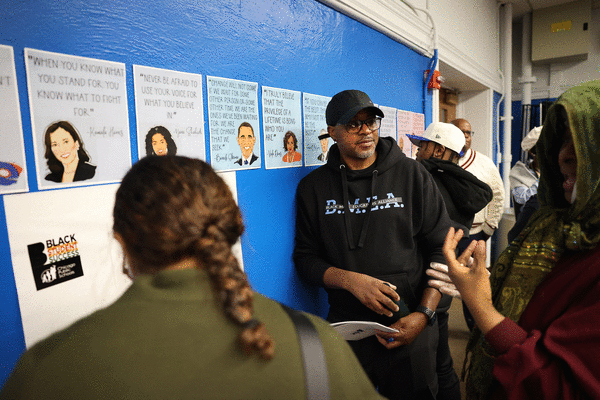
CHICAGO — Chicago Public Schools has won back millions of federal dollars withheld by the Trump administration over the district’s Black Student Success Plan and its policies supporting transgender students.
CPS sued the U.S. Education Department in March for rescinding roughly $5.8 million in grants, accusing officials of abruptly pulling the money without proper notice. The case was settled Thursday, according to federal court documents.
The district has not said how much money will be returned or whether it has received the funds.
“The district looks forward to working with the U.S. Department of Education to ensure these resources reach schools and students as quickly as possible,” a CPS spokesperson said in a statement Friday.
The Education Department did not respond to the Tribune’s request for comment.
The district’s Black Student Success Plan was officially unveiled in February last year. Advocates who champion the initiative argue that Black students — who make up a third of the CPS student body — are uniquely positioned to fail because of historic and ongoing racial inequalities in Chicago.
But soon after, Defending Education, a national conservative advocacy group filed a complaint with the Education Department, contending that students of all races struggle in Chicago schools. Nearly half of the student body is Latino, and 12% is white. In April, federal education officials launched an investigation citing the complaint.
In a letter to district leaders last fall, assistant secretary for civil rights Craig Trainor called the plan “textbook racial discrimination” and “racially restrictive programming.” He also alleged CPS violates federal law by allowing transgender students to use facilities that align with their gender identity.
When the district refused to scrap those policies, the agency rescinded the unrelated federal grants. The money was part of the Magnet Schools Assistance Program, a longstanding initiative aimed at desegregating public schools and expanding school choice.
CPS argued in its lawsuit that the Education Department did not follow procedural requirements when it withdrew the funds. The district also noted the agency has yet to issue any formal findings from the civil rights investigation.
CPS and school districts across the country have faced scrutiny for diversity, equity and inclusion policies under the Trump administration. The White House has argued that, in directing resources to racial groups that have historically fallen behind, officials are discriminating against other students.
In June, CPS CEO Macquline King was subpoenaed to testify before the Republican-led U.S. House Committee on Education and the Workforce, where she was grilled for hours on the district’s policies supporting transgender students and other initiatives. Last week, she received another letter from lawmakers on the committee.
While the district hasn’t backed down from its policies, it has stopped short of calling out the Trump administration. During the hearing, King sidestepped lawmakers’ most pointed questions by citing the district’s compliance with state law. And CPS didn’t publicly announce the lawsuit over the rescinded magnet school grants or its recent settlement.
Meanwhile, the federal investigation and other bureaucratic hurdles have significantly slowed the plan’s implementation. The Chicago Board of Education announced the members of its Black Student Success Committee in July, months after it had initially planned to launch.
Part of the district’s argument in the lawsuit was that the initiative was still in the planning phase and that it “has not yet implemented” it.
The plan, a 46-page blueprint, aims to break down persistent achievement barriers for Black students. Among other goals, the plan looks to close academic gaps, double the number of Black male teachers and reduce out-of-school suspensions and expulsions for Black students. It also seeks to boost culturally responsive curriculum, including lessons on Black history and culture.
Supporters point out the discrepancies between the district’s Black students and their peers.
Four-year graduation rates for CPS students have steadily climbed over the past two decades, reaching 84% in 2024, according to a December report from the To&Through Project. Still, Black male students continue to trail their peers, with a graduation rate of 77% last year, mirroring national trends.
And while college enrollment and completion rates have improved districtwide, Black students haven’t seen the same gains. In fact, 135 fewer Black graduates from the class of 2018 completed college within six years compared with those in the class of 2008, the To&Through Project found.
Previous research has found that Black students are significantly more likely to be suspended than their peers. The district has since taken steps to reform its disciplinary policies, including removing school resource officers in 2024.
So far, CPS has received a $250,000 philanthropic grant to host a districtwide Black Student Union conference. The money will also support a new Black male educator pipeline initiative, focused on providing supports for Black teachers through mentoring and wellness programming, the district said.
____
©2026 Chicago Tribune. Visit at chicagotribune.com. Distributed by Tribune Content Agency, LLC.






Comments