Six have died in California ICE facilities under Trump. It's the most in 20 years
Published in News & Features
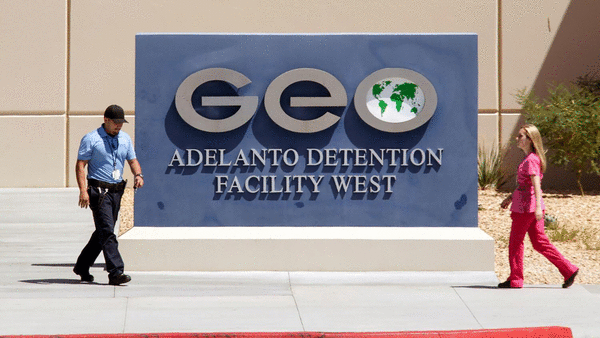
At least six people in California have died in U.S. Immigration and Customs Enforcement custody during President Donald Trump’s second term — the highest number of deaths under a presidential administration in nearly two decades.
The data, sourced from government records and compiled by an immigration data analysis firm called Relevant Research, found that 56 people had died in ICE custody since the start of the current administration. That is roughly one person every 11 days.
In California, all six of the deaths occurred at hospitals and shortly after people had been at federal detention centers. Four of the deaths were of people held at the Adelanto ICE Processing Center in San Bernardino County. Two other people died after detainment at the Imperial Regional Detention Facility near the U.S. and Mexico border.
“Being in ICE custody is much broader than whether or not someone’s actually just physically inside of an immigrant detention facility,” said Austin Kocher, president of Relevant Research, at a Monday afternoon virtual news conference about the data.
Families of the deceased in five of the cases have alleged the facility or ICE failed to provide adequate medical care, according to media reports and an investigation by the California Department of Justice published in May.
The state DOJ investigation found that detention conditions had largely worsened as the federal administration’s mass deportation campaign led to “overcrowding and strained resources.” Dozens of news outlets have reported similar worsening conditions at detention facilities across the country.
“In a way, the complications of detention centers are bleeding out, to use unfortunately a very graphic and accurate metaphor, into all of these other medical facilities,” Kocher said.
Kocher, who is also a research fellow at American University’s Center for Latin American and Latino Studies, launched the “Detention Mortality Dashboard” earlier this month. The dashboard, using ICE records, shows that 289 people have died in ICE custody since October 2003. The data does not include deaths of people who were released from custody and later died from complications.
California accounts for 40 of the total deaths, which is second most in the nation after Texas. The two states are among the highest in total number of ICE detainees. In 2006, six people in California died in ICE custody — the most in any reported year for the state.
“This is not a problem that started with the Trump administration,” Kocher said.
As of this year, California has about 9,200 beds across eight U.S. Immigration and Customs Enforcement detention facilities. All are operated by private companies and located in the southern half of the state.
Kocher said the data does not seek to answer why someone died in custody, noting that ICE announcements for deaths may be incomplete, inaccurate or framed to criminalize the person. He is also unable to evaluate the medical claims.
Following a death of a person in custody, ICE must issue an initial news release announcing the death. The agency then must publicize a more detailed report within 90 days. These reports have become shorter, less detailed and more dehumanizing under Trump’s second term, Kocher said.
“We’re not necessarily going to repeat those kinds of claims or repeat that kind of language, especially because we can’t verify it,” Kocher said.
The six people that died under Trump’s second term are Jose Guadalupe Ramos-Solano, Alberto Gutierrez-Reyes, Luis Yanez Cruz, Gabriel Garcia Aviles, Huabing Xie and Ismael Ayala-Uribe. All except Xie, of China, and Yanez Cruz, of Honduras, originated from Mexico.
This week, the California Legislature has advanced several detention-related bills to Gov. Gavin Newsom’s desk. Among the legislation are efforts to impose a 25% tax on the gross income of for-profit corporations that operate immigration detention facilities, prohibit the use of state-owned property for immigration enforcement and deny businesses involved with detention facilities from receiving state grants or loans.
Newsom has until Sept. 30 to sign or veto the bills.
_____
©2026 The Sacramento Bee. Visit sacbee.com. Distributed by Tribune Content Agency, LLC.






Comments