UK's Burnham risks Trump anger with new sanctions on Israel
Published in News & Features
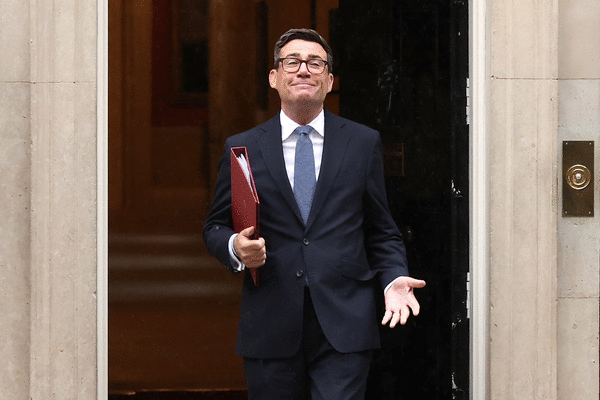
U.K. Prime Minister Andy Burnham’s government is expected to ban trade with Israeli settlements in the West Bank on Tuesday as he seeks to adopt a stronger policy on an issue that’s important to his governing Labour Party but may anger U.S. President Donald Trump.
A new sanctions regime targeting Israel, but limited to Jewish settlements in the West Bank, will be announced by Foreign Secretary Ed Miliband, according to people familiar with the matter.
Burnham and Trump spoke by phone Monday, according to a readout from 10 Downing Street, which said the two leaders discussed a two-state solution for Israel and the Palestinian territories. That suggests Burnham used the call to notify Trump that the sanctions on Israel were coming.
Downing Street and the Foreign Office declined to comment.
Bloomberg first reported that Britain was drafting the sanctions package last month as it sought to raise pressure on Israel over its decision to advance home-building in a strategically important part of the West Bank.
Proposals under consideration included a new sanctions regime including measures to prevent the exchange of goods and services with Israeli settlements.
Miliband has also looked at expanding existing human-rights sanctions to cover the obstruction of aid, which has been blamed for exacerbating the humanitarian crisis in Gaza. The foreign secretary has also been looking at explicitly endorsing the International Court of Justice’s non-binding 2024 opinion that Israel’s occupation of territory that Britain now recognizes as the state of Palestine is unlawful.
U.K. officials are nonetheless concerned that the announcement may provide an early setback for Burnham’s relationship with Trump. British diplomats have privately told the U.S. that the sanctions are largely symbolic and will have no material impact on the U.K.’s wider relationship with Israel on trade or security, in a bid to soothe the Trump administration’s response, people familiar with the matter said.
The proposals were drawn up in the wake of Israel’s decision to open a tender for the construction of 1,200 settlement homes in one section of the West Bank. Disputes between Israeli settlers and Palestinians have further flared in recent months as Israeli Prime Minister Benjamin Netanyahu faces a tough battle to keep his job in a general election slated for Oct. 27.
Burnham was joined by the leaders of Canada and five European governments, including France, Germany and Italy, in a statement condemning the housing plan as “unacceptable” and urging Netanyahu to withdraw the tender. German Chancellor Friedrich Merz separately denounced Israeli National Security Minister Itamar Ben Gvir’s call for nightly assassinations in Gaza.
Burnham is eager to show Labour early on that he takes a more critical view of Israel than his predecessor, Keir Starmer.
Although Starmer toughened his stance toward Israel over his two years in office, including formally recognizing the state of Palestine, his early refusal to demand that Netanyahu halt his military campaign in Gaza split the left. That helped drive down Labour’s standing in the polls and fueled Green Party election gains across the country.
Burnham, whose return to Parliament forced Starmer’s departure last month, apologized for Labour’s stance on Israel’s military action in Gaza under his predecessor, saying the party “didn’t get it right.” Last month, Burnham’s new defense secretary, Wes Streeting, who faced stiff competition from a Muslim independent candidate in his own northeast London constituency at the last general election, said Israel had “fallen short” of international standards.
©2026 Bloomberg L.P. Visit bloomberg.com. Distributed by Tribune Content Agency, LLC.






Comments