The dangerous pull of Twin Cities urban exploring
Published in News & Features
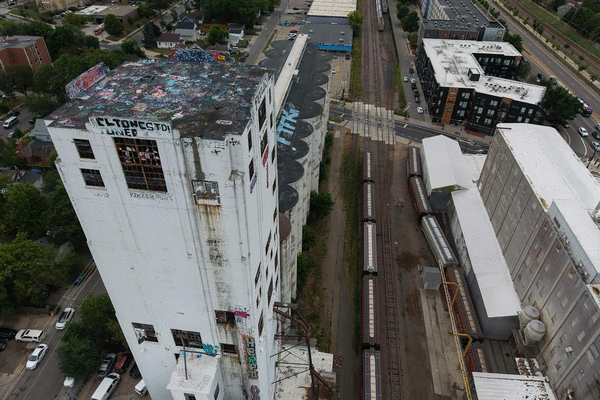
MINNEAPOLIS — Vox Payne heard the screams and instantly knew where they were coming from.
“I immediately texted my next-door neighbor and we both were like, ‘That was the tower, wasn’t it?’” Payne said.
Her house sits in the shadow of an abandoned grain elevator in south Minneapolis that’s become a dangerous hot spot for urban explorers.
Ash Ranallo-Korbel, an 18-year-old from Forest Lake, was exploring the Checkerboard grain mill with friends in early August when he fell 20 stories after reportedly hanging from a metal beam. Minneapolis firefighters rescued the teen using a truck’s aerial ladder to reach an elevated platform he landed on.
He remains in the hospital with significant injuries, and it’s unclear if he will fully recover following numerous surgeries that have been detailed by his mother on Caringbridge.org.
Urban exploring, a decades-old pastime, has exploded in popularity more recently in the Twin Cities. Social media platforms, including TikTok and YouTube, have exposed more people to the hobby and formerly little-known locations of abandoned grain mills, factories and tunnels. It often attracts teens and young adults seeking a sense of discovery or thrill — inspired by and eager to share their adventures on social media.
The latest injury has renewed scrutiny as the Minneapolis Police and Fire departments warn that those who enter abandoned buildings risk injury or death, and that they will be arrested for trespassing and other crimes.
Those who pursue urban exploring say the risk is not going to stop people from doing it. Sneaking into properties, and the dangers that go with it, is a draw for some, along with the high-up views of the city, the other-worldly aesthetics and labyrinth-like spaces.
“There’s an excitement that comes with stepping into the unknown, not knowing what you’re going to find, and experiencing places that most people will never see,” said a 24-year-old explorer who goes by CbexMN on TikTok and asked not to be named because of the illegal nature of the hobby.
The explorer got into what practitioners call “urbex” after a friend took her along and she enjoyed the adrenaline rush.
Since then, she’s chronicled her trips to caves, tunnels and other grain mills that loom over the city, covered in graffiti. On one occasion she was able to outwait police officers trying to apprehend her until they left, she said.
She believes the “curiosity and rush is what keeps people coming back,” but said the seriousness of the latest injury “definitely made me think more about how quickly things can go wrong while exploring.”
The secrecy and danger that attracts urban explorers are what alarm public-safety officials.
Minneapolis police have had a growing number of calls for urban exploring trespassing in the last two years. After more than 80 reports in all of 2025, there have already been more than 100 incidents through Aug. 3, Minneapolis Police Sgt. Garrett Parten said.
“While they are seeking fun and adventure, what they’re doing is illegal and extremely dangerous,” Parten said at a news conference after the teen’s fall at the Checkerboard grain mill. Police have arrested 15 explorers so far this year.
At least three explorers have died since 2009 in the Twin Cities, including two drownings in flooded tunnels and one fatal grain elevator fall in 2015.
Ranallo-Korbel, a recent graduate of Forest Lake High School, was exploring the mill with friends the night of the fall. He had been “looking forward to the next chapter of life” and is a “talented artist, a dedicated worker, and someone whose contagious smile and sympathetic soul brighten every room,” his family wrote in an online fundraising campaign to help cover medical and related expenses.
On Sept. 6, his mom, Nicole Emery, wrote on CaringBridge that he had begun to communicate with nonverbal gestures.
“It is so incredibly sad to see that he remembers the incident, but so amazing that he is in there and his memory mind is working,” Emery posted.
Another post showcased drawings by Ranallo-Korbel, while others included photos of happy memories where he’s seen hugging family members.
The family declined to comment through a spokesperson for the law firm Romanucci & Blandin, which has been investigating the lead-up to the accident and concerns over the property’s security.
Officials are concerned about how social media has spurred an influx of new young explorers.
TikTok has myriad urban exploration videos, some showing people in the Checkerboard tower days after Ranallo-Korbel’s fall. Many of the posts are slideshows where explorers rate each site on a 10-point scale based on how much they enjoyed it, its accessibility and the level of police or security presence.
One video shows a person using an electric saw to break through a wooden panel to gain entry to an old building. Others include text overlays that describe how they outran officers, or were caught. One by CbexMN says she “almost fell to my death” and narrowly avoided a fall.
Payne said she has called police and firefighters more than 50 times in the last year to report people on top of the Checkerboard mill, but feels that officers don’t respond as often as they should.
“If they were showing up more, the kids would be more scared to go in,” she said.
She was critical of the property owners, Checkerboard LLC, who took over the property several years ago, and said they don’t seem to have a security guard. Workers removed the metal beam after the teen fell from the tower, and have been sealing up openings more, Payne said.
After the most recent fall, Checkerboard LLC released a statement saying “our thoughts are with the young person injured and their family and hope everyone will join us in holding them in their prayers.”
The property owners did not respond to requests for additional comment.
Some veteran explorers have lamented how social media and the explosion in popularity around urban exploring has negatively affected the hobby. The garbage and graffiti that now cover the floors and walls of some spaces have been disappointing for longtime explorers who remember them in their original state.
Greg Brick, who wrote the 2009 tunnel and cave book “Subterranean Twin Cities,” said he doesn’t view himself in the same category as the thrill seekers who break into grain mills.
Instead, Brick, 59, is motivated by scientific intrigue, going into tunnels and caves to further his geological interests. He still explores natural caves, but no longer enters the manmade tunnels that are considered off-limits “critical infrastructure.”
“I wish I could just get permission to go in these places, but that’s a thing of the past,” Brick said.
Still, some explorers from the pre-TikTok days say the risk was a motivator even back then.
Jared Hanks, 38, said he started urban exploring after graduating college, when a friend inspired him to hop from a bridge to a narrow beam. From there the excursions escalated: The roof of the Mall of America, scrambling up scaffolding on the outside of the Minnesota State Capitol, all the way to the dome at the top.
He credits his former hobby with helping him build confidence.
“Trusting yourself, and being able to feel the fear and do it anyways and move forward, that was the whole goal of doing that stuff,” he said.
At the same time, there’s both “good and bad” reasons people do urban exploration, Hanks said. He thinks some are doing it for “ego-based or clout reasons,” possibly spurred on by social media.
Assistant Minneapolis Fire Chief Melanie Rucker warned that the mills and tunnels are too unpredictable and dangerous, with risks such as asbestos and other chemicals, not to mention the risk to firefighters if they have to enter for a rescue.
She urged people who view TikTok videos glamorizing urban exploring to realize it’s a crime, and that “they’re only showing you the good parts, they’re not showing you the dangers and the injuries that can occur.”
The decommissioned mills are also not safe to climb on, Rucker said, with floors that can collapse without warning.
John Wall is the president of Wall Companies, which owns a decommissioned grain mill just east of the University of Minnesota campus. He said the site has been an ongoing headache and source of worry. The complex, recognized by the “United Crushers” graffiti on the silos, has been a magnet for explorers.
Wall has spent tens of thousands of dollars to move dirt and boulders to block off the entrances and weld shut the openings. The trespassers still find a way in.
“It’s my biggest fear that I wake up one morning and I hear on the radio that some kid died in my property,” he said.
©2026 The Minnesota Star Tribune. Visit startribune.com. Distributed by Tribune Content Agency, LLC






Comments