Did Gov. McMaster act lawfully in sending National Guard to DC? SC's high court to decide
Published in News & Features
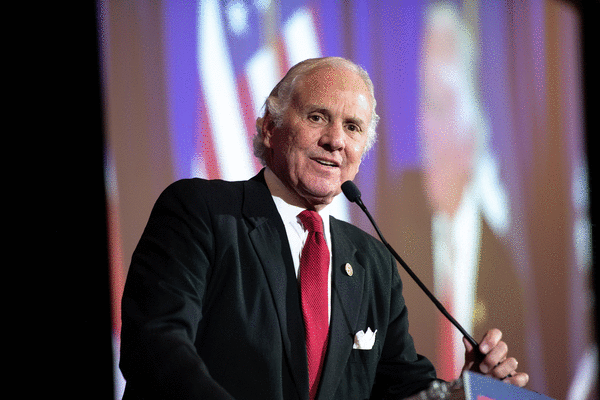
COLUMBIA, S.C. — Did Gov. Henry McMaster exceed his authority in sending 500 South Carolina National Guard troops to the District of Columbia at President Trump’s behest?
That was the question Tuesday before state Supreme Court justices as they first heard from a lawyer from the S.C. Public Interest Foundation argue no, followed by an opposing attorney representing McMaster and National Guard Maj. Gen. Robin Stilwell.
For nearly an hour, lawyers argued in gentlemanly fashion — one calling the other “my friend,” for example — and justices tossed them questions not just about the governor’s power, but also whether the Public Interest Foundation has the standing, or right to sue, the governor and the major general.
The five justices, including one temporary justice — Judge Dan Hall — made no immediate decision. Neither did they indicate when they might rule. From their questions, polite but focused, a ruling could go either way.
“Hundreds of South Carolina guardsmen spent the better part of this year in Washington, D.C., not repelling an invasion or putting down a riot ... but picking up trash, spreading mulch and patrolling subway lines,” said Public Interest Foundation attorney Allen Chaney of the South Carolina American Civil Liberties Union.
Chaney’s arguments were met head-on by Grayson Lambert, McMaster’s top lawyer, who cited precedents over the years and told the justices that “The governor’s decision to call out the militia is unreviewable ... that decision may not be interfered with by judicial authority.”
Out-of-state National Guard deployments are permitted under state law and last fiscal year alone, there were more than 9,500 troops sent out of state for training purposes alone, Lambert told the justices.
And, “there is a long history of the Guard being deployed out of state under the governor’s command,” Lambert said, mentioning wars against Native Americans and Mexico in the 1800s “where the Guard, at that point, the militia, is sent of state to be mustered into government service.”
More recently, the Guard has deployed to Atlanta for security missions in 1996 and to North Carolina the same year for hurricane relief, Lambert said.
The case’s history
The case was brought in January by the Public Interest Foundation in the original jurisdiction of the S.C. Supreme Court, meaning it was not tried in lower courts first. Another plaintiff in the case is James Weninger, identified in the lawsuit as a Berkeley County resident, a Navy veteran who served 16 years in a military law enforcement capacity and a “current taxpaying resident of South Carolina.”
“Weninger’s service experience has taught him the value of a clear separation of military and civilian law enforcement: The military exists and is trained to protect our country from its enemies, and it should not be put in a position where the enemies are the American people,” the complaint in this case said.
“Mr. Weninger seeks to ensure that South Carolina’s military is not being misused for political reasons, and to ensure that South Carolina’s guardsmen are not being asked to undertake a deployment that is not authorized by law,” the complaint said.
McMaster has deployed the guard twice to the District of Columbia, and each time he exceeded his authority granted to him by state law, the lawsuit said.
The two deployments grew out of a 2025 executive order by President Donald Trump declaring a “crime emergency” in the District of Columbia, even though violent crime there was at a 30-year low, the lawsuit said.
McMaster sent 500 troops in all
In August 2025 in response to Trump’s order, McMaster volunteered to send S.C. National Guard troops to the District.
He subsequently sent 200 troops for a deployment of “more than a month,” the lawsuit said.
In a second deployment, in November 2025, McMaster sent “over 300” National Guard troops to the District of Columbia, the lawsuit said.
“Crime is not out of control in the District of Columbia; Washington, D.C., is not suffering an increase in violent crime; and Washington, D.C., is not experiencing rising violence,” the lawsuit said, adding that neither did Washington’s mayor ask for the troops.
The governor exceeded his authority because state law empowers him to only deploy the guard in cases of war, invasion, rebellion, and natural disasters or other emergencies, the lawsuit said.
The lawsuit seeks a declaration by the Supreme Court that the governor exceeded his authority and a permanent injunction forbidding further deployments in response to Trump’s order.
Governor’s case
In a 66-page brief by McMaster and Stilwell, they argued that “as the commander-in-chief of the National Guard, the Governor enjoys broad statutory and constitutional authority to call out the Guard and deploy it. The Governor’s decision to activate the Guard and deploy it to Washington, D.C. at the President’s request is consistent with the S.C. Code of Laws, the S.C. Constitution, and historical practice.”
The brief further argued that “whether conditions existed in Washington, D.C., that warranted calling out the Guard was the Governor’s decision alone ... and state law allows the Governor to activate the Guard to aid civil officers in the execution of the laws.”
The brief also took issue with the plaintiffs’ description of District of Columbia crime conditions, citing a Trump presidential memorandum finding that the District was “under siege from violent crime” and people were “unable to live peaceably” there.
“The governor deployed the Guard to assist with enforcing the laws to bring peace and order to the capital. That’s what Guard members are doing: directly assisting officials to address the specific issue for which the Governor called out the Guard,” the brief said.
The state Constitution "gives the Governor the power to call out the militia to ‘execute the laws’ and ‘preserve the public peace,” the brief said. “Between that broad language and centuries of historical practice of governors sending the militia outside South Carolina while under a governor’s command, the deployment to Washington, D.C., fits comfortably within the Governor’s constitutional call-out power as commander-in-chief.”
High court sits at Clemson University
The arguments in the National Guard case and other cases were held in the Brooks Center for the Performing Arts at Clemson University. The high court travels on occasion around the state as part of an effort to educate the public and students about the court system.
The Center seats nearly 1,000 people and from the video of the event, it looked mostly full.
Those in attendance heard not only the arguments but brief statements by Clemson President Benjamin Ayers, former state judge and lawmaker Gary Clary and S.C. Senate President Thomas Alexander, R-Oconee, and a Clemson graduate, class of 1978.
Alexander, who made a plea for civil discourse and the rule of law, told the crowd that courts “are an essential part” of our system of government and were the reason why Americans resolved disputes peacefully “rather than the point of a bayonet.”
Quoting the Book of James in the Bible, Alexander said people should be “quick to listen, slow to speak and slow to anger.”
When the court ultimately come out with its decisions, having arrived at them through reasoned argument and the law, Alexander said, “Its judgment will be respected.”
_____
©2026 The State. Visit thestate.com. Distributed by Tribune Content Agency, LLC.




Comments