Carney calls for closer Canada-EU alliance to defend values
Published in News & Features
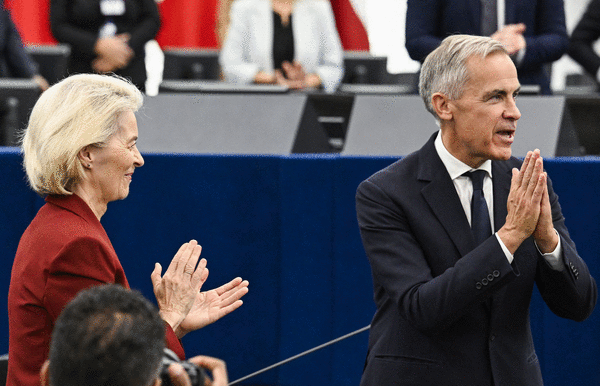
Prime Minister Mark Carney called for a closer alliance between Canada and the European Union in a bid to establish a bulwark strong enough to ward off intimidation from world powers like the U.S. and China that could threaten their sovereignty and territorial integrity.
Carney welcomed a speech made by European Commission President Ursula von der Leyen, when she proposed that Canada become the first “associate member” of the E.U., noting that Canadians support closer ties. President Donald Trump threatened a new round of tariffs against the bloc if he deems the new relationship to be harmful to the U.S.
“We do not seek power to dominate others,” Carney told European lawmakers in Strasbourg, France, on Thursday. “On the contrary, we are pursuing resilience so no one can control our open markets, impair our sovereignty, threaten our territorial integrity, or undermine our freedoms, our democracies, our rule of law.”
Trump has demolished the transatlantic relationship, calling into question American security guarantees for Europe and starting trade wars with both Brussels and Ottawa. The E.U. and Canada have been seeking to form alliances with like-minded partners to band together and oppose the pressure tactics and intimidation of the world’s dominant economies, particularly the U.S. and China.
“Europe and Canada are each strong,” he added. “Europe and Canada are even stronger together.”
Carney’s government, economically shaken by a trade war with the U.S., has made it a top priority to forge deeper partnerships with allies, including the E.U. After U.S.-Canada talks ended last month, Trump imposed 50% tariffs on $20 billion of goods imported from Canada, and Carney soon retaliated with tariffs on a roughly equal amount of U.S.-made products.
Asked about Trump’s criticism of the proposed alliance, Carney said that the move toward an enhanced relationship was a positive development that will make Canada a “better partner with the U.S.” He also said there would be debates and a vote in Canadian parliament on the final structure of any alliance, stressing that “we’re at the start of a road.”
Trade between the E.U. and Canada jumped to €130 billion ($149 billion) last year, following the provisional implementation of a free-trade agreement in 2017. The E.U. is Canada’s second-largest trading partner after the U.S.
Von der Leyen was vague on what associate membership would entail, but said the two regions would seek closer cooperation on manufacturing, tech, defense and energy, and cited the Arctic as a “flagship joint project.”
Among the proposals outlined by Carney were greater cooperation in critical materials, defense industrial capacity, AI, space and payments. Noting that Canada has deposits of more than 34 critical minerals, he said that an E.U.-Canada alliance could “help fill Europe’s need for reliable supply, Canada’s need for advanced processing capabilities.”
In addition, he said that Canada and Europe should also explore the creation of an integrated market for financial services. He also called for Canada’s inclusion in the E.U. program that allows students to study in the bloc’s universities.
Canada’s government has made clear it’s eager to boost economic ties with the rest of the world, including the E.U., in a multi-year strategic shift to reorient trade flows more to the east and west, rather than being primarily focused southbound toward the U.S.
“We are not fair-weather allies. We do not pursue zero-sum deals. Our commitment to the rule of law, and our unyielding defense of human dignity, individual freedom, and democracy share the same deep roots, the same unwavering dedication,” he said. “We believe that our prosperity grows when it is shared. This is a sharing of choice not coincidence.”
The proposal could cause problems in both Canada and in Europe. Previous ideas, including a proposal to offer a “light” membership to Ukraine was shot down by both Kyiv, who feared it would be detrimental to full membership, and by a number of capitals, who insisted the lengthy, merit-based accession process had to be the same for all.
The proposal to formalize a relationship with the E.U. was panned by Canada’s Conservative Party, which is the main federal opposition group. Conservative Leader Pierre Poilievre wrote on social media earlier this week that “We will NEVER be the 51st U.S. state. And we will NEVER be the 28th E.U. state.”
A recent Abacus Data survey found 80% of Canadians support closer integration with the E.U. on issues such as foreign policy, defense and economic opportunities, up six percentage points since February. Support for full E.U. membership is weaker, with 49% of saying they’re in favor of it.
“The objective is not self-sufficiency. It is collective resilience,” Carney said. “This mutual advantage is at the core of the case for a deeper partnership between Canada and Europe.”
—With assistance from Max Ramsay.
©2026 Bloomberg L.P. Visit bloomberg.com. Distributed by Tribune Content Agency, LLC.






Comments