St. Paul leaders silent as police chief's lawsuit against mayor looms
Published in News & Features
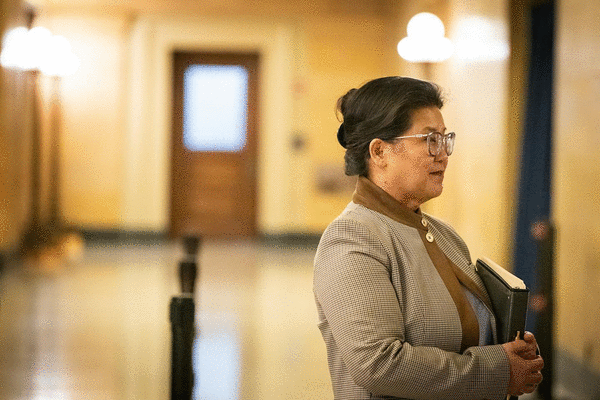
MINNEAPOLIS — A day after St. Paul Police Chief Axel Henry filed a lawsuit claiming Mayor Kaohly Her sexually harassed him, alleging unwanted physical contact and retaliation, there has been near-silence from leaders in the city and in Minnesota about the rare legal action between two top city leaders.
No public statements from officials calling for either to resign. No boosters trumpeting support.
The lawsuit comes less than a week after the city announced that the misconduct investigation into the mayor found she “engaged in offensive and inappropriate behavior” in violation of the city’s workplace conduct policy, according to a summary of the report, but did not sexually harass or retaliate against anyone.
The Star Tribune has contacted more than 20 current and former elected officials, business and community organizations and former police leaders seeking comment on Henry’s new allegations, but nearly all have declined comment or have not responded.
Those who have spoken up worry about the impact of the suit on St. Paul, as Her, Henry and the rest of the city’s leaders try to tackle homelessness, the ailing downtown and high property taxes.
Former City Council member Kathy Lantry said she supported the chief’s right to file the lawsuit, but she worried about the broader consequences for the city.
“It’s a snowball of distractions,” she said of the lawsuit. Lantry said she has seen progress on some of St. Paul’s most persistent challenges over the last several months, but worries the suit will suck up too much time and attention from key city leaders. Not only are the mayor and chief involved, but the city attorney will have to defend the city of St. Paul, and several high-ranking city officials named as witnesses to the events Henry’s lawsuit describes.
“That is so counterproductive for the city of St. Paul,” Lantry said.
Jane Prince, another former city council member, wondered how Henry could continue as an effective police chief while suing the city and the mayor. Prince also wondered why Henry did not attempt to resolve the issues with the mayor, as a professional trained in de-escalation and difficult conversations.
The two-page summary of the outside investigator’s findings, released to the public on Friday, is not the full report compiled by the the St. Cloud-based Resolute Law.
Henry has requested the full report, as have media outlets including the Minnesota Star Tribune. So far, no one outside the St. Paul human resources office and City Attorney’s office has seen the report, according to someone familiar with the matter.
On Sept. 17, the day before city officials released a two-page summary of the document, Human Resources Director Kamaria Kassim emailed Henry informing him that the inquiry was complete and noted that the city would comply with “relevant laws” regarding its results.
State law gives the city attorney’s office 10 business days to release the report to Henry. The office is expected to redact sensitive details, such as the names of people who gave testimony.
In his 73-page lawsuit, Henry complained of a perceived double standard. “[T]he City provided Mayor Her, the accused, with a detailed accounting of the investigation’s findings while withholding that same information from Chief Henry, the victim and complainant — an asymmetry that itself evidences the City’s institutional bias in Mayor Her’s favor, not to mention further retaliation against Chief Henry.”
Jane Kirtley, professor emerita of media ethics and law at the University of Minnesota, urged Her to publicly release the full report, which was paid for by St. Paul taxpayers.
Henry’s lawsuit only heightens the public interest in this case, she said.
“It’s time for Her to step up and be candid about what the report found,” Kirtley said in a phone interview. “It will forestall rumor and innuendo and let the public know what the report concluded without being filtered through interested parties.”
“It’s a lot worse to have people speculating about what’s going on. Whatever the situation is, better to have caveats available for people to scrutinize.”
Two recent human resources investigations into a St. Paul elected official suggest redacted versions of investigators’ reports will be released to the public.
In late 2024, Ward One Council Member Anika Bowie was accused of wrongdoing by a former aide, Jon Berry, and council colleague, Ward Seven’s Cheniqua Johnson. In an email she sent to several people at City Hall, Bowie accused Berry of poor job performance and insinuated that after she fired him, Johnson had hired him back to the city because she believed they had a previous romantic relationship.
Bowie was investigated by an outside law firm, Soldo Consulting of Woodbury, which substantiated the allegations made against her including bullying.
Unlike Her’s case, Bowie was not required to seek training. Berry filed a lawsuit against the city, alleging defamation and privacy violations, and was recently awarded a $360,000 settlement.
St. Paul does not use insurance for legal settlements, so the money for settlements and judgements comes from the city’s general fund.
A second aide’s complaint about Bowie was investigated earlier this year, with a redacted version of the full report also released to the public.
That aide has threatened a lawsuit of her own.
©2026 The Minnesota Star Tribune. Visit at startribune.com. Distributed by Tribune Content Agency, LLC.





Comments