Iran says it won't soften demands as Trump rejects Hormuz offer
Published in News & Features
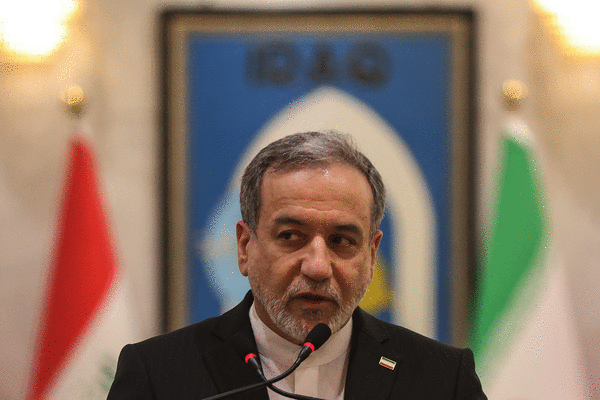
Iran stuck to its seven-day proposal for reopening the crucial Strait of Hormuz, saying it won’t soften its conditions, while President Donald Trump sent mixed signals about his willingness to reach a deal.
The conditions Iran wants are something Washington might have agreed to about a year ago, Trump told Axios in an interview on Sunday, saying that Tehran has overplayed its hand. The U.S. president added that he expects negotiations to resume this week even though he rejected Iran’s latest proposal, Axios reported.
Earlier, the Islamic Republic indicated it was awaiting a definitive U.S. response to its demands and that it had yet to receive anything from Qatari and Pakistani mediators, state-run broadcaster IRIB reported late Saturday, citing Foreign Minister Abbas Araghchi.
“The U.S. president has made some good remarks as well as many contradictory ones, which unfortunately we hear from him frequently,” Araghchi was quoted as saying.
Only a “negotiated solution” can resolve the impasse over the global energy bottleneck, he added.
U.S. and Iranian negotiators had been exploring a deal that would see Tehran reopen the strait and Washington lift a blockade of Iranian ports, according to a person familiar with the matter. The pact would have been similar to the memorandum of understanding the two reached in mid-June, which led to a fragile ceasefire that soon collapsed.
“They made a proposal but I rejected it,” Trump said Saturday as he departed the White House, referring to Iran. “They want to make a deal where they open the strait immediately because they’re losing so badly.”
Araghchi took a defiant stance in a television interview aired Sunday, seeking to put the onus on the U.S. president to accept Iranian demands he has rejected.
“We are ready to open the strait if certain things are done by the U.S.,” Araghchi told NBC’s Meet the Press. “And these things are not new.”
While there’s always room for negotiations, “we have no reason to come back to diplomacy and engage with this administration once again” because the U.S. has repeatedly attacked Iran during Trump’s second term, Araghchi said.
“We stand firm in the face of any aggression against us, even if it comes to a doomsday war,” the minister said.
Oil advanced while U.S. Treasuries slipped after Trump rejected Iran’s latest proposal to reopen the Strait of Hormuz, renewing concerns about Middle East tensions that have roiled bond markets. Brent crude climbed 1.3% to just below $106 a barrel as trading in Asia opened Monday.
The Wall Street Journal reported that negotiators are pressing Iran to make concessions on its nuclear program to revive the peace talks and placate Trump on an issue he has made a top priority.
Treasury Secretary Scott Bessent said the U.S. campaign to squeeze Iran’s economy is working, arguing that China — the biggest buyer of Iranian oil — has sharply reduced its support and left Tehran with fewer options other than negotiating over the Strait of Hormuz.
“Probably within the next two weeks, they’re going to make their final delivery of oil to China and then they will have nothing,” Bessent said on Fox News’ Sunday Morning Futures. “I believe that they are feeling the pressure here and that’s why they want the deal.”
Houthi attacks
Saudi Arabia’s capital came under attack from Houthi militants in Yemen on Saturday — the latest sign of Iranian-backed groups stepping up hostilities against U.S. allies in the Middle East.
Saudi-backed coalition forces in Yemen said air defenses intercepted two drones launched by the Houthis toward Riyadh, as well as a ballistic missile targeting the southern border area of Khamis Mushait.
About a week ago, air-raid alerts were issued for Riyadh’s residents for the first time since the height of hostilities during March and April. Air defenses intercepted missiles headed toward the Saudi capital.
Earlier, the Wall Street Journal reported that Trump expects to resume the bombing campaign against Iran after the U.S. midterm elections in early November and is skeptical about Tehran’s willingness to meet his demands.
Iranian President Masoud Pezeshkian said at the United Nations General Assembly last week that Tehran wouldn’t allow freedom of navigation through the Strait of Hormuz while sanctions and a U.S. blockade remained in place, and wouldn’t give up its right to develop nuclear technology for economic purposes.
_____
(With assistance from Sara Gharaibeh, Tony Czuczka, Jon Herskovitz, Anand Krishnamoorthy and Michael Heath.)
_____
©2026 Bloomberg L.P. Visit bloomberg.com. Distributed by Tribune Content Agency, LLC.





Comments