Ukraine expects no Black Sea ceasefire in coming months
Published in News & Features
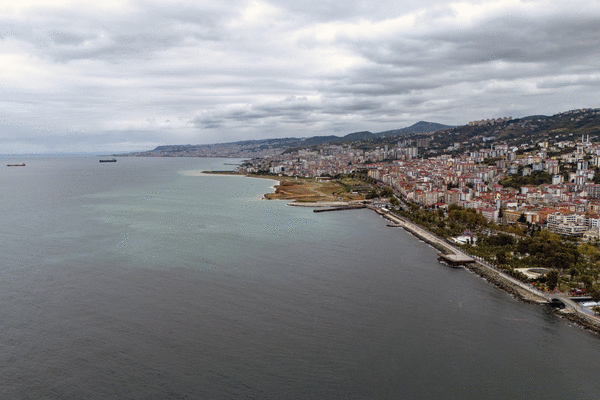
Ukraine sees no positive signs that there could be a ceasefire covering grain exports via the Black Sea in the coming months, as strikes in the region have drastically cut the country’s ability to export products vital to global supplies.
“Unfortunately, it’s hard to imagine any possible solutions in the nearest months on this issue,” Ukraine Agriculture Minister Taras Vysotskyi said in an interview in Brussels. “We have to really prepare that the situation remains as critical as it is now.”
Vysotskyi said Ukraine had been informed by countries facilitating talks that Russia has so far rejected all proposals from Kyiv’s partners, adding that “all of the possible rounds have been tried, and so far none of the results” have been achieved. He was scheduled to update European Union peers on the situation later on Monday.
Escalating strikes between Russia and Ukraine, responsible for more than a quarter of the world’s wheat shipments, have pushed up global grain prices at a time when European farmers have also grappled with extreme weather. The possibility of talks around allowing grain exports via a limited ceasefire or moratorium on strikes helped ease prices this month. Turkey was one of the countries that had said it was trying to reestablish a grain corridor to enable these exports.
Ukraine has seen an increase in exports using alternatives to the Black Sea, now at 45% of what needs to be shipped. However, Ukraine’s analysis is that a maximum of 50% of agricultural commodities can be exported via these routes, meaning there is a risk that around 30 million tons of agricultural commodities will not be exported from the country this marketing year, Vysotskyi said.
In an interview earlier this month, E.U. Agriculture Commissioner Christophe Hansen said the bloc was looking “at all possible lanes” to support grain exports from Ukraine.
Ukraine had sought specific support from the European Union for its agricultural sector, beyond the broad-based financial aid the bloc already provides. But Vysotskyi said the European Commission, the bloc’s executive arm, had denied the request for €220 million ($250 million) for farmers and a mechanism to support their liquidity, though the country would have sufficient funding via a $250 million low-interest World Bank loan.
“It’s going to more or less provide us a possibility to survive until the new year,” Vysotskyi said. “But now we already have to think what’s going to happen from the spring after the new year, because the situation keeps being critical.”
Ukraine also made a request in August to increase its E.U. tariff-free quotas for 2027 for bioethanol and sugar, as it looks to boost exports of products that the bloc needs. Should this happen without an issue, the country will seek to increase its quotas for other agricultural products, Vysotskyi said.
—With assistance from Olesia Safronova and Pyotr Kozlov.
©2026 Bloomberg L.P. Visit bloomberg.com. Distributed by Tribune Content Agency, LLC.





Comments