'I'd rather die here than in Africa': Migrants describe violent deportation flight
Published in News & Features

On a tarmac in Texas, federal agents repeatedly ordered a group of shackled immigrants off a bus and onto an airplane that they had heard was destined for Africa.
Many complied, but some men refused. They had sought protection in the U.S. after fleeing repressive governments and asked to speak to lawyers before being deported to a faraway continent.
"Tell us where you're taking us," Kenis Adalberto López, a 44-year-old from Nicaragua, said he told immigration agents through tears. "I'd rather die here than in Africa."
Eventually, an agent boarded the bus and fired pepper balls at the men, according to interviews with three of them. López, who was hit twice in the chest with projectiles, said he was strapped to a stretcher and carried onto the plane, where he was restrained for the roughly 24-hour journey to Bangui, the capital of the Central African Republic.
More than 25,000 people have been expelled from the U.S. under a Trump administration program to deport asylum seekers and other migrants to "third countries" where they have no ties.
A federal appeals court ordered a pause on the program last week, saying the government failed to give migrants "a meaningful opportunity" to challenge their deportations to third countries. The Trump administration vowed to take the case to the Supreme Court, with Atty. Gen. Todd Blanche describing the program as "an entirely legal and invaluable tool to stem the tide of illegal immigration."
The administration has routinely said that its enforcement operations are carried out in compliance with federal law and that detainees are treated humanely.
The Aug. 29 deportation of López and 42 others to Bangui highlights the sometimes violent tactics that officials have used to force detainees onto flights out of the U.S. — and the perils that await them once they land.
López and others recounted their journey in phone interviews from Africa.
The plane carried migrants from several countries, including Iran, Bangladesh and Afghanistan. Human rights lawyers say that many of them, including an Afghan man whose brothers worked with the U.S. military, had no criminal records and had been granted a special protection that barred them from being returned to their home countries because they had proved to a judge that they faced possible torture there.
Two of the men who resisted boarding the plane were kept in full-body restraint suits resembling straitjackets for much of the flight, according to witnesses. All of the deportees were shackled at the ankles and wrists while in the air.
After stops in two other African countries, the plane touched down in the Central African Republic, one of the world's poorest nations and the site of an ongoing civil war between Muslim and Christian rebels that has claimed tens of thousands of lives over the last 15 years. The primary languages are Sango and French.
The migrants were given shots for yellow fever and taken to a housing complex, where they remain today, monitored at all times by armed guards.
Bangui, which sits across a wide river from the Democratic Republic of Congo, is battling a recent cholera outbreak and faces water shortages and power outages.
Crime is rampant, with the U.S. government itself warning Americans not to visit the Central African Republic because of "unrest, crime, kidnapping, landmines, health issues and terrorism."
Three flights carrying U.S. deportees have arrived there since June, according to human rights groups tracking the issue. Many complain that U.S. immigration agents confiscated their identity documents upon detention and never returned them, making it all but impossible to leave the country. Their immigration status in the Central African Republic is unclear.
Two men who arrived on a July 31 flight recounted being kidnapped on the street by armed men who they believe were police officers.
Yasmani Moreno said he and the other detainee each had to pay the equivalent of $100 to be released.
Moreno, 31, who arrived in Florida on a raft from Cuba in 2016, was initially allowed to stay in the U.S. under the "wet foot, dry foot" policy, which until 2017 let Cubans who reached U.S. soil remain in the country. His temporary permit expired before he obtained a green card.
He has documented his time in Africa extensively on TikTok, taking his followers for walks along Bangui's muddy streets. "They sent me to a failed state," he said in an interview.
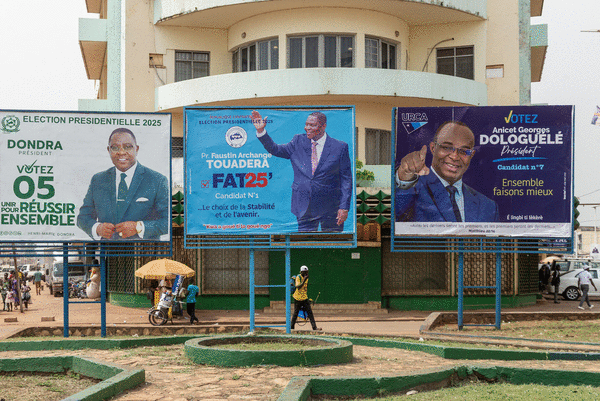
After decades of coups and strife, government forces have sought to disband many militia groups there, sometimes with the help of mercenaries with the Wagner Group, a Russia-based military contractor accused of human rights abuses. International experts have denounced President Faustin-Archange Touadera's repression of the opposition and push to eliminate term limits as worrisome turns toward autocracy.
For deportees who came to the U.S. after fleeing authoritarian countries, an unknown future in another undemocratic nation is frightening.
Luis Hernández, 38, escaped Nicaragua after he marched in 2018 pro-democracy protests that were violently suppressed by the left-wing Sandinista government. He asked for political asylum at the U.S. border. A judge denied his request, but granted him protection from deportation under the international Convention Against Torture. For years, he led a quiet life working as a waiter in hotels in Washington, D.C.
In the past, people with such protection were generally allowed to stay and work in the U.S. indefinitely.
But in February, Hernández went to a regular immigration check-in and was detained. He was held in jails across the U.S., he said, until he was taken by bus to the tarmac in Texas on Aug. 28.
President Trump, in his push to expel 1 million people annually, has vastly expanded the pool of migrants eligible for deportation, with asylum seekers and people who a judge said may be tortured upon return now making up a growing share of detainees.
The U.S. has earmarked around half a billion dollars in aid to third countries who agree to take deportees, according to an investigation by the nonprofit journalism consortium Forbidden Stories, which found that in some cases, deportees sent to third countries were later returned against their will to their home nations.
"This is a deliberate attempt by the Trump administration to place refugees whom the U.S. government has determined need protection directly in harm's way," said Savi Arvey, director of policy for refugee and immigrant rights at Human Rights First.
Hernández said he was never notified that he was going to be sent to Africa — but that he and fellow deportees had heard rumors about flights there and suspected their fate when they saw the size of the plane they were being ordered to board. He said he was struck twice in the back and once in the knee with canisters containing pepper spray after he resisted boarding; pains from the blows persist.
After arriving in Bangui, he said, he went days without eating and sleeping, and suffered what he described as a mental breakdown.
"This is inhuman," he said. "It's psychological violence."
He is worried in particular about ties between the Central African Republic and Russia, which is an ally of Nicaragua's Sandinista government.
Sandinista operatives are suspected in a series of shootings, abductions and killings of Nicaraguan exiles in Costa Rica in recent years. Hernández wonders whether he is safe.
He has been following the news in the U.S. — including the recent appeals court ruling against the third country deportation program. His lawyer has urged him to look for another country that might grant him political asylum, but Hernández still holds out hope that the U.S. will welcome him back.
"There will be justice," he said. "There's still a democracy there."
____
Linthicum reported from Mexico City. Special correspondent Ismael López in Jacksonville, Fla., contributed to this report.
____
©2026 Los Angeles Times. Visit at latimes.com. Distributed by Tribune Content Agency, LLC.






Comments