DA in Lindsay Clancy case won't confirm if he'll prosecute her again
Published in News & Features
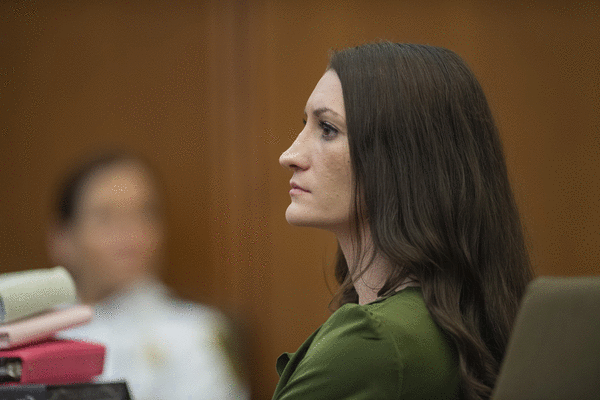
BOSTON — The district attorney who charged Lindsay Clancy with three counts of first-degree murder for the strangling deaths of her children won’t say whether his office plans on prosecuting her again.
“We’re gonna see what happens with the motions,” Plymouth County DA Timothy Cruz told reporters Tuesday after Clancy’s first hearing since a mistrial was declared in her case earlier this month.
The Duxbury mom’s attorney Kevin Reddington spent the morning arguing a motion for a required finding of not guilty, focusing a lot of his time on what he called “woefully deficient” evidence in the case.
He’s also filed a motion to dismiss the charges against his client, citing double jeopardy. That motion will be heard in November. Attorney Matin Weinberg, who also represented Karen Read, is joining the case in a limited fashion for those arguments.
“We’re doing a very thorough review right now,” Cruz said while a gaggle of journalists followed him to his car. “We’re gonna continue to do our job to make sure we do what’s best in the interest of justice and the interest of those three children.”
Clancy is accused of murdering her three kids, Cora, 5, Dawson, 3, and Callan, eight months, in January 2023. During her trial, Reddington didn’t dispute that she killed the children, arguing instead that Clancy was suffering from postpartum psychosis at the time and can’t be held criminally responsible.
But when he spoke in court Tuesday, Reddington homed in on what he said was an inadequate investigation and a lack of probable cause in the prosecution’s case.
“Where is the evidence that she did this?” Reddington asked. “There was no investigation.”
He pointed to apparent blood and drug residue that was not tested and inconsistencies that weren’t investigated further by the State Police. Reddington suggested that Clancy was told she killed her children before she ever confessed to the crime and made statements about what happened that night that turned out not to be true.
For example, Clancy said she slashed her window screen with a knife before jumping out and paralyzing herself from the waist down in a two-story fall, but Reddington noted that evidence presented at the trial showed the screen was not slashed, saying his client’s recollection might be a “false memory.”
The defense attorney referred back to a request he’d made to split the case earlier this year, before Clancy’s trial started, which was denied by Judge William Sullivan.
“You are put in a conundrum where you have to admit culpability when you raise the issue of criminal responsibility,” Reddington said. At the time, he said that his client would admit to the killings if the case was split in two.
Reddington also recalled asking Sullivan to give the jurors a Bowden instruction before deliberations, which would have informed them that reasonable doubt can be based on inadequate police investigations.
“If ever a case called for Bowden instruction, it was this one,” Reddington said in court.
Even if the Commonwealth could prove that Clancy killed the children beyond a reasonable doubt, Reddington said they also had to prove that Clancy didn’t have a mental disease or defect at the time — which none of their experts could say.
“Why would this woman, who the evidence shows clearly and unequivocally was a nurse, a mother, a friend, did nothing wrong in her life, why would she kill those three children,” Reddington asked.
When it was the prosecution’s turn to argue against the motion, Assistant District Attorney Shanan Buckingham called Reddington’s argument against probable cause, “laughable.”
She noted that Reddington had stipulated to certain facts during the trial and said this was the first time she’d heard the argument about a lack of evidence from him.
Moving on to the criminal responsibility arguments, Buckingham said that the Commonwealth doesn’t dispute that Clancy had a mental disease or defect at the time of the killings.
“The next part of the analysis comes into play, and I would suggest that’s where the focus of the evidence is,” she said, explaining that to prove criminal responsibility, the prosecutors had to show, beyond a reasonable doubt, that Clancy understood the difference between right and wrong and could comport her behavior to the law.
“Not every defendant with a mental illness lacks criminal responsibility,” she said.
Clancy “was in a point in her life where she felt like she was never going to be the same, never going to be the person that she was before,” Buckingham argued, and so the defendant decided she was going to commit suicide, and “she was going to take the kids with her — she didn’t want them to suffer.”
Judge Sullivan said he would take the motion under advisement.
Clancy will be back in court Nov. 2 for a hearing on other motions filed, including Reddington’s motion to dismiss the case and his request for an inquiry into the lone, holdout juror.
That juror’s attorney Heather O’Connor appeared in court to request more time before arguments were heard on the inquiry motion.
She spoke to reporters outside the courthouse to tell them that her client, who she referred to as “Juror Doe,” but who was identified by his other lawyer as Michael Peguy Desronvil, wants privacy.
The inquiry motion requests information about any criminal or domestic abuse cases Desronvil may be involved in and his cell phone records from during the deliberations.
When asked whether the juror disclosed domestic abuse allegations against him during voir dire, O’Connor said that Desronvil believes he filled out his jury questionnaire accurately.
She said the singling out of her client was “unusual,” adding to the gathered media,, “it needs to end.”
________
©2026 MediaNews Group, Inc. Visit at bostonherald.com. Distributed by Tribune Content Agency, LLC.






Comments