Quebec separatists win power in new challenge for Canada's Carney
Published in News & Features
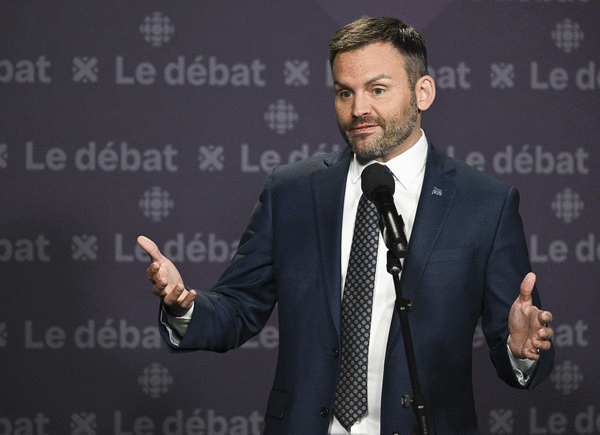
Voters in Quebec elected a separatist political party for the first time in more than a decade, setting the stage for more strained relations with Prime Minister Mark Carney’s government and an eventual referendum on the province’s independence from Canada.
The Parti Québécois won the election, Radio-Canada declared shortly before 8:40 p.m. Montreal time on Monday. It wasn’t yet clear whether the PQ would win a majority of the 127 seats in the provincial legislature, allowing it to control the agenda without the help of minor parties.
PQ Leader Paul St-Pierre Plamondon, a 49-year-old former lawyer, is set to become the French-speaking province’s new premier. He has promised to hold a referendum on secession during a first four-year term — but not before U.S. President Donald Trump leaves office.
“The completely unprecedented situation we have just experienced with the Americans — which is unacceptable on the part of the Trump administration — does not provide a calm environment to reflect on our future,” St-Pierre Plamondon said during a recent TV debate.
It would be the third referendum in the province’s history. In the last attempt in 1995, the pro-sovereignty “yes” vote lost by a margin of just over one percentage point.
The Parti Québécois was leading or elected in 62 seats as of 8:47 p.m. — it needs 64 to hold a majority. The Quebec Liberal Party was running second with 32. The governing Coalition Avenir Québec was leading or elected in just four.
Market risk
A referendum, even if several years away, is a significant risk to Canadian unity. Patrick Taillon, a constitutional expert at Université Laval, pointed to the “volatility and unpredictability” of voters, where people who are “dissatisfied at a given moment” can suddenly tip the scales.
Risk premiums for Quebec bonds have widened lately. A spread index on 30-year Quebec bonds is more than 9 basis points above its Ontario equivalent, up from about 7 basis points two weeks ago. Quebec’s 10-year bond spreads over Canadian government bonds are also currently the widest among the four major provinces.
“Clearly spreads would widen and perhaps rather sharply in a true referendum campaign, especially if it surprised pollsters by not rejecting separation,” Derek Holt, Bank of Nova Scotia’s head of capital markets economics, said in a report Monday.
But for now, many Quebecers don’t view a referendum as a priority.
The PQ’s victory is not necessarily an endorsement of separation. Several polling firms have shown about 70% of Quebecers are opposed to independence, especially with the ongoing trade war with the U.S. However, their view could very well change if U.S.-Canada tensions ease, or Carney’s strong popularity wanes.
“As far as I’m concerned, the referendum, if it happens, it’ll happen. It’ll create uncertainty, whatever,” Alain Bouchard, the co-founder and executive chairman of the Canadian convenience store giant Alimentation Couche-Tard Inc., said. “I’ve voted ‘yes’ before, and I’ve voted ‘no.’ As far as I’m concerned, if it comes up again, we’ll see. But it’s not my main concern.”
Bouchard was speaking Friday at a Montreal event organized by Andrew Lutfy, the head of apparel company Groupe Dynamite Inc. Lutfy gathered hundreds of Quebec business leaders to ask the next government to reduce regulatory hurdles and implement policies to help boost Quebec’s gross domestic product to $701 billion over the next seven years.
The province has become “uninvestable, much less attractive than other markets around the world,” said Lutfy, whose company is based in the Montreal region.
St-Pierre Plamondon said after the event that he was “pleasantly surprised,” and the business leaders’ comments resonated with his views. The PQ’s plan includes large cuts in the number of civil servants and a gradual reduction in the corporate income tax rate to 9.5%, from 11.5%, offset by a reduction in grants for businesses.
His agenda sits well with many businesses. In his first 100 days in office, Quebec’s new premier has promised to unlock funds to address homelessness, eliminate taxes on used goods, lower the gas tax, create a secretary to overhaul the bureaucracy, conduct an audit of technology projects and lower immigration thresholds.
St-Pierre Plamondon emphasized during his campaign that it’s important for Quebec to have greater control over its language, culture, immigration and finances. That may exacerbate tensions with the federal government.
CAQ’s collapse
St-Pierre Plamondon’s fortunes were lifted by the collapse in popularity of the ruling Coalition Avenir Québec.
When the CAQ first came to power in 2018, Premier François Legault promised to promote Quebec’s autonomy and distinct identity without calling for a formal separation, ending the rotation of power between federalists and separatists.
Legault won a landslide reelection victory in 2022, thanks to his strong leadership during the Covid-19 pandemic. Public support just went downhill from there, with an economic agenda tarnished by failed investments in private projects and a credit downgrade, and crumbling healthcare and education systems.
Legault stepped down in April. His successor, Christine Fréchette, couldn’t shift the narrative and her party’s support dropped during the campaign.
©2026 Bloomberg L.P. Visit bloomberg.com. Distributed by Tribune Content Agency, LLC.




Comments