About 30 Alaska Native youths buried at boarding schools decades ago are now returning home
Published in News & Features
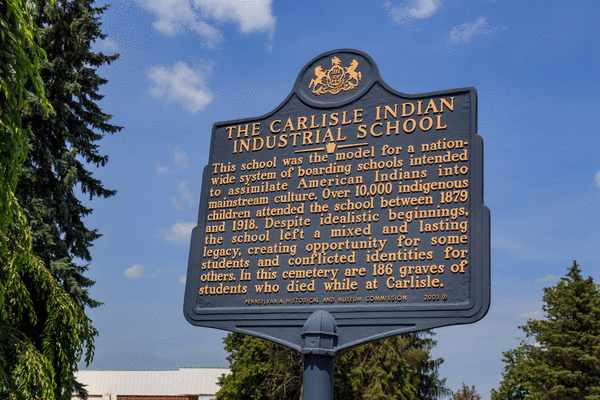
Around 30 Alaska Native students who died more than 100 years ago at boarding schools designed to sever connections to their culture are returning to be reburied in their homelands.
In the 19th and 20th centuries, Alaska Native and Indigenous youths from across the U.S. were sent to boarding schools or other institutions operated by the federal government and others, like religious organizations. There, students were forcibly assimilated into American culture.
At least 31 from Alaska died while attending institutions like the well-known Carlisle Indian Industrial School in Pennsylvania between 1819 and 1969, according to a 2024 Interior Department report. While the report identified about 900 other deaths during that period, the government hasn't determined the total number of Indigenous students who died at one of the schools during that era.
Last week, the remains of three Alaska Native children who died at the Carlisle school in the early 1900s after they were taken from their communities as teenagers were disinterred from the now-closed institution's cemetery and transferred to descendants following research led by the Alaska Native Heritage Center.
About 25 others whose remains were exhumed from gravesites more than a decade after dying at an Alaska boarding school and being taken to an out-of-state institution will also be returned to the state this month, Benjamin Jacuk, the heritage center's director of research, said in an interview.
The homecomings, made possible by Native Heritage Center researchers who scoured records scattered across the country and identified current descendants, was the largest single repatriation of Alaska students from Carlisle, Jucuk said in a Facebook post.
The effort, including remains of the other 30 or so, also appears to represent the largest overall number of such returns to the state over such a short time frame.
"I'm really just happy to see that things are starting to move ... that we're able to actually reunite families that had been split apart, not necessarily (to) right the wrongs of the past, but to be able to bring healing to our families," Jucuk said.
Long journey's end
The three Alaska Native students at Carlisle — Iñupiaq youths Tummassak and Edward Angalook, and Lucy Spaulding, a Tsimshian girl from Metlakatla — began returning home after the Office of Army Cemeteries transferred their remains to living family members during a Sept. 30 ceremony.
All three died of tuberculosis, according to Alaska Native Heritage Center researchers and online Carlisle records.
Angalook, who was 20 years old when he died in 1905, was reburied in Unalakleet — the Bering Sea village where ANHC researchers said renowned reindeer herder Sinrock Mary raised him — on Oct. 1, Jucuk said.
Tummassak was buried in Shishmaref during a ceremony on Oct. 4, while Spaulding's family is planning a memorial service next week, according to Jacuk.
Reburial plans for the approximately 25 other students, who were all from the same Athabascan village, have yet to be finalized, he said. The students died during a tuberculosis epidemic, according to the researcher.
The three Alaska Native youths buried at the Carlisle school's cemetery were among 12 of the institution's students that the U.S. Army planned to repatriate this year at the request of family members and tribal nations.
A fourth Carlisle student, Mabel Booth, who also was known by the last names of Stack or Stock, was originally set to return to Alaska as part of the recent repatriations.
But testing of remains from the gravesite thought to belong to the Tsimshian girl from Loring showed that they were "inconsistent with the burial records" of the child, the Office of Army Cemeteries, which oversees the disinterment process, said in a statement.
The remains were returned to the grave and marked unknown, according to the statement. The Army "remains fully committed" to identifying and locating the remains of children in unknown gravesites at the school, according to the statement.
"Please be assured that the Army team continues to work tirelessly to uncover vital information that will help us learn more about these children and where in the cemetery they are buried," Karen Durham-Aguilera, executive director of the Office of Army Cemeteries and Army National Military Cemeteries, said in the statement.
'Assimilative institutions'
The Alaska students were among more than 18,600 Indigenous youths who attended one of approximately 415 boarding schools or similar institutions, including about two dozen in Alaska, over the period detailed in the federal government's 2024 report. More than 7,800 Native American or Alaska Native students attended Carlisle, including 127 from Alaska.
The schools separated children from their families or communities and stripped them of their language, cultural and religious practices, using often violent and traumatic methods, to integrate them into Western culture.
Poor conditions, malnourishment and disease were common at the schools, the federal government said in an earlier 2022 report. Students also experienced "rampant" physical, emotional and sexual abuse, according to the report.
Those who survived often experienced chronic physical ailments, disease and mental problems as adults due to the trauma and stress of the experience, which can negatively alter DNA passed down through future generations, according to the 2024 report.
The report didn't include the number of students or deaths at 1,025 other boarding schools or educational institutions that weren't operated or funded by the federal government.
The overall number of deaths is likely higher than those identified in the 2024 report, the federal government acknowledged.
Researchers at ANHC, publishing their findings online, said they've also identified dozens more educational institutions not included in the 2024 report that were run by the federal government or other groups like religious organizations in Alaska.
But ANHC researchers said it's unclear how many Alaska Native youths died at the schools or other institutions, like day schools or sanitoriums, where classes were offered during the era of forced assimilation.
"To give an idea of how many kids really went there, you can confidently say that every Alaska Native today has a relative — a grandparent — that (attended), even if it wasn't necessarily a boarding school, one of those kinds of assimilative institutions," said Sophia Dupras, an ANHC researcher who contributed to the effort and whose tribal affiliation is Unangax̂.
At least three of the 14 Alaska Native students who died at Carlisle have been returned to Alaska previously, including one in an effort led by Kodiak Island's Alutiiq Museum. Jacuk said he couldn't recall students who died at other schools being repatriated.
Some boarding schools, like Mt. Edgecumbe High School in Sitka, continue to operate, but without what the 2024 report called "assimilationist intention or practices."
Reckoning with history
The repatriation effort was an extension of ongoing work the Alaska Native Heritage Center has undertaken with the support of other tribal organizations in the state to honor boarding school students and highlight the lingering effects — such as substance abuse rates and the frequency with which Indigenous people go missing or experience violence — the era has had on Indigenous people through exhibits and events, Jucuk said.
"It does still have consequences today," he said of the boarding school era.
Jucuk, of Dena'ina and Sugpiaq descent, said one of his grandfathers attended a boarding school but rarely spoke about his experiences.
The Army approached the Alaska Native Heritage Center in 2024 to ask if the museum would help identifying family members of the children buried at Carlisle, Jucuk said.
Researchers used the papers of school administrators and prominent Alaska missionaries like Sheldon Jackson, genealogical records, census data, university archives and church records accessed thorough agreements with a number of religious organizations, among other methods, to confirm the identities of the Carlisle students and identify present-day relatives, Jucuk said.
The records were often incomplete, riddled with errors like misspelled names or hard to read because of illegible handwriting, he said.
In Tummassak's case, she was listed as Tomicock on her gravestone, as Tomiclock in school records and couldn't be tied to any current family members, Jucuk said. But researchers caught a break when an ANHC researcher viewing a photo of her recognized a matriarchal chin tattoo that appeared to match that of a great-great grandmother who closely resembled Tummassak, he said.
After identifying living relatives and confirming that they wanted to bring their descendants home, researchers helped families navigate the complicated repatriation process, Jucuk said. Some of the students' relatives, he said, didn't know of the ancestor or that they had died while attending a boarding school.
This is the first group of children from Carlisle that ANHC has identified and helped repatriate, Jucuk said.
ANHC researchers said they will continue working to document the deaths of students at boarding schools and locate the burial locations of students who died at Carlisle in addition to other efforts, like digitizing church records from the era and recording oral histories.
"We're hoping that we're able to bring at least some form of healing to a wound that a lot of people didn't know was there," Jucuk said. "But it's also that acknowledgment of the wound, not only for our own communities, but really for Alaska in general, that this is a part of our history."
_____
©2026 Anchorage Daily News. Visit at adn.com. Distributed by Tribune Content Agency, LLC.




Comments