Could wine grapes as raisins save struggling industry? A former Napa grower is betting on it
Published in News & Features
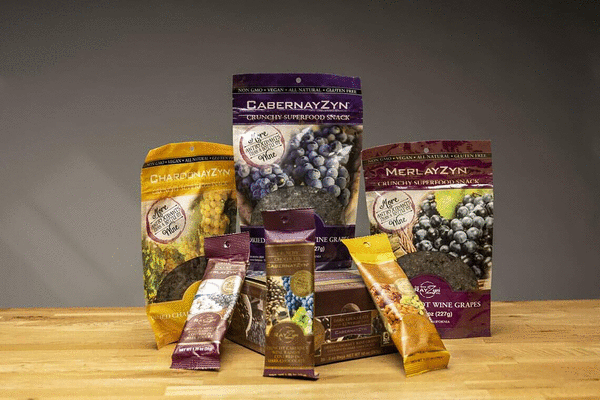
People have debated the health benefits of wine for years.
Older studies suggested that a glass of red wine could reduce the risk of cardiovascular disease, but more recent studies question that conclusion.
One man is trying to add to the debate: He wants consumers to eat wine grapes.
Andrew Cates, co-founder of the Wine RayZyn Co., is turning wine grapes into raisins — a non-alcoholic product not to be confused with the tobacco product Zyn. The former Napa Valley grape grower and winemaker works with his father, a retired cardiologist, on the endeavor.
Cates views his wine grape raisins as the next great superfood. He also wants to reduce waste and boost the struggling wine industry with a secondary market for selling grapes.
“The question that I keep on asking is: Why are we growing some of the most nutrient-dense fruits on Earth strictly for one channel? Wine,” Cates said. “It doesn’t make sense. We should be eating these things.”
Cates’ company refers to his product as “wine raisins,” “dried wine grapes” and “Wine RayZyn.” They are filled with fiber and are billed as having “more antioxidants than a glass of wine” on product packaging. Antioxidants — typically found in fruits, vegetables, whole grains, nuts and seeds — can prevent cell damage. The plain raisins are vegan, gluten-free and have no added sugars or preservatives, according to the food label.
The wine raisins are made with different wine varietals: cabernet sauvignon, chardonnay and merlot. Some are coated with chocolate, caramel and Greek yogurt. The company has previously harvested grapes that could not be made into wine following wildfire smoke-taint, including from Cates’ own vineyard.
Wine grapes have traditionally not been eaten because of their thicker skins, seeds and higher acidity levels. They are also not grown with table consumption in mind as with other grapes.
The majority of RayZyn’s wine grape drying and processing occurs at a facility in Colusa County, California, with some conducted in Oregon as well. For the confections part of the business, Cates said he uses facilities outside of California.
The wine raisins have an earthier flavor compared to traditional raisins and still have their seeds, which Cates intends for consumers to eat. The chocolate-covered raisins taste similar to other chocolate-covered fruit products. The caramel-covered raisins bear a resemblance to Milk Duds, according to Bee reporters who tasted the product.
“I’m not trying to step on the toes of the wine market,” Cates said. “I want to work with the wine market.”
California growers and winemakers of all sizes are wrestling with an oversaturated market due to a steep drop in consumer demand and the loss of the majority of wine exports to Canada. Many consumers are drinking less or buying ready-to-drink beverages such as beer and canned cocktails.
In recent years, many grape growers have left fruit to rot on vines, and many winemakers have product sitting in tanks. Numerous grape growers and winemakers have laid off staff.
The wine and grape industries are billion-dollar enterprises in California. The state produces around 80% of all wine in the U.S., according to industry groups. The wine industry supports more than 422,000 jobs statewide, generating about $73 billion in annual economic activity, according to the California Department of Food and Agriculture.
The most recent grape crush report from the U.S. Department of Agriculture shows wineries crushed 2.62 million tons of wine grapes in the Golden State in 2025, down over 8% from 2024. The average prices for red and white wine grapes per ton were down 4.4% and 0.9%, respectively, from 2024 to 2025.
Cates sees his business as an opportunity for grape growers who don’t have contracts for their fruit to still earn some money, even if it is less than what growers could historically sell it for in the wine market.
The former owner of Segassia Vineyard, he knows firsthand what it is like to have uncontracted grapes. After buying the vineyard in 2012 and enduring many of the challenges that growers and winemakers are facing, Cates sold the property last year. This year, Cates said he had a multi-million dollar investment fall through, so the company will likely not harvest and process new grapes. It will instead rely on existing inventory for any orders that come in.
For $29.99, a consumer can purchase a 12-pack of 1.6 ounce bags of plain wine raisins on the RayZyn website. This price goes up to $49.99 for a six-pack of eight ounce bags of plain raisins and $32.99 for a 10-pack of 0.6 ounce bags. For the large chocolate bundle, which includes yogurt- and caramel-covered raisins, the price tag is $29.99 for a total of roughly 17.5 ounces of raisins.
Cates described his business as a “for-profit company that has a real deep social mission.”
“I think (the raisins) can change the way people function,” Cates said. “I think it can change their gut biome given the fiber aspect, and I think it could solve a real problem that we are having with the wine grape growing crisis.”
Four RayZyn Facts
—Founded in 2014, RayZyn has undergone two funding rounds: one in 2016 that raised $2.5 million from investors and a smaller equity crowdfunding round after that.
—Cates said the company was profitable in 2020 and 2023 but declined to share further information about its finances.
—Cates said RayZyn has processed over 1,000 tons of grapes from various California wine regions since its founding. Depending on financing, Cates hopes to harvest 1,000 tons next year and 2,000 to 3,000 tons after that.
—The company has sold its raisins to the Ritz-Carlton, Los Angeles International Airport, San Francisco International Airport and United and American Airlines. Consumers can purchase the products on the RayZyn website, Amazon and in certain airport stores.
____
©2026 The Sacramento Bee. Visit at sacbee.com. Distributed by Tribune Content Agency, LLC.






Comments