Great Lakes oil spills are usually small but still harm water, study warns
Published in News & Features
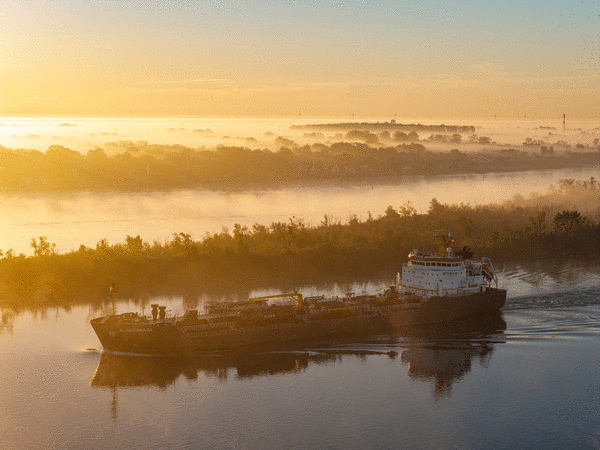
Oil spills pose a multifaceted threat in the Great Lakes, where oil transit pathways overlap and concentrate in major waterways such as the Straits of Mackinac and St. Clair River, a group of researchers found in a new study led by Lake Superior State University.
Although major oil spills such as the Enbridge Line 6b rupture into a Kalamazoo River tributary in 2010 are an important concern for health, safety and the Great Lakes environment, the scientists argued smaller, more frequent oil spills deserve greater attention because the problems they cause accumulate over time.
"We tend to focus on the large spills because of their impacts, but smaller spills happen much more frequently, and their ecological effects remain largely unstudied," Cecilia Heuvel, an LSSU postdoctoral research associate at the university's Center for Freshwater Research & Education, said in a statement.
Huevel and her coauthors published their work in the Journal of Great Lakes Research in September.
They reviewed oil spills that took place in both the U.S. and Canadian sides of the Great Lakes basin from 2014-2024. They found 6,453 total spills, but said data about the amount of oil released and the source of the spills was often lacking, as is research into the impacts of oil spills in the Great Lakes.
That leaves an incomplete picture for anyone trying to understand the impact oil spills have on the Great Lakes environment and people living in the region.
"Without an accurate picture of the amount or type of oil being released into the Great Lakes, and the absence of environmental monitoring following spill events, it is not possible to assess the ecological effects of spills in these critical ecosystems," they wrote. "While rare, large spills can be devastating due to their size and the scale of their clean up, the cumulative impacts of multiple smaller oil spills may have equally significant, albeit different detrimental ecological consequences, yet remain poorly understood, in part due to knowledge gaps in existing spill records."
The research was published as the future of Enbridge's Line 5 remains a source of heated debate in Michigan as well as the most prominent example of the oil infrastructure traversing the region.
Enbridge's pursuit to replace the 73-year-old pipelines with a tunnel beneath the Straits of Mackinac hit a roadblock this summer when the Michigan Supreme Court ordered further review of the environmental impacts of operating the pipelines. Officials then announced the Michigan Department of Environment, Great Lakes and Energy will reconsider permits it issued for the tunnel project.
The research spearheaded by LSSU was conducted alongside science groups including the U.S. Coast Guard's Oil Spill Center of Expertise and others that are investigating the ways oil behaves in fresh water compared to salt water.
"We have a lot to learn about how oil behaves in fresh water still," Heuvel said in an interview with The News. "That's been an ongoing question through everything we’ve done over the last few years. There's a lot of research that's been done in marine systems on oil behavior" but not on fresh water systems.
Great Lakes connecting waters most at risk
The scientists who worked on the study looked at past research, news reports and U.S. and Canadian oil spill databases to look for patterns in recent Great Lakes area oil spills and figure out which areas are most at risk. They focused on spills in the Great Lakes, connecting waters, or shoreline counties.
The waterways that connect the five Great Lakes — the St. Marys, St. Clair, Detroit, Niagara and St. Lawrence rivers as well as the Straits of Mackinac and Lake St. Clair — are more at risk of oil spills than the lakes and may be more sensitive to the pollution, the researchers found.
Those connecting waterways tend to have more urban and industrial development on their shorelines as well as more shipping activity. Spills there have more of a chance of reaching sensitive shoreline areas, since the connecting waterways are not as likely to disperse the contaminants.
Data gaps hurt oil spill research
There were significant gaps in the data researchers reviewed, Heuvel said. American and Canadian first responders coordinate their responses to oil spills, but they haven't coordinated their data collection.
"They respond to incidents together, however that hasn't translated over to reporting systems yet," she said.
Databases of U.S. oil spills did not include a source for approximately a third of the oil spills in the U.S. side of the Great Lakes from 2014-2024, the researchers found. In Canada, about a quarter of spills were from an unknown source.
The amount of oil spilled during each incident also was often a mystery. Publicly available Canadian spill data did not include volumes of releases until 2023, and only 35% of American spills included volume estimates.
The type of oil released also was frequently left out of those databases, the researchers said.
"Together, these limitations introduce considerable uncertainty into assessments of spill magnitude and ecological risk, highlighting the need for more complete and standardized reporting," they wrote in the paper.
Of the spill reports that had information about the amount of oil released, most were small, Heuvel said. That could shape how she and other researchers study the issue in the future.
"Oil spills within the environment can be devastating both in terms of animal life and people's ability to enjoy it," she said. "If we're considering the cumulative impact of multiple small spills versus the impact of a single large spill, we're potentially looking at very different responses in the environment. With multiple small spills, we're looking at more of a low-level lasting effect on the system whereas with a large spill we'd be looking at more short term consequences."
Small oil spills spell 'death by a thousand cuts'
Most of the spills were small, with fewer than 132 gallons spilled, but collectively they accounted for most of the total reported volume of oil spilled in the region from 2014-2024, the researchers found.
That could put the environment at risk of "death by 1,000 cuts" as the impacts of small oil spills accumulate, the scientists said.
Those small spills have been caused by industrial facilities, vehicles, gas stations and wrecked pleasure boats. Most spills originate outside of the oil and gas industry, Heuvel said. They often include oil-based products that aren't fuels, such as hydraulic fluid used to lubricate equipment.
"It kind of makes you reconsider where oil is used and how ubiquitous it is in our culture," she said.
The researchers highlighted multiple small or medium oil spills from Algoma Steel in Sault Ste. Marie in 2022 that led to drinking water advisories for residents who source water from the St. Marys River. In 2025, about 1,320 gallons spilled from a Shell refinery in Sarnia, Ontario into the St. Clair River.
Those spills show how "proximity of industry to the Great Lakes increases the potential for spills to affect aquatic ecosystems, particularly in constrained waterways," the researchers wrote.
Transportation poses another oil spill danger, they said. Regular passenger vehicles like cars and trucks typically carry between 10 and 25 gallons of gasoline, and oil spills from those vehicles may be underreported or considered insignificant, the researchers found. They pointed to a 2024 case in which a gas station in Ottawa Lake, Michigan, released about 12,000 gallons of diesel into a creek about 10 miles upstream of Lake Erie.
"There's a lot of different, ongoing threats to the system," Heuvel said. "They may be smaller, but they're continuous and the impacts of them are not clear to us yet."
_____
©2026 The Detroit News. Visit detroitnews.com. Distributed by Tribune Content Agency, LLC.






Comments