Racist group chats sparked fear at FIU. Now a judge signals who may win lawsuit
Published in News & Features
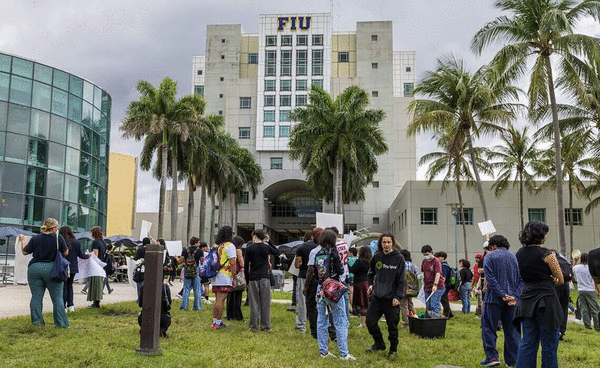
A federal judge in Miami signaled Thursday that she is strongly inclined to rule in favor of Florida International University in a First Amendment lawsuit brought by four students suspended or expelled over racist, antisemitic and violent messages exchanged in private group chats.
Chief U.S. District Judge Cecilia Altonaga, speaking after two days of testimony, said the university had presented strong evidence that the messages frightened students, disrupted campus operations and interfered with its educational mission, regardless of whether the students intended their remarks as jokes.
“I’m strongly inclined to deny your motion for preliminary injunction and enter a judgment on the merits for the defendant,” Altonaga told the attorneys and students. “Strongly inclined to do so.”
The judge emphasized that she has not reached a final decision and would give the students’ lawyers another opportunity to persuade her through additional arguments. But she delivered a direct warning about their prospects.
“It does not look good for you gentlemen over there,” Altonaga said, addressing the students.
Her remarks followed extensive testimony from Dr. Emmanuele Bowles, a senior FIU administrator, who described students afraid to attend classes, complaints from parents and faculty members, increased campus police patrols and weeks of university resources diverted from other investigations to address the controversy.
Bowles said the messages generated approximately 60 incident reports, numerous emails and expressions of alarm from student organizations representing Black, Jewish and other minority communities.
The lawsuit challenges disciplinary sanctions against Abel Carvajal, Dariel Gonzalez, Ethan Ratchkauskas and Dante Mojena, who contend that FIU violated their constitutional rights by punishing offensive but protected speech. Two were expelled and two were suspended, according to the judge’s summary of the sanctions.
The students maintain that the conversations consisted largely of deliberately provocative jokes, internet memes and political exaggerations that were never intended as genuine threats.
Their attorney, Anthony Sabatini, argued that the university had misinterpreted the private messages and reacted to a controversy amplified by news coverage rather than to an actual danger on campus.
FIU, represented at trial by Chris Bartolomucci, a partner at the lawfirm Schaerr Jaffe, maintains that the messages contained threats and caused serious disruption to the university community.
Fear in classrooms and dormitories
Bowles, who oversees FIU’s civil rights compliance operations, testified that the controversy produced an extraordinary reaction at a university with more than 56,000 students, the vast majority of whom belong to minority communities.
She said students reported fearing for their safety in classrooms, dormitories and other campus facilities after excerpts of the conversations became public in March.
One Black student wrote to university officials that the messages went beyond offensive language.
“The threats made in this group chat go far beyond casual racism. They resemble a manifesto of extreme violence,” the student wrote in an email read during Thursday’s proceedings.
“Many of us no longer feel safe walking around campus, attending classes, or moving about our dorms,” the email continued. “This is a serious mental health and physical safety issue.”
The student described the controversy as “a life-threatening and traumatizing situation, not a matter of opinion.”
Another student reported that the conversations made her fearful whenever she was on campus.
“As a Latino student, I feel unsafe and in danger knowing these students and their respective organizations are still on campus and permitted,” the student wrote in an incident report presented as evidence.
Bowles said similar concerns were expressed by other students during telephone calls and meetings with university administrators.
The testimony also addressed the experiences of Sandra Jean-Pierre, a Black law student who uses a wheelchair and shared a class with Carvajal.
According to an email from adjunct law professor Julie Talbot, Jean-Pierre became visibly shaken and had difficulty concentrating when Carvajal attended class. Talbot reported that the student was able to focus more effectively when he was absent.
Jean-Pierre later testified in a university proceeding that her fears affected her concentration, sleep and participation in class between March 4 and April 15.
Talbot asked whether Carvajal could be required to attend class remotely through Zoom, but FIU declined because no disciplinary action had yet been taken against him and imposing such a requirement could interfere with his education.
Bowles said the concerns were particularly acute among law students because they could encounter participants in the group chats in their classes.
University increases patrols
Bartolomucci questioned Bowles extensively about the university’s response after the messages became public.
She testified that FIU organized eight meetings with student leaders, inviting representatives from more than 80 organizations.
Among the groups involved were the Black Student Union, the Jewish student organization Hillel, the National Pan-Hellenic Council and student government representatives.
Senior administrators, including FIU President Jeanette Nuñez, the provost, police chief, general counsel and dean of students, participated in the meetings.
Bowles said students wanted to know whether they were safe and what the university was doing to address the messages. Officials explained the disciplinary and investigative processes but were limited in what they could disclose by student privacy laws.
The university also met with representatives of the Miami-Dade branch of the NAACP, who said students had contacted the organization seeking answers.
According to Bowles, some NAACP representatives discussed encouraging campus protests or advising families against enrolling their children at FIU.
Campus police increased their presence in heavily populated areas, including the Graham Center, the College of Law and student dormitories.
The controversy required substantial administrative resources, Bowles said, including reviewing extensive chat records, investigating complaints and coordinating assistance for affected students.
She testified that investigators in her office were reassigned from other responsibilities, including sexual assault and sexual misconduct investigations, to examine the messages.
“We had to pull our investigators off of investigating claims of sexual assault, sexual misconduct investigations,” Bowles said during cross-examination.
She said the work consumed weeks that otherwise would have been devoted to other investigations.
In nearly 20 years at FIU, Bowles testified, she could not recall another student-conduct controversy that generated comparable fear and disruption.
Defense challenges claims of disruption
Sabatini sought to undermine the university’s account by distinguishing between students feeling frightened and actual interruptions to academic activities.
Under questioning, Bowles acknowledged that she was unaware of any student who had been confirmed to have missed class because of the group chats.
She also acknowledged that no classes were canceled as a result of the controversy.
The attorney suggested that the university’s decision to increase police patrols reflected an effort to reassure students rather than evidence that the four plaintiffs posed an immediate danger.
Bowles agreed that the increased police presence was intended to provide a sense of safety to the campus community, not to locate or confront the students who had participated in the chats.
Sabatini also questioned the origins of the complaints received after news organizations published excerpts of the messages.
He pointed to incident reports containing nearly identical wording, suggesting that some students had copied and submitted complaints without personally reviewing the original conversations.
Bowles acknowledged similarities among some reports but said her office also received individual complaints and met with students whose concerns were not based on copied statements.
She emphasized that FIU had an obligation to take all reports seriously.
The attorney questioned why university officials considered certain messages genuine threats when campus police and prosecutors had not pursued criminal charges.
Bowles distinguished between the legal standards for criminal prosecution and the university’s responsibility to address conduct that could threaten student safety or violate campus regulations.
She testified that FIU officials reviewed messages about shooting a professor, blowing up Dolphin Mall and committing violence against Black people and women. Some were referred to campus police for assessment.
Publicity and disciplinary action
Sabatini argued that the timing of the university’s disciplinary response suggested that publicity had played a significant role.
Earlier Thursday, Devin Parra, FIU’s assistant dean of students and director of Student Conduct and Academic Integrity, acknowledged that news coverage accelerated the disciplinary process.
Parra nevertheless maintained that the charges were based on the content of the messages and the university’s conduct rules.
He also acknowledged that the students had not been charged under the university’s specific disruptive-conduct provision, although FIU maintained that other provisions of its disciplinary code applied.
During Wednesday’s testimony, the students defended their statements as edgy humor, however offensive they might appear outside the context of the private conversations.
Gonzalez testified that even comments about beheading Black people were intended as jokes.
“If you just see this by itself, then yeah, it looks horrible,” Gonzalez said. “But if you see it within the context, it’s perfectly fine.”
Carvajal similarly argued that offensive humor does not necessarily imply a genuine threat.
“Just because something is of a humorous nature doesn’t mean everybody finds it funny,” he testified.
‘Very strong evidence’
At the conclusion of Thursday’s proceedings, the judge directed both sides to submit revised proposed findings addressing several unresolved legal questions.
Among them is whether Carvajal, who administered one of the group chats, can be held responsible for statements made by other participants.
The judge also requested additional analysis of how the students’ private speech was connected to FIU, whether disruption could be attributed to individual plaintiffs or the group collectively, and how Supreme Court precedents concerning student speech apply to the case.
Although the judge indicated that she was leaning toward FIU, she emphasized that she wanted a decision supported by a complete evidentiary record and additional legal briefing.
She also said the evidence suggested that FIU had acted because of disruption and student fear rather than an effort to suppress political viewpoints.
“There’s very strong evidence that the discipline that was imposed upon each of you was not done to censure your speech or for political reasons,” Altonaga told the students.
The judge urged the parties to consider mediation, particularly because two students had been expelled and two had received suspensions.
She set Dec. 14 as the deadline for revised proposed findings and Dec. 17 for closing arguments.
_____
©2026 Miami Herald. Visit miamiherald.com. Distributed by Tribune Content Agency, LLC.






Comments