Miami Hispanic voters split over GOP, Trump -- immigration, economy the big issues
Published in News & Features
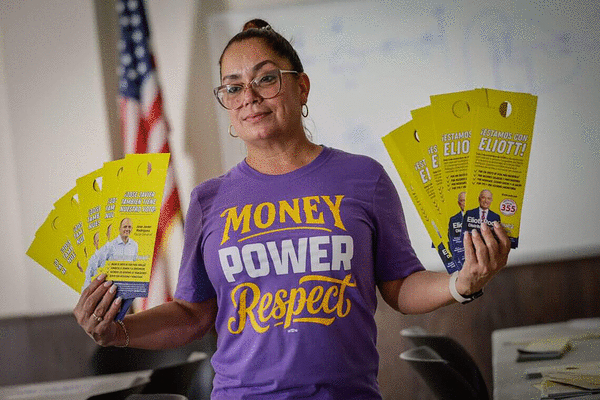
MIAMI — Mayumi Castro Fernandez voted for Donald Trump twice, but after high food and fuel prices, higher health insurance costs and the Trump administration’s immigration crackdown, she switched her voter registration from Republican to no party affiliation and voted blue this election.
“If after all these years, they didn’t keep their promises … I don’t have to wait two more years to say, ‘Oh, we’ll see what happens,’” she said. “Right now, I’m choosing another side.”
Castro Fernandez, 54, a native of Cuba who gained her citizenship in 2013, is knocking on doors to support Democrat Eliott Rodriguez in his bid to unseat Republican Rep. María Elvira Salazar for Florida’s 27th congressional district.
“I’ll knock on the door and talk to someone, and when I ask them what’s affecting them: high prices, gasoline, food, rent,’’ said Castro Fernandez, who cleans planes at Miami International Airport and is a member of the service employees union 32BJ SEIU, which is canvassing for Rodriguez. “Here in Florida and especially in Miami, things are out of the ordinary.”
While Castro Fernandez’s concerns resonate with other Hispanic voters in Miami-Dade, Hispanic Republicans still have a commanding presence in the county. Voter registration data analyzed by the Miami Herald show the number of registered Hispanic Republican voters grew by more than 14,000 from October 2024 to October 2026 in Miami-Dade, while roughly 9,500 Hispanic voters left the Democratic Party in the same period.
But support for the GOP is showing stress fractures as Hispanic voters take umbrage at Trump’s aggressive immigration and deportation policies, and high food and gas prices resulting from the war in Iran.
Freddy Moros, 61, a biologist originally from Venezuela who lives in Miramar, voted for Trump for president in 2024, believing the Southern border was in crisis and the country needed a “strong hand” against criminals.
But now Moros, who is registered without party affiliation, said he feels immigrants, particularly Venezuelans, are being criminalized under the Trump administration’s immigration crackdown.
“The fact that these people are being mistreated and treated like criminals, that’s something I find unacceptable,” he said.
This year, he left the governor’s ballot blank and split his ticket between Congressional and Florida attorney general races.
Moros took offense after Republican gubernatorial candidate Byron Donalds said at El Arepazo, a popular Venezuelan restaurant in Doral, that Venezuelans who had lost Temporary Protected Status should be deported.
He didn’t vote for Florida’s Republican attorney general James Uthmeier, choosing instead to vote for Democrat José Javier Rodriguez. The strike against Uthmeier, for Moros, was his championing of Alligator Alcatraz. Uthmeier led the state’s effort to build Alligator Alcatraz, the controversial immigration detention center in the Everglades that Gov. DeSantis shuttered in June.
But he feels Republican U.S. Rep. Mario Díaz-Balart has helped him and the Venezuelan community, so he got Moros’ vote, as did Republican Sen. Ashley Moody. Díaz-Balart is up for reelection in Florida’s 26th Congressional District, which represents parts of Miramar; Moody is running against Democrat Angie Nixon for Florida’s U.S. Senate seat.
Moros’ ticket-splitting is something political experts say they are seeing more among Hispanic voters.
“The Hispanic vote is not a given for the conservative party,” said Barbara Casanova, a conservative political strategist and the founder of HispanicVotes.org. “You need to work at it and engage.”
Moros, too, took issue with lumping Hispanics together as a monolithic voting bloc, citing the need for nuance.
“We’re tired of Venezuelans being categorized and labeled. Either you’re ‘MAGA’ or you’re ‘anti-MAGA.’ But 90% of the Venezuelans who immigrated to the United States as adults are educated professionals,” he said. “We have the capacity for discernment; we can distinguish between what is good and what is bad.”
Jared Nordlund, the Florida state director at the nonpartisan Latino civic advocacy group UnidosUS, said Latino voters will likely be a “swing vote” in the coming years, especially with so many voters registered without party affiliation.
“Not too long ago, Miami-Dade was blue, and that was a lot because of the Hispanic vote,” Nordlund said. “I think it’ll be very telling these next couple years where this ultimately goes, in terms of blue or red in the county.”
Recent polls for the governor’s race had mixed results about whether Donalds or Democratic candidate David Jolly led among Hispanic voters. Hispanicvotes.org commissioned a poll in mid-October among 760 Hispanic voters in Florida and found Jolly with a roughly 4% lead over Donalds, although the difference is within the margin of error.
“Part of the reason to have the poll is to communicate to the party, ‘Hey, we’re not going to see a red wave,’” said Casanova, who is also secretary for the Republican Hispanic National Assembly. “We need to invest more in communicating and messaging to the Hispanic voter. Don’t take us for granted.”
An earlier poll from NBC 6/Telemundo asked 625 Hispanic voters in Florida similar questions, finding it was Donalds who enjoyed the lead over Jolly by about 7 percentage points. In that poll, 10% of voters said they were undecided.
Miami-Dade has more Hispanic voters registered without party affiliation than Democrats. But when looking at all registered voters in the county — not just Hispanic voters — Democrats are still the biggest party, according to a Herald analysis.
Swaths of conservative base stay strong
In Hialeah, a GOP stronghold where 76% of the vote went to Trump in the 2024 presidential election, residents told the Miami Herald they’re continuing to support Republican candidates at the state level.
Rosa Hernandez of Hialeah cited the economy among her reasons for supporting Donalds and other Republican candidates this election cycle. She said she voted for Díaz-Balart for Congress and also approves of the jobs that other South Florida GOP congressional representatives are doing, including Salazar and U.S. Rep. Carlos Gimenez.
“The way the economy is right now, everybody needs relief,” she said. “People are very concerned about property taxes,’’ she said, supporting Amendment 3, the statewide ballot question that proposes raising the homestead exemption for primary residences. “Some people who are almost done paying for their homes or already done paying for their homes, their taxes are killing them, especially elderly people.”
Many voters who visited the John F. Kennedy Library in Hialeah to vote early said they were supporting Republican candidates, although some noted their concerns with Trump’s immigration policies.
For Carlos Milanese, taxes, insurance and immigration were some of the main issues he was thinking about when he headed to the polls.
“I’m pro-legal immigration,” said Milanese, 43, of South Miami. “What I don’t support is deporting people to places that aren’t their country of origin.”
A native of the Dominican Republic, he’s a registered Republican who is supporting Donalds for governor. He said he aligned the most with Donalds’ proposed policies and economic vision, though he wasn’t specific.
Some returning to Democrats
While Hispanic residents in Hialeah largely lean Republican, political opinions span the spectrum across Miami-Dade’s Latino communities.
Alberto Abella, a 70-year-old Doral resident from Cuba, recently left the Democratic Party and registered as no party affiliated, but he said he’s planning on voting for Democrats to bring about change.
“I can’t say it’s immigration, or the economy or gasoline prices, because it’s everything,” he said.
Coral Domenech, 37, said deportations and rhetoric about immigration caused her to regret her vote for Trump in 2024. The mother of two, registered without party affiliation, moved to Miami from Puerto Rico in 2021 and supported Trump in the last election because she aligned with the conservative, traditional values he shared.
But Domenech said she’s struggling to buy a house, her son can’t afford quality health insurance, and a 23-year-old woman whom she views as a daughter recently received her deportation order to return to Cuba.
“Everything is more expensive; they cancelled the living wage against the employees,” she said, referring to legislation passed by the state that prevented local governments from requiring contractors to pay employees above minimum wage. “We’re the middle class, we’re the ones who move the country.”
She said she recently passed a Certified Nursing Assistant course and is working on getting certified as a phlebotomist, but she’s struggling to save enough to take the exam. She said she was still weighing who to vote for this election cycle but said she doesn’t identify as a Republican.
Castro Fernandez, the airline maintenance worker at MIA who is voting for Democrats this election, said immigration was also a turning point for her. She said she could clearly recall a speech in which Trump said he would deport criminals, but she didn’t expect deportations to extend so broadly.
“I’ve seen a family who’s been in this country for 20 years be persecuted,” she said. “Their kids were born here and went to a university here. Their parents are persecuted, hiding in their house because of ICE.”
While Nordlund said immigration is one issue that can capture Hispanic voters, it’s often ranked fourth or fifth in order of importance behind issues such as food, gas, health insurance and wages. It depends on how close someone is to immigration issues, such as whether they’ve had friends or family lose Temporary Protected Status (TPS).
“I definitely am very interested around the Venezuelan vote because a lot of people have lost TPS, and I think that’s going to probably be a big swing part of the data out there, in a sense,” Nordlund said.
The Trump administration ended TPS last year for the approximately 600,000 Venezuelans living in the United States, many residing in South Florida.
Casanova said the Trump administration and elected officials aren’t properly communicating their immigration strategy, including why Trump terminated some Biden-era policies that she described as letting in too many asylum seekers for the country to process.
“I think there’s a miscommunication in the media as to what issues are really important to the Hispanic voter, and it’s the same issues, kitchen table issues that are of interest to all voters: affordability, inflation, gas prices,” said Casanova of HispanicVotes.org.
The future of Miami-Dade’s largest voter bloc
Nordlund predicts that lots of voters this cycle, and potentially going forward, may be more driven by issues or particular candidates than party loyalty.
Castro Fernandez said she’s going to see which of the candidates who get elected help improve the lives of working class people. And if they don’t, she’ll be right back where she is now, knocking on doors from Little Havana to Cutler Bay.
“If in two years, the person who I support now doesn’t help and doesn’t fulfill their promises of improving health care, improving workers’ wages and all the promises they’ve made, then I’ll be in the streets again trying to get them out,” she said.
©2026 Miami Herald. Visit at miamiherald.com. Distributed by Tribune Content Agency, LLC.






Comments