Cuban state security detains award-winning journalist Yoani Sánchez in Havana
Published in News & Features
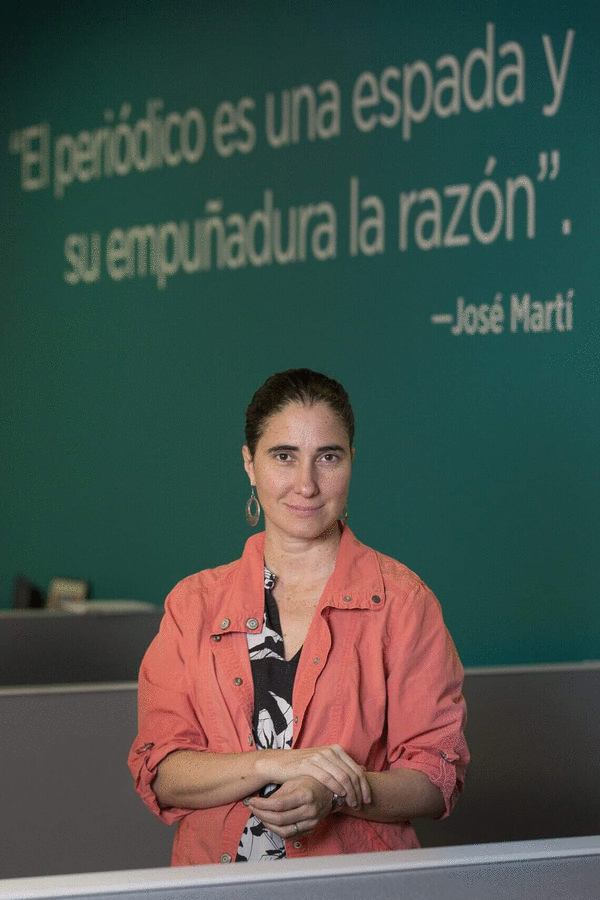
Cuban State Security agents detained Yoani Sánchez, the award-winning founder and director of the independent news outlet 14ymedio, in Havana on Thursday morning amid the latest government crackdown on independent journalists.
It was the third detention of an independent journalist in the Cuban capital this week.
“Yoani Sánchez has been detained by State Security today in Havana,” journalist Reinaldo Escobar, Sánchez’s husband, who is currently in Madrid, announced on Facebook.
Sánchez left her home in Nuevo Vedado at about 9:30 a.m. to shop at a neighborhood market, 14ymedio reported. About 10 minutes later, she sent colleagues a four-word message. It read “Me secuestró la policía” (“The police kidnapped me”). Her whereabouts are unknown at the time of publication.
Erika Guevara-Rosas, Amnesty International’s senior director for research, advocacy, policy and campaigns, condemned the detention on X. She described it as “violent” and as “a new and alarming attempt” by Cuba’s leader Miguel Díaz-Canel’s government “to silence the voices of journalists.”
“Yoani Sánchez is an internationally recognized journalist for the independence and rigor of her work,” Guevara-Rosas wrote. “Her detention not only attacks a journalist, it attacks the right of all of society to inform and be informed.”
Sánchez, 51, was born in Havana and studied philology at the University of Havana. She gained international attention with her blog Generación Y, started in 2007, and founded 14ymedio in May 2014 with Escobar. Her honors include Spain’s Ortega y Gasset Prize for digital journalism, a Maria Moors Cabot special citation from Columbia University and the International Press Institute’s World Press Freedom Hero award.
A widening crackdown
“This is not an isolated incident,” Guevara-Rosas wrote, calling it “a repeated pattern of harassment, intimidation and repression.”
On Tuesday, State Security agents handcuffed Camila Acosta, a reporter for independent news outlet Cubanet and correspondent for Spain’s ABC, near her Havana home. She was held in a cell at the Playa police station and released that night.
Acosta said her family did not know where she was for more than eight hours. She received an official warning for filming an agent who had blocked her from leaving home on Oct. 28, according to the Cuban Institute for Freedom of Expression and Press. The alleged offense carries up to three years in prison, the group said.
A day earlier, police handcuffed CubaNet contributor Adelth Bonne Gamboa in Havana’s Santos Suárez neighborhood. He was released hours later, but officials seized his work equipment, fined him 3,000 pesos under Decree-Law 370—a decree criticized by human rights activists for curtailing free speech—and threatened him with prison.
Henry Constantín, director of La Hora de Cuba and a regional vice president of the Inter-American Press Association’s press freedom committee, has been jailed since Sept. 16. He was arrested in Camagüey, a city in central Cuba, after answering a summons and is held in pretrial detention at Kilo 7 prison on a “disobedience” charge.
Constantín is accused of missing an earlier summons, which he denies. The Committee to Protect Journalists called the case “yet another attempt to silence independent reporting.”
At least three other journalists remain in prison. José Gabriel Barrenechea, a 14ymedio contributor, is serving six years for “public disorder” after a 2024 blackout protest; the Supreme Court rejected his final appeal on July 28. Jorge Bello Domínguez, jailed since the July 11, 2021, protests, is serving 15 years, and the Inter-American Commission on Human Rights granted him precautionary measures in March over his health. Independent reporter Ángel Cuza Alfonso was arrested again on April 30.
The Cuban Observatory for Freedom of Expression reported 39 press freedom violations in September, up from 17 in August. The rights group Prisoners Defenders counted a record 1,351 political prisoners at the end of September.
Havana’s denials
Cuban officials have repeatedly told U.S. media that the country holds no political prisoners.
“There are no political prisoners in Cuba; I assure you of that,” Díaz-Canel said in an April interview with NBC’s Meet the Press. He called the idea that critics are jailed for speaking out “a big lie”.
Deputy Foreign Minister Carlos Fernández de Cossío told Zeteo’s Mehdi Hasan in September 2025 that “there are no arbitrary arrests in Cuba.” Asked whether people were jailed for protesting, he replied: “Arbitrarily, no.”
©2026 Miami Herald. Visit at miamiherald.com. Distributed by Tribune Content Agency, LLC.



Comments