Inside the deadly cat-and-mouse game between human smugglers and the Coast Guard
Published in News & Features

AGUADILLA, Puerto Rico — To the enlisted members and officers of the Coast Guard Cutter Joseph Doyle, their mission on Sept. 28 is known as the “miracle on the Mona.”
They saved almost 50 people that day from the Mona Passage, a treacherous waterway between Hispaniola and Puerto Rico known for big waves, strong currents and smuggling sorties conducted under cover of night. The survivors — and the dead — were Dominican and Haitian migrants, most of whom treaded water for more than 12 hours overnight in rough seas after one of the smugglers they paid to take them to Puerto Rico began attacking them with a machete, investigators say, sending everyone on the overloaded 40-foot boat into the water.
At least three people died that day and another 10 remain missing and presumed dead. But it has become the stuff of lore on the Doyle that so many survived the ill-fated voyage — a trip reserved for only the most desperate willing to risk everything for a shot to make it to Puerto Rico, where mainland United States is just a domestic flight away.
“What concerns me is the ventures that get lost, that we never found,” said Capt. Robert Stiles, deputy commander of Sector San Juan, who was on the Doyle that day. “And there is no way of knowing. It’s hard to get numbers. It’s hard to find these vessels because the nature of this whole voyage is to try to evade detection. Those are the things that keep us up at night.”
The Coast Guard has stopped several overloaded migrant boats in the Mona Passage since August, some with as many as 75 people on board. According to the agency, cutters have returned almost 350 people since August to the Dominican Republic who were stopped transiting the passage.
Most of the boats carry people from Hispaniola — the island that is home to Haiti and the Dominican Republic — fleeing poverty or gang violence. But over the last two years they have also come from Uzbekistan, Ukraine and even China, said Rebecca Gonzalez-Ramos, the Homeland Security Investigations special agent in charge for Puerto Rico. “And, it’s important to know that once you’re in Puerto Rico, you’re in the United States. They don’t stay on the island. They’re going to go to the airport.”
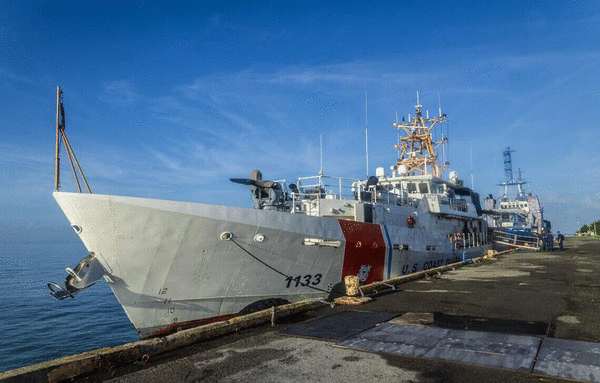
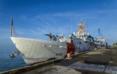
Early this month, the Miami Herald hitched a ride aboard the Doyle, a 154-foot fast-response cutter, one of five such ships assigned to Coast Guard Sector San Juan. The Doyle, with its four officers and 20 enlisted members, mostly young men and women between the ages of 18 and 30, patrols the Mona Passage every day.
They know the waterway well. And they know the patterns of the illusive smugglers who move migrants at a steep price — as much as $5,000 a person, according to court records.
But the smugglers can be as unpredictable as the conditions in the passage. “The weather can be beautiful, as it is today, or it can be six- to eight-foot seas,” Cmdr. Matthew Pinhey, commanding officer of the Doyle, told the Herald from the deck of the ship, with clear, blue skies overhead. “Once you get out of the shadow of the island, it gets very rough.”
Sometimes the smugglers take their human cargo the entire 80 miles from the Dominican Republic to the western banks of Puerto Rico. Sometimes they push them overboard to avoid being caught, or leave them stranded after pocketing their cash, depositing them at one of two uninhabited islands in the middle of the waterway.
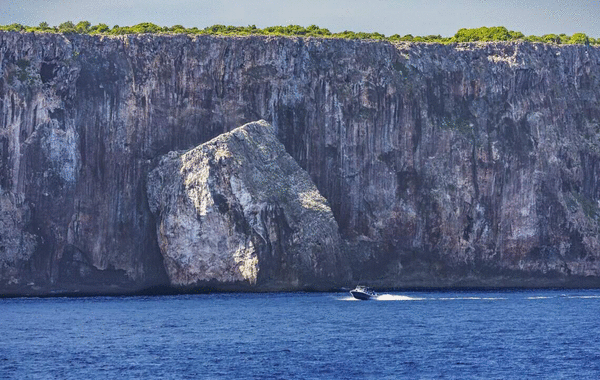
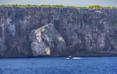
There is Monito Island, a small mesa that protrudes from the Caribbean, and the larger Mona Island, about seven miles of rocky cliffs and sandy beaches. Other than a contingent of Puerto Rico Department of Natural Resources rangers, no one lives there.
“They have no regard for human life,” Stiles said of the smugglers. “They would just as soon drop you over the side or on Mona Island or Monito and let you figure it out.”
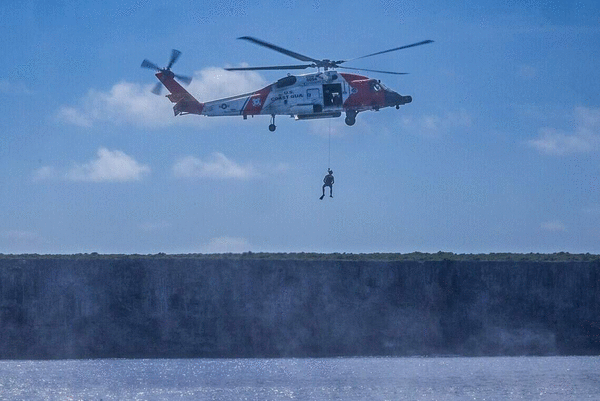
This means rescue swimmers, either from a cutter or dropped from a helicopter, have to go into the water, making the situation even more dangerous. Oftentimes, the migrants, despite growing up on an island, can’t swim.
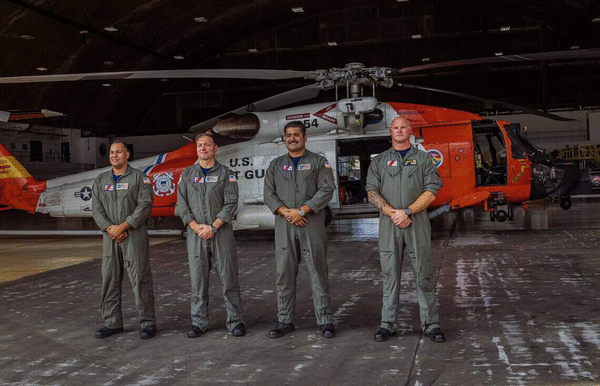
“They can grab ahold of you. They’re often panicking. They’re trying to stay alive,” said Aviation Survival Technician Chief Tommy Hyde, a rescue swimmer who took part in the Mona rescue mission from an MH-60 Jayhawk helicopter.
Cmdr. Matt Romano, chief of response for Sector San Juan, showed reporters scars all over his forearms from rescuing people from a rocky shelf on Monito.
An added danger to rescue missions off Monito: Birds. The tiny island is a wildlife reserve and nesting seabird colony of native species, including the brown booby and frigate. Tens of thousands of birds perch atop Monito at any one time, meaning helicopters can’t get too close or else they might crash due to a bird strike.
Any migrants stranded on the island have to be picked up by boat crews, oftentimes having to jump into the water.
“It’s a pretty unnerving and jaw-dropping jump for them to get into the water, and then one of our swimmers will go in and recover them,” Stiles said. “It’s one at a time, and we’ve done loads of 10, 15, 20 people.”
‘Miracle on the Mona’
The first people to find the migrants on Sept. 28 were crew members of a civilian boat, who came across the capsized vessel and rescued four people. The crew called the Coast Guard, relaying that the people they rescued said dozens more were still out there. The smugglers’ vessel had flipped around 11 p.m. the night before and all the migrants had either been treading water in the dark or stranded on Mona Island.
The Doyle was already at sea and about an hour away when it got the call around noon. When the cutter arrived at Mona Island, the situation was chaotic and complex.
“We don’t know what we’re walking into, we don’t know where everybody is, we don’t know how far spread out they are,” said Pinhey, the commanding officer of the Doyle. “It’s the fog of war, when we don’t know what’s going on. That’s probably the hardest part.”
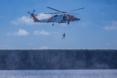
Stiles and Romano called on Coast Guard Air Station Borinquen to launch its two MH-60 Jayhawks. Lt. Stan Raymond, a Jayhawk pilot, had just landed from a training flight when the alarm went off.
“Without hesitation, we signed out another aircraft and got going,” Raymond said. His chopper arrived about 40 minutes after getting the call, and he and his crew began working with a U.S. Customs and Border Protection Air and Marine Operations crew in locating survivors.
Two of the survivors were on a rock on the island. His rescue swimmer was hoisted into the water and saved them, Raymond said.
Aviation Mechanic Technician 2nd Class Geraldo Hernandez, who operates the hoist for the rescue swimmer, also acts as an additional set of eyes for the pilots. Once the two people were saved from the rocks, he spotted the overturned vessel with people clinging to the hull. Others were in the distance, floating in different directions.
“That’s when it was a shock, when you see everyone in the water. And, I mean they were spread out for miles,” said Hernandez, 33, who was a Marine before joining the Coast Guard six years ago. “Miles to the east, miles to the west. On the coast. People on the rocks. It was a little daunting.”
Hyde, the rescue swimmer, saved another person who had been treading water since around 11 p.m. the night before.
“Once I got him in the cabin, he started kissing the deck and collapsed. Just exhaustion,” Hyde said.
For the next three hours, the search continued, with efforts being coordinated from the Doyle. Lt. j.g. Libby Jackson, the Doyle’s 25-year-old executive officer, said another person on the rocks was picked up by the cutter’s “small boat,” a center-console, rubber-lined hull boat launched from the back of the ship.
The Doyle crew was also directing not only the Coast Guard helicopters, but also one flown by pilots with Fuerzas Unidas de Rápida Acción, or FURA, a division of the Puerto Rican police that also patrols the Mona Passage.
“There was a multi-layered approach to getting this case to be successful,” said Capt. Jeffrey Owens, commanding officer of Air Station Borinquen. He oversees about 20 pilots and 80 enlisted members who patrol all of Puerto Rico, along with the U.S. Virgin Islands.
In the end, the 49 people were placed on any available deck space on the Doyle. Almost all of them were taken back to the Dominican Republic and Haiti.
“I think about that all the time. Anywhere else, that’s a mass tragedy. They are somebody’s wife, child, sons, daughters, family, and they’re gone. They’re not coming back,” said Stiles, the deputy commander of Sector San Juan. “But, when you get into a job like this, you focus on what you can do. And, the fact that 49 people survived, it was part of the reason it became the miracle on the Mona. It’s probably one of the only instances where you can say only 13 people died, and somehow that’s working out.”
Jackson, the cutter’s executive officer, has been stationed on the ship for about a year and a half and has seen her fair share of sadness patrolling the Mona Passage. But the Coast Guard Academy graduate said the mission is one she won’t forget.
“I think this case could be one of those that is a once-in-a-lifetime case, at least you hope it’s once-in-a-lifetime due to the severity and how big of a loss of life there was,” Jackson said while standing on the beach on Mona Island. “It feels really good that my crew was able to save 49 lives, but we couldn’t save them all. I wouldn’t wish a case like this on anyone in the Coast Guard.”
Capital Charges
Among the rescued were Danny De La Rosa, Maximo Castillo-Cabrera and Victor Alfonso Montilla Espirito Santo, now accused of not only human smuggling, but also causing the deaths of 13 people.
Prosecutors say De La Rosa hacked at their passengers with the machete, igniting the panic that flipped the boat. All three face the death penalty if convicted.
Gonzalez-Ramos, HSI special agent in charge for Puerto Rico, hopes the severity of the potential punishment will encourage the defendants to cooperate with investigators who have been trying for years to identify the organizations behind the dangerous smuggling ventures.
The smugglers who do get caught are typically working for someone else, and they’d rather do a few years in prison than risk ending up on the wrong side of dangerous criminals.
“That has always been a challenge in our investigations here. In the last five years or more, we have not been able to identify who’s behind it,” Gonzalez-Ramos told the Herald.
Despite the danger, there’s no expectation that the smuggling operations will tail off anytime soon. Perhaps the arrival of fall and winter, and with it rougher and more unpredictable seas, will reduce the flow. But when summer arrives again, so will calmer weather.
The Doyle will continue on through it all. Almost as soon as it docked back in the port of Mayaguez after more than 12 hours on the water with the Herald, the crew cast off again and headed back out to sea for another patrol.
©2026 Miami Herald. Visit at miamiherald.com. Distributed by Tribune Content Agency, LLC.






Comments